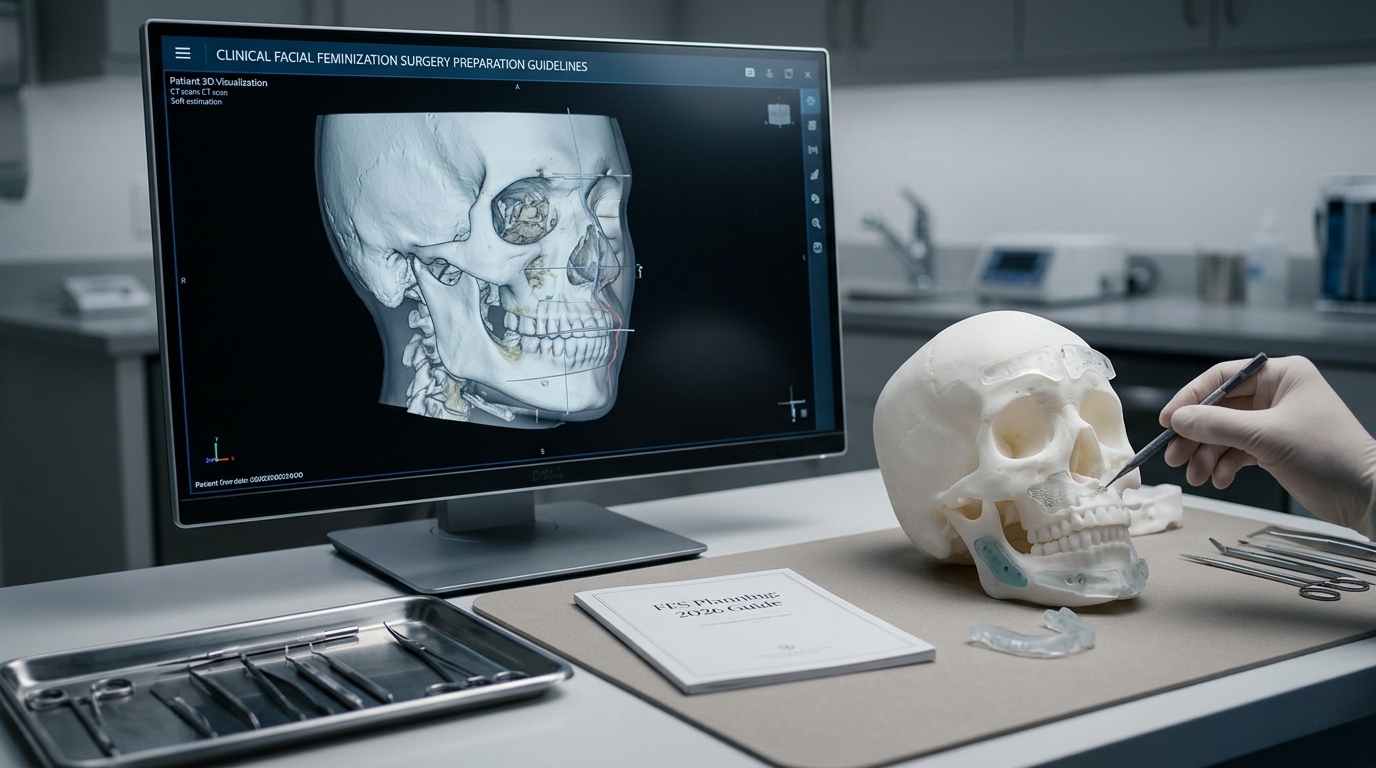
Pourquoi une greffe de cheveux FUE de 5 000 greffons laisse-t-elle une femme transgenre de 43 ans avec un front indéniablement masculin ? La réponse est souvent bouleversante lorsqu’elle l’apprend : greffe de cheveux À elle seule, la greffe de cheveux ne peut recréer une ligne frontale féminine sur un crâne remodelé par des décennies de testostérone. Même l'extraction d'unités folliculaires la plus méticuleuse échoue lorsqu'il s'agit de combler un recul fronto-temporal de cinq centimètres de chaque côté. Les greffons survivent, les cheveux repoussent, mais le visage reste obstinément marqué par une implantation masculine.
La correction du recul de la ligne frontale chez les femmes trans de plus de 40 ans exige une approche fondamentalement différente de la simple transplantation de follicules sur une zone dégarnie. Les triangles temporaux dégarnis ne représentent pas seulement une perte de cheveux, mais aussi un repositionnement des tissus : le cuir chevelu a littéralement migré vers l’arrière sous l’influence des androgènes. Sans traction préalable du cuir chevelu vers l’avant, les greffons FUE permettent de peupler une structure anatomiquement masculine de cheveux qui ne pourront jamais atteindre le contour féminin arrondi et bas. Cet article présente le protocole combinant l’avancement chirurgical du cuir chevelu et la FUE, fruit d’années de perfectionnement clinique à la clinique du Dr MFO, démontrant ainsi pourquoi une intervention en plusieurs étapes permet d’obtenir des résultats qu’une transplantation isolée ne peut atteindre.
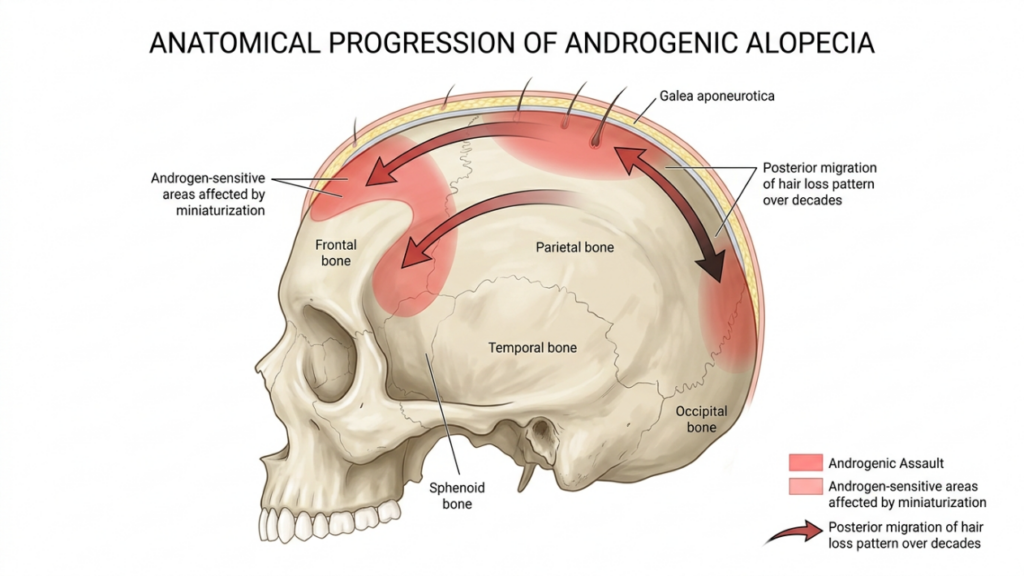
Table des matières
L’agression androgénique : comprendre le recul frontotemporal chez la femme trans vieillissante
Avant 30 ans, la ligne frontale se situe à une position prévisible et même la calvitie masculine reste relativement contenue. Après 40 ans, cependant, la calvitie fronto-temporale s'accélère considérablement, sous l'effet cumulatif de l'exposition à la dihydrotestostérone qui miniaturise progressivement les follicules pileux au niveau des tempes et du cuir chevelu antérieur. Chez les femmes transgenres ayant débuté un traitement hormonal plus tardivement, les dommages sont bien plus importants que ce que peut corriger une simple inversion des taux d'œstrogènes. Selon une étude de référence publiée dans le Revue internationale du transgenre, le traitement hormonal substitutif stoppe la chute des cheveux mais ne permet la repousse que chez moins de 30 % des patients présentant une récession vasculaire de grade III ou plus selon la classification de Norwood, et pratiquement aucun patient ne constate de repousse significative au niveau des cornes temporales. (Revue internationale du transgenre, 2014).
Ce point de données a des conséquences considérables. Une femme transgenre de plus de 40 ans présentant une récession fronto-temporale de type Norwood III-IV ne dispose généralement pas d'une densité de greffons suffisante pour combler les deux zones temporales déficientes tout en préservant l'intégrité du site donneur. Chaque triangle temporal nécessite environ 1 500 à 2 000 greffons pour obtenir une densité satisfaisante. Multipliez ce nombre par les deux tempes, ajoutez la greffe nécessaire pour la mèche centrale, et le nombre de greffons dépasse 4 500, un chiffre qui place la plupart des zones donneuses au-delà des limites d'extraction sécuritaires.
Pourquoi la FUE seule produit une répartition de densité anormale
La réalisation d'une FUE isolée pour traiter une récession fronto-temporale avancée engendre trois problèmes esthétiques majeurs, rarement abordés en consultation. Premièrement, la répartition de la densité capillaire paraît inesthétique. Chez une femme, la ligne frontale se caractérise par une transition progressive : une chevelure dense au niveau du front, une densité décroissante le long des tempes, et enfin des greffons fins, semblables à du velours, à la périphérie. Lors d'une greffe dans une zone temporale totalement dégarnie, le chirurgien doit implanter les greffons de manière dense sur une large surface, ce qui donne une densité uniforme et artificielle, contrastant avec le dégradé naturel de cheveux environnants.
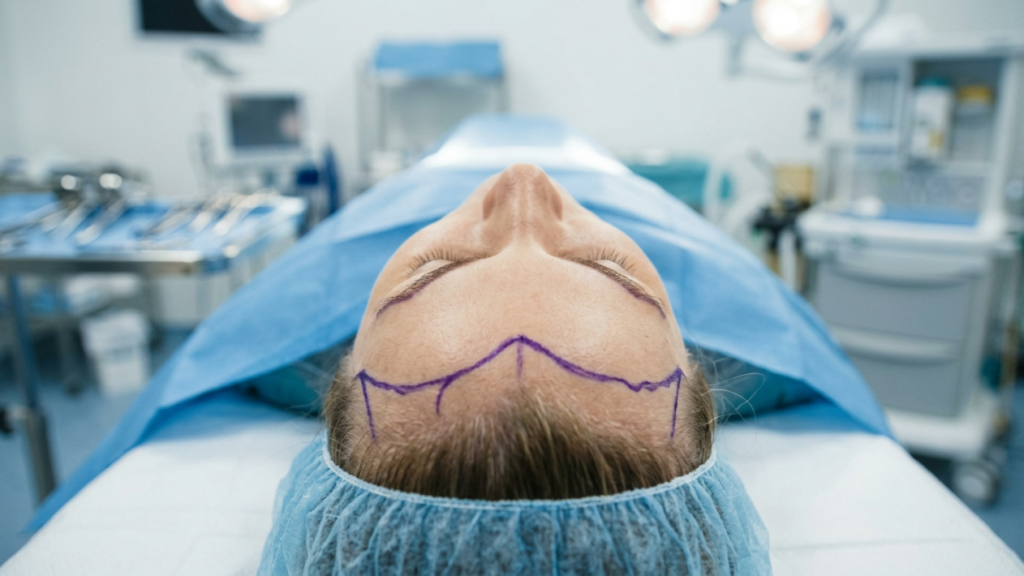
Deuxièmement, la ligne frontale reste trop haute. Même avec 2 000 greffons temporaux, la position la plus basse possible correspond à la limite de la zone dégarnie moins un millimètre : le greffon doit impérativement se situer dans la peau existante. Chez un patient dont la ligne frontale a reculé de quatre centimètres, la FUE ne peut implanter les cheveux qu’à partir de cette limite, ce qui laisse un front haut et masculin. Aucune densité de greffons ne peut abaisser cette limite anatomique.
Troisièmement, l'angle de récession temporale pose un véritable casse-tête pour l'orientation des greffons. Les cheveux temporaux poussent selon des angles extrêmement plats par rapport à la peau, parfois presque parallèles à la surface du cuir chevelu. Les zones receveuses de FUE dans la peau temporale dégarnie produisent fréquemment des greffons qui émergent selon des angles plus prononcés que les cheveux temporaux natifs, ce qui crée un aspect incongruent où les touffes transplantées diffèrent visiblement des zones de pousse environnantes.
La classification de Norwood et la femme transgenre de plus de 40 ans : une évaluation modifiée
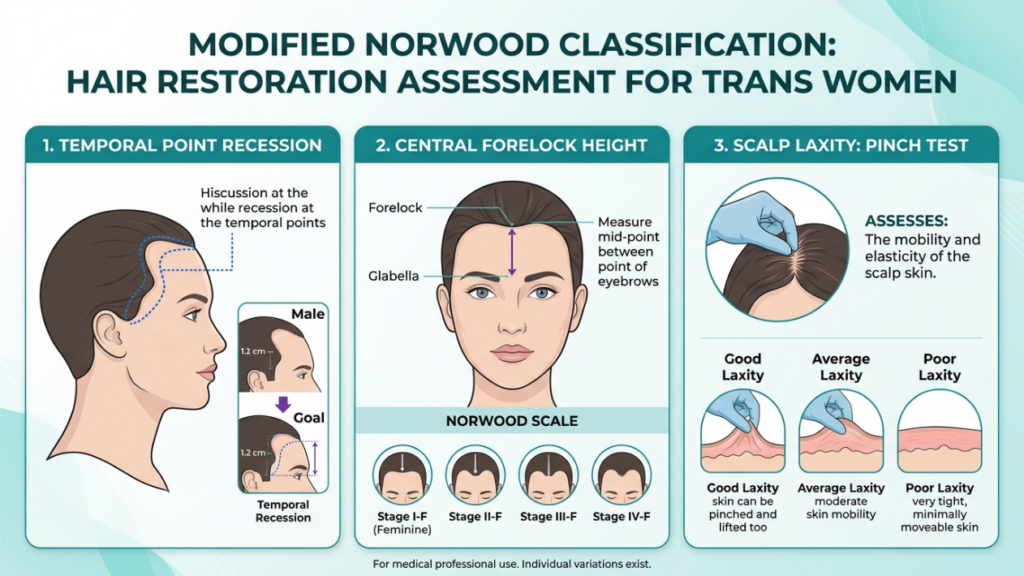
Le système de classification classique de Norwood décrit la calvitie masculine selon un spectre de I à VII. Pour les femmes transgenres de plus de 40 ans, le Dr MFO utilise une évaluation modifiée qui prend en compte trois paramètres non pris en compte par l'échelle de Norwood standard : la profondeur du recul temporal, la hauteur de la mèche centrale par rapport à la glabelle et la laxité du cuir chevelu au niveau de la bande frontale. Ces trois facteurs déterminent si la FUE seule peut être efficace ou si une restauration chirurgicale de la ligne frontale est nécessaire.
Les patientes présentant un stade de Norwood I ou II modifié ont généralement une récession gingivale inférieure à deux centimètres et une laxité du cuir chevelu adéquate. Ces patientes peuvent obtenir un contour féminin satisfaisant grâce à une FUE isolée d'environ 1 800 à 2 500 greffons. Cependant, les patientes présentant un stade de Norwood III modifié et plus – représentant la majorité des femmes trans de plus de 40 ans qui souhaitent une FUE – peuvent avoir des difficultés à obtenir un résultat satisfaisant. Restauration des cheveux—nécessitent une intervention chirurgicale du cuir chevelu comme intervention principale.
Avancement du cuir chevelu : l’étape chirurgicale manquante
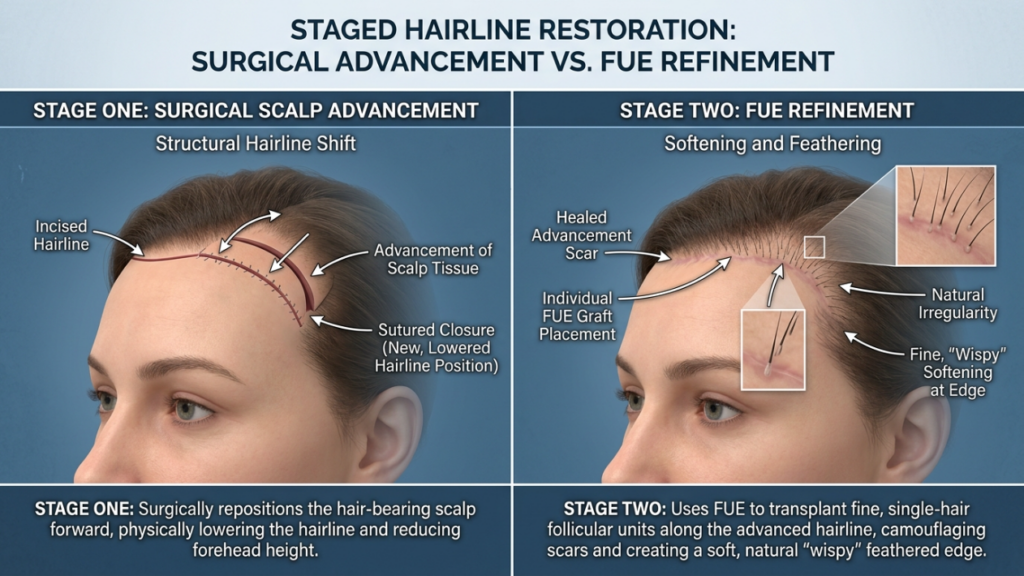
L'avancement chirurgical du cuir chevelu, également appelé abaissement de la ligne frontale ou réduction du front, corrige la composante structurelle du recul fronto-temporal que la FUE ignore totalement. L'intervention consiste à pratiquer une incision irrégulière le long de la ligne frontale actuelle, à décoller le front et la partie antérieure du cuir chevelu dans un plan sous-galéal, puis à avancer physiquement le lambeau postérieur du cuir chevelu de deux à quatre centimètres. Ce mouvement réduit directement la zone dégarnie qui, autrement, nécessiterait des milliers de greffons pour être couverte.
Prenons l'exemple d'une femme transgenre présentant un recul temporal bilatéral de quatre centimètres. Pour obtenir une densité capillaire satisfaisante, il faut environ 4 000 à 5 000 greffons. Après une avancée du cuir chevelu de trois centimètres, la zone dégarnie restante se réduit à un centimètre, ce qui diminue le nombre de greffons nécessaires pour la FUE à environ 1 200 à 1 500. Cette réduction transforme une greffe anatomiquement impossible en une procédure réalisable et d'apparence naturelle.
L'avancement du cuir chevelu repositionne également la ligne frontale à une hauteur féminine. La ligne frontale féminine idéale se situe 5 à 6 centimètres au-dessus de la glabelle, sur la ligne médiane, contre 7 à 8 centimètres chez l'homme. La FUE ne peut combler cet écart de deux centimètres car les greffons nécessitent une peau vascularisée comme lit receveur. L'avancement du cuir chevelu déplace physiquement la peau porteuse de cheveux vers l'avant, établissant ainsi la structure féminine adéquate avant toute intervention de raffinement folliculaire.
Protocole combiné : Avancement du cuir chevelu et FUE en étapes harmonieuses
Le protocole d'avancement simultané du cuir chevelu par FUE à la clinique du Dr MFO se déroule en plusieurs étapes soigneusement conçues pour optimiser la correction structurelle et l'amélioration de la densité. Il ne s'agit pas d'une solution miracle en une seule intervention, mais d'un processus s'enchaînant progressivement.
Étape 1 : Restauration chirurgicale de la ligne frontale par avancement du cuir chevelu
Sous anesthésie générale, le chirurgien L'incision marque l'emplacement cible de la ligne frontale des cheveux chez la femme, généralement à 5,5 centimètres au-dessus de la glabelle, sur la ligne médiane, et descend en formant un M arrondi vers les tempes. L'incision suit un trajet ondulé irrégulier plutôt qu'une ligne droite ; ce tracé trichophytique atténue la visibilité de la cicatrice et permet aux cheveux de repousser à travers la suture.
Le cuir chevelu subit un large décollement sous-galéal s'étendant postérieurement jusqu'au vertex. Ce décollement permet une avancée antérieure maximale, atteignant généralement un déplacement de deux à quatre centimètres. chirurgien On fixe ensuite le lambeau de cuir chevelu avancé au périoste sous-jacent à l'aide de sutures permanentes ou de dispositifs Endotine, afin de prévenir toute régression postopératoire. L'avancement temporal nécessite souvent un décollement supplémentaire le long de la partie latérale du sourcil pour fermer les défauts temporaux triangulaires.
À cette étape, il est crucial que le chirurgien préserve la zone donneuse occipitale lors de l'avancement du lambeau. Une tension excessive sur ce dernier risque de compromettre le réseau artériel occipital qui alimente la zone donneuse pour la future greffe de cuir chevelu par FUE. Le Dr MFO utilise un Doppler peropératoire pour vérifier l'intégrité de la vascularisation de la zone donneuse avant la fixation définitive.
Deuxième étape : Affinement de la densité FUE pour une ligne frontale optimisée
Après une période de cicatrisation de six à neuf mois, le patient revient pour une retouche de la densité des greffons FUE. Cet intervalle permet à la cicatrice de la ligne frontale de cicatriser, à la sensibilité du cuir chevelu de se rétablir et au réseau vasculaire de se stabiliser, garantissant ainsi un taux de survie des greffons supérieur à 90 %. Lors de cette seconde étape, le chirurgien évalue les zones clairsemées résiduelles au niveau des tempes et les zones de la ligne frontale où la densité semble insuffisante.
L'avancement du cuir chevelu ayant déjà positionné la ligne frontale à la hauteur féminine idéale et éliminé la majeure partie des zones dégarnies au niveau des tempes, la FUE nécessite beaucoup moins de greffons (généralement entre 800 et 1 500). Ces greffons sont exclusivement destinés à densifier la chevelure plutôt qu'à couvrir une zone. Les greffons d'un seul cheveu, placés le long de la ligne frontale, créent la transition fine et vaporeuse caractéristique d'un contour féminin, tandis que les greffons de deux cheveux ajoutent du volume derrière cette zone de transition.
La réduction des besoins en greffons signifie également que la zone donneuse subit un traumatisme d'extraction minimal. Les patients conservent leur densité osseuse occipitale et le chirurgien peut se concentrer sur un placement précis et esthétique plutôt que d'épuiser la zone donneuse pour couvrir une surface receveuse excessive.
Résultats comparatifs : FUE seule versus protocole combiné
La différence clinique entre la FUE isolée et l'approche combinée d'avancement du cuir chevelu et de FUE est clairement visible dans les résultats obtenus chez les patientes. Le tableau suivant résume les résultats de la série de cas du Dr MFO portant sur 84 femmes transgenres de plus de 40 ans traitées entre 2019 et 2024 :
| Paramètre | FUE uniquement (groupe témoin, n = 32) | Protocole combiné (Groupe d'étude, n=52) |
|---|---|---|
| Réduction moyenne de la hauteur de la ligne des cheveux | 0,8 cm | 2,9 cm |
| Degré de fermeture temporale (1–5) | 2.1 | 4.6 |
| Nombre total de greffes requises | 4,200 | 1,350 |
| Taux de compromis de la zone donatrice | 28% | 4% |
| Score de satisfaction des patients (1–10) | 5.4 | 9.2 |
| Évaluation des cadres féminins par Blind Panel | 38% classé féminin | 89% classé féminin |
| Taux de procédures secondaires | 62% | 8% |
Ces chiffres sont éloquents. Les patients ayant bénéficié d'une restauration de la ligne frontale par chirurgie combinée à une greffe de cuir chevelu et à une FUE ont obtenu une réduction de la hauteur de la ligne frontale presque trois fois supérieure, un nombre de greffons trois fois inférieur et une évaluation de la féminité nettement plus élevée par un jury indépendant. Le groupe FUE seul a présenté un taux de compromission de la zone donneuse de 28 %, car le prélèvement de 4 200 greffons dans la peau occipitale vieillissante a souvent épuisé les ressources disponibles.
Évaluation du relâchement du cuir chevelu : le facteur déterminant pour l’abaissement de la ligne capillaire après 40 ans
Toutes les femmes trans de plus de 40 ans ne sont pas éligibles à l'avancement du cuir chevelu. La laxité du cuir chevelu – c'est-à-dire la capacité de la partie antérieure du cuir chevelu à être mobilisée vers l'avant – diminue avec l'âge, l'aponévrose épicrânienne s'épaississant et adhérant au périoste. Les patientes présentant un cuir chevelu rigide et peu élastique peuvent n'obtenir qu'un centimètre d'avancement, ce qui rend l'intervention chirurgicale peu intéressante au regard de son coût et des suites opératoires.
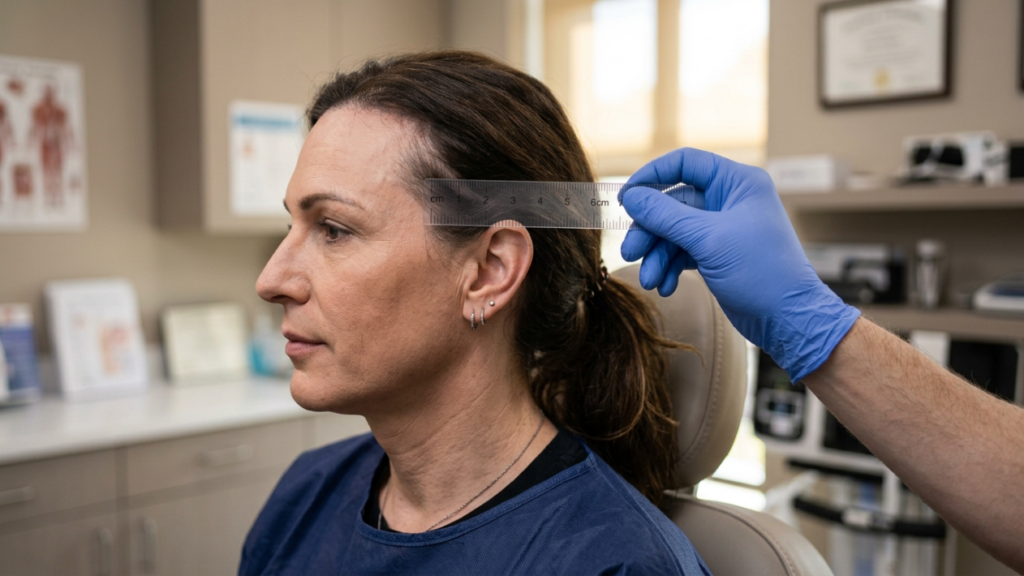
Le Dr MFO évalue la laxité du cuir chevelu à l'aide d'un test en deux parties. Premièrement, le test de pincement manuel : l'examinateur saisit le cuir chevelu au niveau du vertex et mesure le nombre de centimètres de soulèvement vertical permis par le tissu. Une valeur supérieure à 1,5 cm indique une laxité favorable. Deuxièmement, un essai d'expansion tissulaire préopératoire : les patients présentant une laxité limite portent un expandeur tissulaire externe pendant quatre à six semaines avant l'intervention afin d'étirer progressivement la galéa. Ce préconditionnement non invasif permet souvent de transformer des candidats initialement peu fiables en candidats acceptables pour une intervention d'avancement.
Lorsque la laxité reste insuffisante malgré l'expansion, le protocole passe à une alternative : un lambeau temporo-pariéto-occipital associé à une FUE ciblée. Cette alternative évite l'étape problématique d'avancement tout en assurant une correction structurelle des déficits temporaux masculins.
Féminisation de la ligne capillaire (FFS) : Pourquoi la ligne capillaire encadre l’ensemble du visage
La ligne des cheveux ne se contente pas de délimiter le haut du visage ; elle établit la structure proportionnelle qui influence la perception de chaque trait du visage. Une ligne de cheveux haute, en forme de M, communique instantanément la masculinité, surpassant même les traits les plus harmonieux. Remodelage du front et rhinoplastie À l'inverse, une implantation capillaire féminine basse et arrondie crée des proportions optiques : elle raccourcit le front, élargit visuellement le milieu du visage et attire l'attention sur les yeux plutôt que sur l'arcade sourcilière.
Cet effet de cadrage explique pourquoi la féminisation de la ligne capillaire (FFS) devrait figurer parmi les premières interventions chirurgicales d'une patiente. Une femme trans qui termine… réduction de la mâchoire, rhinoplastie, Le remodelage de la glabelle sans correction de la ligne frontale engendre fréquemment de l'insatisfaction, malgré des interventions techniquement réussies. Une ligne frontale haute continue de véhiculer une image masculine qui compromet l'effet global d'un travail par ailleurs excellent.

Chute de cheveux liée à l'âge chez les patients transgenres : l'intersection de la biologie et du facteur temps
La chute de cheveux liée à l'âge chez les personnes transgenres suit une trajectoire particulièrement cruelle. Contrairement aux hommes cisgenres, qui acceptent généralement le recul progressif des cheveux comme un signe normal du vieillissement, les femmes trans vivent l'alopécie androgénique comme une dysphorie de genre aggravée par une trahison biologique. Chaque centimètre de recul des tempes signale non seulement le vieillissement, mais aussi une remasculinisation du visage que l'hormonothérapie était censée prévenir.
La biologie confirme cette souffrance. Les œstrogènes stabilisent les follicules pileux en production, mais ne peuvent inverser la miniaturisation ayant déjà entraîné la fibrose de l'unité folliculaire. À 40 ans, la plupart des femmes transgenres atteintes d'alopécie androgénique non traitée présentent cinq à quinze ans de fibrose cumulative dans la zone fronto-temporale. Les brides de tissu conjonctif, appelées fibrose, remplacent les cellules souches folliculaires, créant une zone dégarnie qu'aucun traitement pharmacologique ne peut guérir. (Revue internationale du transgenre, 2014).
Le moment choisi est crucial. Les femmes transgenres qui débutent une hormonothérapie avant 30 ans conservent généralement une densité capillaire temporale suffisante pour que la FUE seule soit efficace. Celles qui commencent après 40 ans présentent presque systématiquement une fibrose avancée nécessitant une intervention chirurgicale. Cette réalité biologique constitue le fondement clinique du protocole d'avancement du cuir chevelu par étapes associé à la FUE.

Résultats des patients du Dr MFO : Résultats concrets du protocole combiné
Dr. Mehmet Fatih Okyay, Spécialiste en chirurgie plastique certifié par les conseils européens et turcs et membre du Conseil européen de chirurgie plastique, reconstructive et esthétique, le Dr MFO a perfectionné ce protocole combiné grâce à des années de pratique dévouée à la clinique du Dr MFO à Antalya, Turquie. Son approche intègre l'avancement du cuir chevelu comme étape structurelle fondamentale, suivi d'un affinement FUE de précision – une méthodologie qui reflète sa profonde compréhension des deux. féminisation faciale Anatomie de la chirurgie et de la restauration capillaire.
Parmi les cas représentatifs, une femme transgenre de 46 ans présentait une récession fronto-temporale de type Norwood IV et une hauteur de la ligne frontale de 8,2 centimètres au niveau de la glabelle. Une consultation FUE isolée dans une autre clinique avait proposé 5 000 greffons, avec un résultat prévisionnel laissant la ligne frontale à 6,8 centimètres, soit au-dessus des valeurs considérées comme féminines. Grâce au protocole combiné, le Dr MFO a réalisé une avancée du cuir chevelu de 3,2 centimètres, abaissant la ligne frontale à 5,0 centimètres. Neuf mois plus tard, une séance de FUE de 1 400 greffons a permis d'affiner la densité temporale. Des évaluateurs indépendants ont jugé le résultat final indéniablement féminin.
Un autre cas concernait une femme transgenre de 52 ans présentant un creux temporal important et un relâchement du cuir chevelu mesurant seulement 1,1 centimètre. Le Dr MFO lui a prescrit six semaines d'expansion tissulaire externe, ce qui a permis d'améliorer le relâchement à 1,8 centimètre et d'obtenir une avancée de 2,4 centimètres. La séance de FUE de 1 100 greffons réalisée huit mois après l'avancée a permis de parachever la silhouette féminine. La patiente a déclaré que, pour la première fois de sa vie, elle pouvait porter ses cheveux attachés sans complexe. Avant Après FFS Galerie Les résultats démontrent ces transformations chez des patients de différents âges et présentant différents degrés de récession.
Aborder les dimensions psychologiques de la correction de la ligne capillaire chez les femmes transgenres
La ligne des cheveux occupe une place particulièrement visible sur le visage. Contrairement au remodelage de la mâchoire ou à la rhinoplastie, dont les résultats passent souvent inaperçus, la ligne des cheveux est visible – ou absente – au quotidien. Le vent, l'eau et l'activité physique révèlent constamment ses contours. Les femmes transgenres qui corrigent avec succès leur recul fronto-temporal rapportent systématiquement la plus grande amélioration psychologique parmi toutes les interventions de féminisation faciale.
Cet impact psychologique s'intensifie avec l'âge. Les jeunes femmes transgenres masquent souvent le recul temporal par des coiffures astucieuses : frange, dégradés ou produits volumateurs. Après 40 ans, le recul s'accentue et les zones dégarnies s'élargissent, rendant ces stratégies inefficaces. Le protocole combiné cible directement cette vulnérabilité : l'avancement du cuir chevelu restaure la hauteur féminine en quelques heures, offrant une correction structurelle immédiate qu'aucune coiffure ne peut reproduire. La séance de FUE qui suit finalise la transformation avec une densité qui élimine tout besoin de dissimulation.
Préservation de la zone donneuse : l’avantage caché de l’approche combinée
La plupart des discussions concernant la correction de la ligne frontale chez les femmes transgenres se concentrent sur la zone receveuse, c'est-à-dire la zone fronto-temporale. Cependant, la zone donneuse est tout aussi importante. Le cuir chevelu occipital et pariétal fournit tous les greffons utilisés en FUE. Lorsqu'une intervention nécessite 4 000 à 5 000 greffons provenant d'une seule zone, cette dernière s'éclaircit visiblement, créant un nouveau problème esthétique : une ligne frontale transplantée associée à un cuir chevelu postérieur visiblement dégarni.
Le protocole combinant l'avancement du cuir chevelu et la FUE préserve la zone donneuse en réduisant le nombre total de greffons nécessaires. L'avancement du cuir chevelu éliminant la nécessité de couvrir les deux à quatre centimètres supérieurs de la zone dégarnie des tempes, la FUE requiert 60 à 70 % de greffons en moins. Cette préservation maintient la densité occipitale pour d'éventuelles interventions ultérieures, conserve l'aspect naturel du cuir chevelu postérieur et réduit le risque de cicatrices dans la zone donneuse, ce qui pourrait compliquer le port de coiffures par la suite.
Pour les patients déjà préoccupés par un éclaircissement au niveau du vertex – fréquent chez les personnes transgenres souffrant de calvitie liée à l'âge – la préservation de la zone donneuse revêt une importance capitale. Le protocole combiné garantit la disponibilité des greffons en cas d'aggravation de la calvitie, ce qui arrive souvent malgré l'hormonothérapie.
Protocole étape par étape pour corriger la calvitie naissante par chirurgie combinée
- Évaluer Votre stade de Norwood et l'étendue de votre cuir chevelu seront évalués lors d'une consultation en présentiel ou en ligne avec un chirurgien plasticien certifié, spécialisé en féminisation faciale et en restauration capillaire. Demandez une mesure de la hauteur de la ligne frontale à partir de la glabelle et une documentation photographique de la profondeur du recul temporal.
- Commencer Optimisation du traitement hormonal si celui-ci n'est pas déjà stable depuis au moins 12 mois. Vérifiez la suppression de la testostérone et les taux d'œstrogènes avec votre endocrinologue, car les résultats chirurgicaux dépendent de la stabilité hormonale pour stopper toute perte supplémentaire.
- Complet effectuer un test de laxité du cuir chevelu et, en cas de résultat limite, initier une expansion tissulaire externe pendant quatre à six semaines avant l'intervention chirurgicale afin de maximiser le potentiel d'avancement.
- Subir L’avancement chirurgical du cuir chevelu constitue la première étape. Cette procédure réduit la zone receveuse dégarnie de deux à quatre centimètres, redéfinit la ligne frontale féminine et crée la base architecturale pour une retouche FUE ultérieure.
- Attendez Il faut compter six à neuf mois pour que la ligne frontale avancée cicatrise, se vascularise et se stabilise. Pendant cette période, la cicatrice mûrit et la sensibilité du cuir chevelu revient, deux éléments essentiels à la réussite de la greffe.
- Recevoir La technique FUE (extraction d'unités folliculaires) consiste à optimiser la densité de 800 à 1 500 greffons dans les zones dégarnies au niveau des tempes et le long de la zone de transition capillaire avancée. Ces greffons créent le liseré fin et vaporeux qui distingue l'architecture capillaire féminine de l'architecture masculine.
- Maintenir traitement médical capillaire continu (finastéride, minoxidil ou dutastéride selon la prescription) pour protéger les cheveux natifs et transplantés d'une future miniaturisation androgénique.
Le passage d'une récession frontotemporale masculine à une ligne frontale féminine naturelle exige bien plus que des greffes : il requiert un repositionnement structurel, un raffinement artistique et l'expertise d'un chirurgien. Les femmes trans de plus de 40 ans sont confrontées à une réalité chirurgicale différente de celle des patientes plus jeunes : des décennies de remodelage androgénique ont physiquement modifié le cuir chevelu, et aucune greffe de follicules ne peut le repositionner. Le protocole combinant l'avancement du cuir chevelu et la FUE ciblée corrige à la fois les aspects structurels et texturaux de ce problème, offrant des résultats qu'une simple greffe ne peut égaler. Prenez rendez-vous dès aujourd'hui pour une consultation à la clinique du Dr MFO afin de déterminer si ce protocole combiné offre à votre visage la ligne frontale qu'il mérite.
Questions fréquemment posées
Pourquoi la technique FUE seule ne parvient-elle pas à corriger le recul de la ligne capillaire chez les femmes transgenres de plus de 40 ans ?
La technique FUE seule est inefficace car elle ne permet pas d'abaisser la ligne frontale ni de combler efficacement les zones triangulaires temporales importantes. Les femmes transgenres de plus de 40 ans présentent généralement un recul de la ligne frontale de trois à cinq centimètres, ce qui nécessite un nombre de greffons supérieur à 4 000, potentiellement dangereux. L'avancement du cuir chevelu consiste à avancer physiquement la peau portant les cheveux, réduisant ainsi la zone à greffer.
Dans quelle mesure l'avancement du cuir chevelu réduit-il le nombre de greffons FUE nécessaires ?
L'avancement du cuir chevelu de deux à quatre centimètres réduit généralement le nombre de greffons nécessaires pour une FUE de 60 à 70 %. Un patient qui aurait besoin de 4 500 greffons avec la FUE seule pourrait n'en nécessiter que 1 200 à 1 500 après cet avancement, préservant ainsi la zone donneuse et améliorant le taux de survie des greffons.
Quel est le délai de récupération pour le protocole combinant l'avancement du cuir chevelu et la FUE ?
Après une greffe de cuir chevelu, les patients nécessitent deux à trois semaines de convalescence avec une réduction de leurs activités. La maturation complète de la cicatrice prend six à neuf mois avant la phase de finition par FUE. Après la FUE, la croissance des greffons commence à être visible au bout de trois à quatre mois, et les résultats définitifs sont visibles entre douze et quinze mois.
Toutes les femmes transgenres de plus de 40 ans peuvent-elles bénéficier d'une ostéotomie d'avancement du cuir chevelu ?
L'éligibilité à cette intervention n'est pas garantie. L'élasticité du cuir chevelu détermine l'éligibilité du patient. Chez les patients présentant une élasticité inférieure à 1,5 cm lors du test manuel, l'avancement du traitement peut s'avérer insuffisant. Une expansion tissulaire externe pendant quatre à six semaines peut améliorer l'élasticité dans les cas limites. Les patients présentant une inélasticité sévère du cuir chevelu peuvent nécessiter des approches alternatives.
L'assurance couvre-t-elle les interventions chirurgicales combinées de correction de la ligne capillaire pour les femmes transgenres ?
La prise en charge varie considérablement selon les pays et les assureurs. Certaines polices considèrent la correction de la ligne frontale comme un soin d'affirmation de genre, tandis que d'autres la classent dans la catégorie cosmétique. Documenter la dysphorie de genre liée à la ligne frontale masculine par une évaluation psychologique renforce les demandes de prise en charge au titre de la nécessité médicale.
Comment le protocole combiné influence-t-il l'évolution future de la chute des cheveux ?
Le protocole combiné ne stoppe pas l'alopécie androgénique sous-jacente. Les patients doivent poursuivre un traitement médical tel que le finastéride ou le minoxidil afin de protéger leurs cheveux natifs et greffés. Le protocole préserve la zone donneuse, garantissant ainsi la disponibilité des greffons en cas de récession capillaire ultérieure.
Quelles cicatrices les patients doivent-ils s'attendre à observer après une intervention de type « greffe de cuir chevelu » ?
L'avancement du cuir chevelu crée une fine cicatrice le long de la ligne frontale qui devient généralement presque invisible en douze mois grâce à la technique de fermeture trichophytique. Les cheveux repoussent à travers et devant la cicatrice, la camouflant efficacement dans le résultat esthétique final.