Waarom ziet een 43-jarige transvrouw er na een FUE-behandeling met 5000 grafts nog steeds onmiskenbaar mannelijk uit in het voorhoofd? Het antwoord is voor de meeste patiënten een enorme klap als ze het voor het eerst horen: haartransplantatie Alleen kan geen vrouwelijke haargrens worden hersteld in een schedel die decennialang door testosteron is vervormd. Zelfs de meest zorgvuldige folliculaire eenheidsextractie (FUE) mislukt wanneer een terugtrekkende haarlijn van vijf centimeter aan elke slaapzijde moet worden opgevuld. De grafts overleven, het haar groeit, maar het gezicht blijft omlijst door een hardnekkig mannelijk patroon.
Het corrigeren van een terugtrekkende haarlijn bij transvrouwen boven de 40 vereist een fundamenteel andere aanpak dan simpelweg het transplanteren van haarfollikels in de kale huid. De kale slaapdriehoeken vertegenwoordigen niet alleen verloren haar, maar ook verplaatst weefsel – de hoofdhuid is letterlijk naar achteren verschoven onder invloed van androgenen. Zonder eerst de hoofdhuid fysiek naar voren te trekken, vullen FUE-transplantaten een anatomisch mannelijk frame met haar dat nooit de ronde, laagliggende vrouwelijke contour kan bereiken. Dit artikel presenteert het gecombineerde chirurgische hoofdhuidverplaatsings- en FUE-protocol dat is ontwikkeld door jarenlange klinische verfijning in de Dr. MFO Clinic, en laat zien waarom een gefaseerde interventie resultaten oplevert die met een geïsoleerde transplantatie niet mogelijk zijn.
Inhoudsopgave
De androgene aanval: inzicht in frontotemporale recessie bij de ouder wordende transvrouw
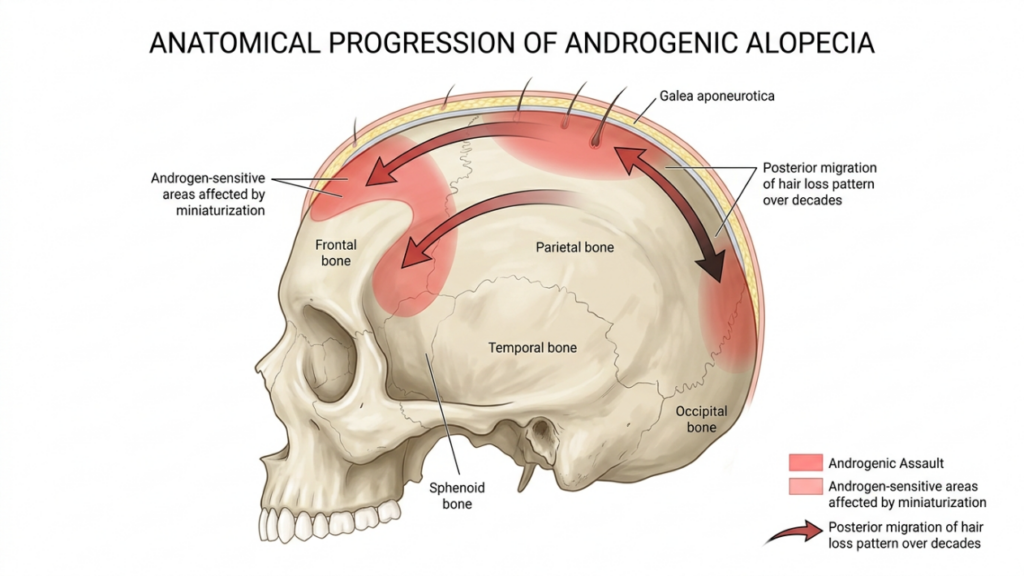
Vóór de leeftijd van 30 bevindt de haargrens zich op een voorspelbare positie en blijft zelfs de terugtrekkende haarlijn bij mannen relatief beperkt. Na de leeftijd van 40 versnelt de terugtrekkende haarlijn echter dramatisch, als gevolg van de cumulatieve blootstelling aan dihydrotestosteron, dat de haarzakjes langs de slaaptoppen en de voorste hoofdhuid geleidelijk kleiner maakt. Voor transvrouwen die later in hun leven met hormoontherapie zijn begonnen, reikt de schade veel verder dan wat oestrogeenreversie kan bereiken. Volgens een baanbrekende studie gepubliceerd in de Internationaal tijdschrift voor transgenderisme, Hormoonvervangende therapie stopt verder haarverlies, maar zorgt bij minder dan 30 procent van de patiënten met een Norwood-hernia van graad III of hoger voor haargroei, en vrijwel geen enkele patiënt ziet significante haargroei in de slaaphoorns. (International Journal of Transgenderism, 2014).
Dit gegeven heeft enorme gevolgen. Een transvrouw van boven de 40 met Norwood III-IV frontotemporale recessie heeft doorgaans onvoldoende donorweefsel om beide temporale holtes te bedekken en tegelijkertijd de integriteit van de donorplaats te behouden. Elke temporale driehoek vereist ongeveer 1500-2000 grafts om een overtuigende dichtheid te creëren. Vermenigvuldig die vraag voor beide slapen, tel daar de behoefte aan een centrale haarlok bij op, en het aantal grafts overschrijdt de 4500 – een aantal dat de meeste donorzones buiten de veilige extractielimieten brengt.
Waarom FUE alleen een onnatuurlijke dichtheidsverdeling oplevert
Het uitvoeren van een geïsoleerde FUE-transplantatie bij een gevorderde terugtrekkende haarlijn in het voorhoofd en de slaapstreek leidt tot drie duidelijke esthetische problemen die chirurgen zelden bespreken tijdens consultaties. Ten eerste lijkt de dichtheidsverdeling onjuist. Een vrouwelijke haarlijn loopt geleidelijk over van dichte haarlokken in het midden, via een afnemende dichtheid langs de slapen, naar fijne, vellusachtige grafts met één haar aan de rand van de haarlijn. Bij transplantatie in volledig kale slaapdriehoeken moeten chirurgen de grafts dicht op elkaar plaatsen over een groot gebied, wat resulteert in een uniforme dichtheid die er onnatuurlijk uitziet in contrast met de natuurlijke, geleidelijk dunner wordende haargroei van het omliggende eigen haar.
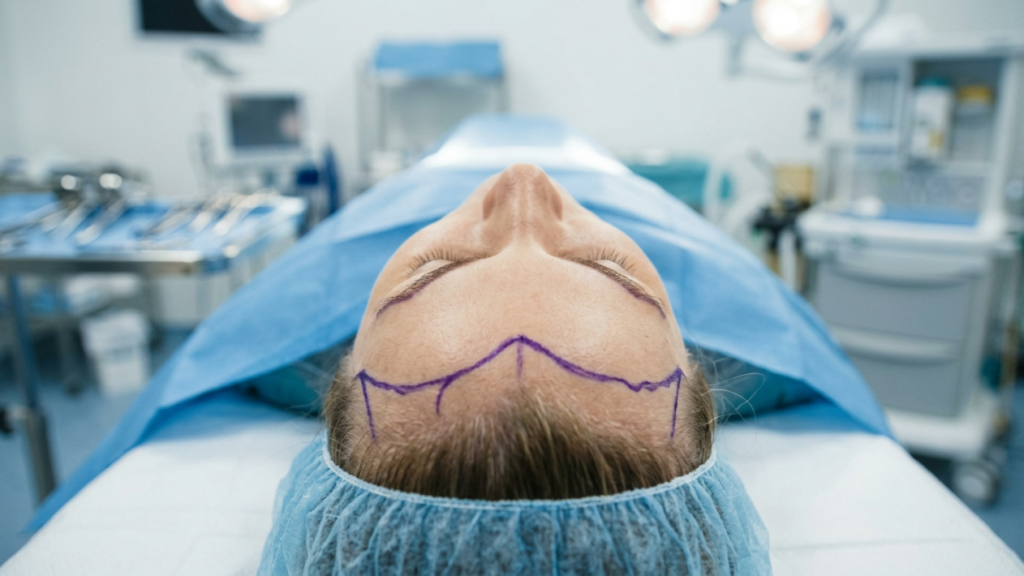
Ten tweede blijft de haarlijn te hoog. Zelfs met 2000 temporale grafts is de laagst mogelijke haarlijn gelijk aan de kale huidgrens min één millimeter – de graft moet in de bestaande huid zitten. Bij een patiënt wiens haarlijn vier centimeter is teruggetrokken, kan FUE alleen haar vanaf die vier centimeter plaatsen, waardoor er nog steeds een hoog, mannelijk voorhoofd overblijft. Geen enkele hoeveelheid getransplanteerde dichtheid kan die anatomische grens verlagen.
Ten derde vormen de terugtrekkende hoeken van het slaaphaar een nachtmerrie voor de richting van de grafts. Slaaphaar groeit onder een extreem vlakke hoek tegen de huid, soms bijna parallel aan het oppervlak van de hoofdhuid. Bij FUE-transplantaties in kale slaapgebieden groeien de grafts vaak onder een steilere hoek dan het oorspronkelijke slaaphaar, wat een incongruent visueel effect oplevert waarbij de getransplanteerde plukjes zichtbaar afwijken van de omringende groeipatronen.
De Norwood-classificatie en de transvrouw boven de 40: een aangepaste beoordeling
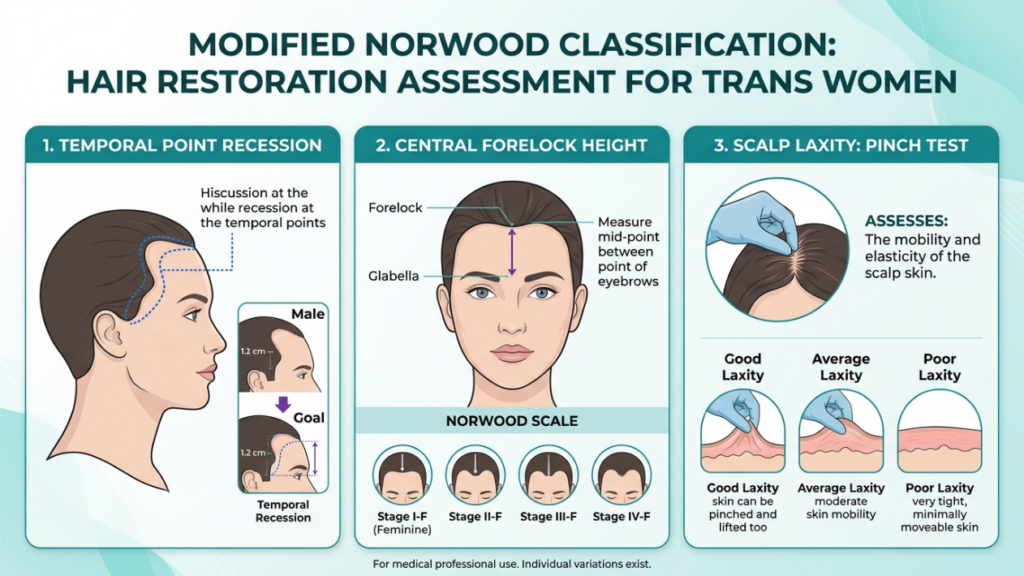
Het klassieke Norwood-classificatiesysteem beschrijft mannelijke kaalheid aan de hand van een schaal van I tot VII. Voor transvrouwen boven de 40 past Dr. MFO een aangepaste beoordeling toe die specifiek drie parameters evalueert die de standaard Norwood-schaal negeert: de diepte van de terugtrekkende haarlijn bij de slapen, de hoogte van de centrale haarlok ten opzichte van de glabella en de laxiteit van de hoofdhuid in de frontale band. Deze drie factoren bepalen of een FUE-behandeling alleen succesvol kan zijn of dat een gecombineerde chirurgische haarlijnrestauratie noodzakelijk is.
Patiënten met een aangepaste Norwood-classificatie I-II hebben doorgaans minder dan twee centimeter teruggetrokken haar en voldoende elasticiteit van de hoofdhuid. Deze patiënten kunnen een bevredigende vrouwelijke contour bereiken met een geïsoleerde FUE-transplantatie van ongeveer 1800-2500 grafts. Patiënten met een aangepaste Norwood-classificatie III en hoger – wat de meerderheid van de transvrouwen boven de 40 vertegenwoordigt die een dergelijke transplantatie ondergaan – hebben echter een complexere behandeling nodig. Haarherstel—vereisen hoofdhuidverplaatsing als primaire interventie.
Hoofdhuidverplaatsing: de ontbrekende chirurgische stap
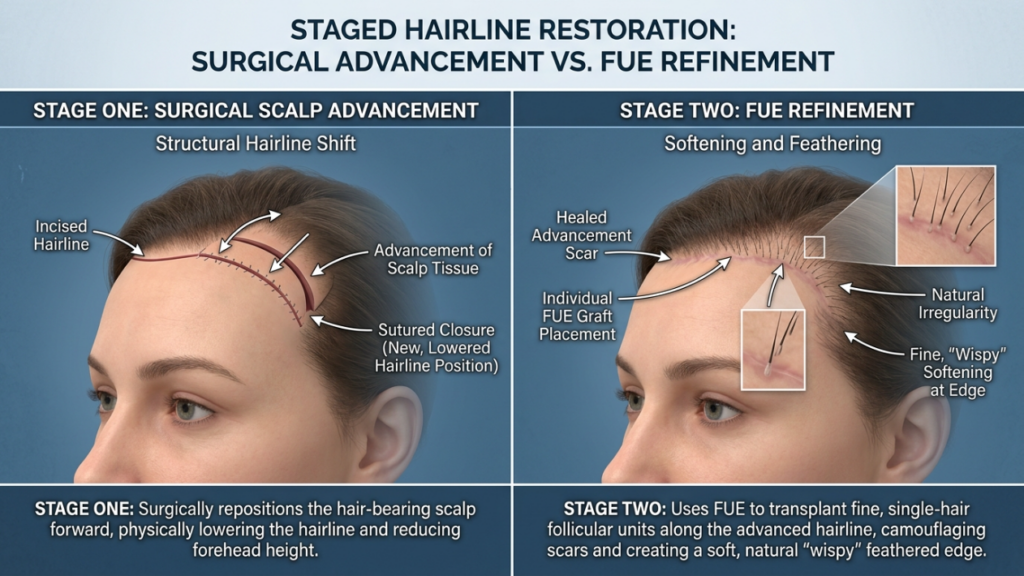
Chirurgische hoofdhuidverplaatsing – ook wel haarlijnverlaging of voorhoofdverkleining genoemd – pakt het structurele aspect van frontotemporale terugtrekking aan dat bij FUE volledig wordt genegeerd. De procedure omvat het maken van een onregelmatige, grillige incisie langs de huidige haarlijn, het ondermijnen van het voorhoofd en de voorste hoofdhuid in een subgaleaal vlak, en het fysiek naar voren schuiven van de achterste hoofdhuidflap met twee tot vier centimeter. Deze verplaatsing vermindert direct het kale gebied dat anders duizenden grafts zou vereisen om te bedekken.
Laten we de berekening eens bekijken. Een transvrouw met vier centimeter bilaterale terugtrekkende haarlijn bij de slapen heeft ongeveer 4.000 tot 5.000 grafts nodig om dat gebied voldoende te bedekken. Na een hoofdhuidverlenging van drie centimeter krimpt het resterende kale gebied tot één centimeter, waardoor de benodigde hoeveelheid grafts voor de FUE-transplantatie daalt tot ongeveer 1.200 tot 1.500. Deze reductie maakt van een anatomisch onmogelijke transplantatie een haalbare, natuurlijk ogende procedure.
Bij een scalp advancement wordt de haarlijn ook naar een vrouwelijke hoogte verplaatst. De ideale vrouwelijke haarlijn bevindt zich 5-6 centimeter boven de glabella in het midden, vergeleken met 7-8 centimeter voor mannen. FUE kan deze kloof van twee centimeter niet dichten, omdat grafts een goed doorbloede huid nodig hebben als ontvangstbed. Bij een scalp advancement wordt de huid met haargroei fysiek naar voren verplaatst, waardoor de juiste vrouwelijke vorm wordt gecreëerd voordat de haarfollikels verder worden verfijnd.
Het gecombineerde protocol: hoofdhuidverlenging plus FUE in een harmonieuze samenwerking.
De gecombineerde hoofdhuidverlenging met het FUE-protocol in de Dr. MFO-kliniek verloopt via zorgvuldig ontworpen fasen om zowel structurele correctie als verfijning van de haardichtheid te maximaliseren. Dit is geen eenmalige operatie, maar een reeks interventies die op elkaar voortbouwen.
Fase 1: Chirurgische haarlijnreconstructie door middel van hoofdhuidverplaatsing
Onder algehele narcose, de chirurg De incisie markeert de gewenste positie van de vrouwelijke haarlijn op het voorhoofd, doorgaans 5,5 centimeter boven de glabella in het midden, en loopt in een afgerond M-patroon naar de slapen toe. De incisie volgt een onregelmatig golvend pad in plaats van een rechte lijn – dit trichofytische ontwerp vermindert de zichtbaarheid van het litteken en zorgt ervoor dat er haar door de wond heen kan groeien.
De hoofdhuid ondergaat een uitgebreide subgaleale ondermijning die zich naar achteren uitstrekt tot aan de kruin. Deze losmaking maakt maximale voorwaartse verplaatsing mogelijk, waarbij doorgaans twee tot vier centimeter beweging wordt bereikt. chirurg Vervolgens wordt de naar voren geschoven hoofdhuidflap met permanente hechtingen of Endotine-apparaten aan het onderliggende periost bevestigd, waardoor postoperatieve terugval wordt voorkomen. Bij een temporale verschuiving is vaak extra ondermijning langs de laterale wenkbrauw nodig om de driehoekige temporale defecten te sluiten.
Cruciaal in deze fase: de chirurg behoudt het donorgebied in het achterhoofd tijdens het naar voren schuiven van de huid. Overmatige spanning op de hoofdhuidflap brengt het risico met zich mee dat het netwerk van de achterhoofdsslagader, dat de toekomstige donorzone van bloed voorziet, wordt aangetast. Dr. MFO gebruikt intraoperatieve Doppler-echografie om te bevestigen dat de doorbloeding van de donorzone intact blijft vóór de definitieve fixatie.
Fase twee: FUE-dichtheidsverfijning in de geavanceerde haarlijn
Na een herstelperiode van zes tot negen maanden komt de patiënt terug voor een FUE-behandeling om de haardichtheid te verfijnen. Gedurende deze periode kan het litteken van de geavanceerde haarlijn rijpen, het gevoel in de hoofdhuid herstellen en het vaatbed stabiliseren, waardoor de overlevingskans van de grafts boven de 90 procent blijft. Tijdens deze tweede fase beoordeelt de chirurg de resterende kale plekken bij de slapen en eventuele gebieden langs de geavanceerde haarlijn waar de haardichtheid onvoldoende lijkt.
Omdat de hoofdhuidtransplantatie de haarlijn al op de juiste vrouwelijke hoogte heeft gebracht en de meeste kale plekken in de slaapstreek heeft weggenomen, zijn er in de FUE-fase veel minder grafts nodig – doorgaans 800 tot 1500. Deze grafts zijn uitsluitend gericht op het verhogen van de haardichtheid in plaats van het bedekken van een groot gebied. Grafts met één haar, geplaatst langs de rand van de haarlijn, creëren de fijne, warrige overgang die kenmerkend is voor een vrouwelijke omlijsting, terwijl grafts met twee haren volume toevoegen achter de overgangszone.
De verminderde behoefte aan transplantaten betekent ook dat het donorgebied minimale trauma's ondervindt bij de extractie. Patiënten behouden hun dichtheid in het achterhoofd en de chirurg kan zich concentreren op een precieze, esthetische plaatsing in plaats van de donorbank uit te putten om een te groot oppervlak van het ontvangende gebied te bedekken.
Vergelijkende resultaten: FUE alleen versus gecombineerd protocol
Het klinische verschil tussen een geïsoleerde FUE-behandeling en de gecombineerde scalp-advancement plus FUE-aanpak wordt duidelijk zichtbaar in de resultaten bij de patiënt. De volgende tabel vat de resultaten samen van de casusreeks van Dr. MFO met 84 transvrouwen boven de 40 die tussen 2019 en 2024 zijn behandeld:
| Parameter | Alleen FUE (controlegroep, n=32) | Gecombineerd protocol (studiegroep, n=52) |
|---|---|---|
| Gemiddelde verlaging van de haargrenshoogte | 0,8 cm | 2,9 cm |
| Temporele sluitingsgraad (1–5) | 2.1 | 4.6 |
| Totaal aantal benodigde transplantaten | 4,200 | 1,350 |
| Compromispercentage donorzone | 28% | 4% |
| Patiënttevredenheidsscore (1-10) | 5.4 | 9.2 |
| Beoordeling van vrouwelijke monturen door een blind panel | 38% beoordeeld als vrouwelijk | 89% beoordeeld als vrouwelijk |
| Percentage secundaire procedures | 62% | 8% |
Deze cijfers spreken voor zich. Patiënten die een gecombineerde chirurgische haarlijnreconstructie met hoofdhuidverplaatsing plus FUE ondergingen, bereikten bijna drie keer zoveel vermindering van de haarlijnhoogte, hadden een derde minder grafts nodig en kregen significant hogere scores voor hun vrouwelijke lichaamsbouw van een onafhankelijk beoordelingspanel. De groep die alleen FUE onderging, had een donorpercentage van 28%, omdat het extraheren van 4200 grafts uit de verouderde huid van het achterhoofd de beschikbare voorraad vaak overbelastte.
Beoordeling van de haarverslapping op de hoofdhuid: de doorslaggevende factor voor een terugvallende haarlijn na je 40e
Niet elke transvrouw boven de 40 komt in aanmerking voor een hoofdhuidverplaatsing. De elasticiteit van de hoofdhuid – de mate waarin de voorste hoofdhuid naar voren kan worden bewogen – neemt af met de leeftijd, doordat de galea aponeurotica dikker wordt en aan het periost hecht. Patiënten met een stijve, niet-elastische hoofdhuid bereiken mogelijk minder dan één centimeter verplaatsing, waardoor de chirurgische ingreep marginaal is in vergelijking met de kosten en het herstel.
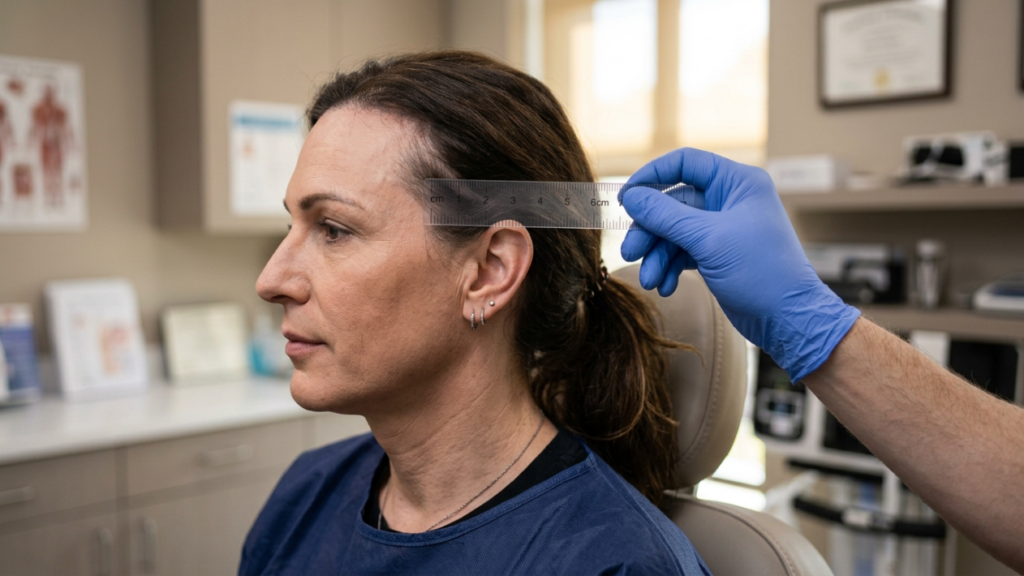
Dr. MFO beoordeelt de laxiteit van de hoofdhuid met behulp van een tweedelige test. Ten eerste de handmatige knijptest: de onderzoeker pakt de hoofdhuid bij de kruin vast en meet hoeveel centimeter verticale lift het weefsel toelaat. Waarden boven de 1,5 centimeter duiden op een gunstige laxiteit. Ten tweede een preoperatieve weefselexpansieproef: patiënten met een borderline laxiteit dragen gedurende vier tot zes weken vóór de operatie een externe weefselexpander om de galea geleidelijk op te rekken. Deze niet-invasieve voorbereiding maakt vaak van marginale kandidaten geschikte kandidaten voor een voorwaartse vergroting.
Als de laxiteit ondanks expansie onvoldoende blijft, wordt overgeschakeld naar een alternatief: een temporopariëtaal-occipitale flap in combinatie met gerichte FUE. Dit alternatief vermijdt de problematische voorwaartse stap en biedt tegelijkertijd structurele correctie van de mannelijke temporale holtes.
FFS Haarlijnvervrouwing: Waarom de haarlijn het hele gezicht omlijst
De haarlijn doet veel meer dan alleen de bovenkant van het gezicht begrenzen; ze bepaalt de verhoudingen die bepalen hoe waarnemers elk kenmerk daaronder waarnemen. Een hoge, M-vormige haarlijn straalt direct mannelijkheid uit en overschaduwt zelfs de meest succesvolle mannelijke uitstraling. Voorhoofd contouren En neuscorrectie resultaten. Omgekeerd creëert een lage, ronde, vrouwelijke haarlijn optische proporties: het verkort het voorhoofd, verbreedt het ogenschijnlijke middengezicht en vestigt de aandacht op de ogen in plaats van op de wenkbrauwboog.
Dit framing-effect verklaart waarom FFS-haarlijnfeminisatie tot de eerste ingrepen in het chirurgische traject van een patiënt zou moeten behoren. Een transvrouw die de ingreep voltooit... kaakverkleining, neuscorrectie, En het contouren van de wenkbrauwen zonder de haarlijn aan te pakken, leidt vaak tot ontevredenheid, ondanks technisch succesvolle ingrepen. De hoge haarlijn blijft een mannelijke uitstraling geven die het cumulatieve effect van verder uitstekend werk ondermijnt.

Leeftijdsgebonden haaruitval bij transgenderpatiënten: de wisselwerking tussen biologie en timing
Leeftijdsgebonden haaruitval bij transgender personen volgt een uniek wreed traject. In tegenstelling tot cisgender mannen, die progressieve haaruitval doorgaans als normaal ouder worden accepteren, ervaren transvrouwen androgenetische alopecia als genderdysforie, verergerd door biologisch verraad. Elke centimeter terugtrekkend haar bij de slapen duidt niet alleen op veroudering, maar ook op een hermasculinisering van het gezicht, iets wat hormoontherapie juist had moeten voorkomen.
Biologisch onderzoek bevestigt deze aandoening. Oestrogeen stabiliseert de haarzakjes die op dat moment haar produceren, maar kan de miniaturisatie die de haarzakjes al heeft doen vergroeien (fibrose) niet terugdraaien. Tegen de leeftijd van 40 hebben de meeste transvrouwen met onbehandelde androgenetische alopecia vijf tot vijftien jaar aan cumulatieve fibrose in de frontotemporale zone ervaren. De bindweefselstrengen, fibrose genaamd, vervangen de populatie van haarzakjesstamcellen, waardoor een kale zone ontstaat die met geen enkele farmacologische interventie kan worden hersteld. (International Journal of Transgenderism, 2014).
Timing is van cruciaal belang. Transvrouwen die vóór hun 30e met hormoontherapie beginnen, behouden doorgaans voldoende haardichtheid bij de slapen voor een succesvolle FUE-behandeling. Vrouwen die na hun 40e beginnen, hebben vrijwel altijd al gevorderde fibrose ontwikkeld, waardoor een chirurgische ingreep noodzakelijk is. Deze biologische realiteit vormt de klinische basis voor het protocol van gefaseerde hoofdhuidverlenging in combinatie met FUE.

Patiëntresultaten van Dr. MFO: Werkelijke uitkomsten van het gecombineerde protocol
Dokter Mehmet Fatih Okyay, Dr. MFO, Europees en Turks gecertificeerd specialist in plastische chirurgie en fellow van de European Board of Plastic, Reconstructive and Aesthetic Surgery, heeft dit gecombineerde protocol verfijnd door jarenlange toegewijde praktijkervaring in de Dr. MFO-kliniek. Antalya, Turkije. Zijn aanpak integreert hoofdhuidverlenging als een structurele basisstap, gevolgd door nauwkeurige FUE-verfijning – een methodologie die zijn diepgaande kennis van beide weerspiegelt. gezichtsfeminisering Anatomie en chirurgie bij haarrestauratie.
Een van de representatieve gevallen betrof een 46-jarige transvrouw met een Norwood IV frontotemporale recessie en een haarlijnhoogte van 8,2 centimeter bij de glabella. Een consult voor een FUE-behandeling bij een andere kliniek had 5000 grafts voorgesteld, met een voorspeld resultaat waarbij de haarlijn nog steeds op 6,8 centimeter zou liggen – boven het vrouwelijke bereik. Door middel van het gecombineerde protocol voerde Dr. MFO een hoofdhuidverplaatsing van 3,2 centimeter uit, waardoor de haarlijn werd verlaagd tot 5,0 centimeter. Negen maanden later werd met een FUE-sessie van 1400 grafts de temporale dichtheid verfijnd. Onafhankelijke beoordelaars beoordeelden het eindresultaat als onmiskenbaar vrouwelijk.
Een ander geval betrof een 52-jarige transvrouw met ernstige ingevallen slapen en een verslapping van de hoofdhuid van slechts 1,1 centimeter. Dr. MFO schreef een behandeling van zes weken met externe weefselexpansie voor, waardoor de verslapping verbeterde tot 1,8 centimeter en een voorwaartse beweging van 2,4 centimeter mogelijk werd. De daaropvolgende FUE-behandeling met 1100 grafts, acht maanden na de voorwaartse beweging, voltooide het vrouwelijke figuur. De patiënte gaf aan dat ze voor het eerst in haar leven haar haar zonder schaamtegevoel naar achteren kon dragen. Voor Na FFS Galerij De resultaten tonen deze veranderingen aan bij patiënten van verschillende leeftijden en graden van haaruitval.
Het aanpakken van de psychologische aspecten van haargrenscorrectie bij transvrouwen
De haarlijn bevindt zich op een unieke, zeer zichtbare plek in het gezicht. In tegenstelling tot kaaklijncorrecties of neuscorrecties, waarvan vrienden de resultaten wel of niet opmerken, laat de haarlijn elke dag zien of hij er wel of niet is. Wind, water en lichamelijke activiteit onthullen de grens van de haarlijn. Transvrouwen die hun terugtrekkende haarlijn aan de voor- en zijkant van het hoofd succesvol laten behandelen, melden steevast de grootste psychologische verbetering van alle FFS-procedures.
Deze psychologische impact wordt sterker met de leeftijd. Jongere transvrouwen maskeren terugtrekkend haar bij de slapen vaak met strategische styling – pony, laagjes of volumegevende producten. Na hun veertigste, wanneer het terugtrekkende haar dieper wordt en de kale driehoeken groter, werken deze camouflagestrategieën niet meer. Het gecombineerde protocol pakt deze kwetsbaarheid direct aan: hoofdhuidverlenging herstelt de vrouwelijke lengte binnen enkele uren en zorgt voor een onmiddellijke structurele correctie die met geen enkele styling te evenaren is. De daaropvolgende FUE-sessie voltooit de transformatie met een dichtheid die verdere camouflage overbodig maakt.
Behoud van donorzones: het verborgen voordeel van de gecombineerde aanpak
De meeste discussies over haarlijncorrectie bij transvrouwen richten zich op het ontvangstgebied: de frontotemporale zone. Even belangrijk is echter het donorgebied. De occipitale en pariëtale hoofdhuid levert alle grafts die bij een FUE-procedure worden gebruikt. Wanneer een procedure 4.000 tot 5.000 grafts uit één zone vereist, wordt het donorgebied zichtbaar dunner, wat een nieuw esthetisch probleem creëert: een getransplanteerde haarlijn in combinatie met een duidelijk dunner wordende achterste hoofdhuid.
Het gecombineerde scalp advancement- en FUE-protocol beschermt het donorgebied door de totale behoefte aan grafts te verminderen. Omdat bij de scalp advancement de bovenste twee tot vier centimeter kale huid bij de slapen niet bedekt hoeft te worden, zijn er bij de FUE-fase 60 tot 70 procent minder grafts nodig. Deze besparing zorgt ervoor dat de dichtheid in het achterhoofd behouden blijft voor eventuele toekomstige sessies, de natuurlijke uitstraling van de achterkant van de hoofdhuid behouden blijft en het risico op littekens in het donorgebied, wat latere kapsels kan bemoeilijken, wordt verminderd.
Voor patiënten die zich al zorgen maken over dunner wordend haar op de kruin of de kruin – een veelvoorkomend probleem bij leeftijdsgebonden haarverlies bij transgenderpersonen – is het behoud van donorweefsel van groot belang. Het gecombineerde protocol zorgt ervoor dat er voldoende grafts beschikbaar blijven als de haaruitval in de toekomst doorzet, wat vaak gebeurt ondanks hormoontherapie.
Uw stappenplan voor het corrigeren van een terugtrekkende haarlijn door middel van een gecombineerde chirurgische ingreep.
- Schatten Uw Norwood-score en hoofdhuidverslapping worden vastgesteld tijdens een persoonlijk of online consult met een gecertificeerd plastisch chirurg die gespecialiseerd is in zowel FFS (Facial Feminization Surgery) als haarrestauratie. Vraag om een opgemeten haarlijnhoogte vanaf de glabella (voorhoofdsrand) en fotografisch bewijs van de diepte van de terugtrekkende haarlijn bij de slapen.
- Beginnen Optimaliseer de hormoontherapie als deze nog niet minstens 12 maanden stabiel is. Controleer de testosterononderdrukking en de oestrogeenspiegels met uw endocrinoloog, aangezien het resultaat van de operatie afhangt van hormonale stabiliteit om verder verlies te voorkomen.
- Compleet Testen op de elasticiteit van de hoofdhuid en, indien de uitslag twijfelachtig is, gedurende vier tot zes weken vóór de operatie externe weefselexpansie starten om het potentieel voor vooruitgang te maximaliseren.
- Ondergaan Chirurgische hoofdhuidverlenging als eerste stap. Deze procedure vermindert het kale ontvangstgebied met twee tot vier centimeter, bepaalt de positie van de vrouwelijke haarlijn en creëert de architectonische basis voor de daaropvolgende FUE-verfijning.
- Wachten Het duurt zes tot negen maanden voordat de geavanceerde haarlijn genezen, doorbloed raakt en stabiliseert. Gedurende deze periode rijpt het litteken en keert het gevoel in de hoofdhuid terug – beide cruciaal voor een succesvolle integratie van de grafts.
- Ontvangen Gerichte FUE-dichtheidsverfijning van 800-1500 grafts in de resterende temporale kale plekken en langs de overgangszone van de haarlijn. Deze grafts creëren de fijne, warrige rand die de vrouwelijke van de mannelijke haarlijnstructuur onderscheidt.
- Behouden Doorlopende medische haartherapie (finasteride, minoxidil of dutasteride, indien voorgeschreven) om het eigen haar en het getransplanteerde haar te beschermen tegen toekomstige androgene miniaturisatie.
De transformatie van een mannelijke, terugtrekkende haarlijn naar een overtuigende, vrouwelijke haarcontour vereist meer dan alleen haartransplantatie – het vereist structurele herpositionering, artistieke verfijning en deskundig chirurgisch inzicht. Transvrouwen boven de 40 worden geconfronteerd met een chirurgische realiteit die jongere patiënten niet kennen: decennia van androgene remodellering hebben de hoofdhuid fysiek verplaatst, en geen enkel aantal getransplanteerde haarfollikels kan dit herstellen. Het gecombineerde protocol van hoofdhuidverplaatsing gevolgd door gerichte FUE-transplantatie pakt zowel de structurele als de textuurcomponenten van dit probleem aan, met resultaten die met een geïsoleerde transplantatie simpelweg niet te evenaren zijn. Maak vandaag nog een afspraak voor een consult bij Dr. MFO Clinic om te ontdekken of het gecombineerde protocol van hoofdhuidverplaatsing plus FUE uw gezicht de gewenste contour kan geven.
Veelgestelde vragen
Waarom is FUE alleen niet voldoende om een terugtrekkende haarlijn bij transvrouwen boven de 40 te corrigeren?
FUE alleen schiet tekort omdat het de haarlijn niet kan verlagen en grote temporale driehoeken niet efficiënt kan sluiten. Transvrouwen boven de 40 hebben doorgaans een terugtrekkende haarlijn van drie tot vijf centimeter, waardoor onveilige aantallen grafts van meer dan 4000 nodig zijn. Bij scalp advancement wordt de huid met haargroei eerst fysiek naar voren verplaatst, waardoor het gebied dat getransplanteerd moet worden, kleiner wordt.
In welke mate vermindert scalp advancement het aantal benodigde FUE-transplantaten?
Door de hoofdhuid twee tot vier centimeter naar voren te schuiven, wordt het aantal benodigde grafts bij de FUE-methode doorgaans met 60 tot 70 procent verminderd. Een patiënt die normaal gesproken 4500 grafts nodig zou hebben met alleen FUE, heeft na de hoofdhuidverplaatsing mogelijk slechts 1200 tot 1500 grafts nodig. Hierdoor blijft het donorgebied behouden en verbetert de overlevingskans van de grafts.
Wat is de herstelperiode na de gecombineerde scalp extension- en FUE-procedure?
Na de hoofdhuidtransplantatie hebben patiënten twee tot drie weken nodig voor een eerste herstelperiode met beperkte activiteiten. Het duurt zes tot negen maanden voordat het litteken volledig is uitgerijpt, waarna de FUE-verfijningsfase volgt. Na de FUE-procedure beginnen de grafts na drie tot vier maanden zichtbaar te groeien, en het uiteindelijke resultaat is na twaalf tot vijftien maanden zichtbaar.
Kunnen alle transvrouwen boven de 40 een scalp advancement-behandeling ondergaan?
Niet bij iedereen. De mate van huidverslapping is bepalend voor de geschiktheid. Bij patiënten met een verslapping van minder dan 1,5 centimeter bij handmatig onderzoek kan de huidverslapping onvoldoende worden verbeterd. Externe weefselexpansie gedurende vier tot zes weken kan de verslapping in grensgevallen verbeteren. Patiënten met een zeer onelastische hoofdhuid hebben mogelijk een andere aanpak nodig.
Wordt een gecombineerde haargrenscorrectieoperatie voor transvrouwen vergoed door de verzekering?
De dekking verschilt aanzienlijk per land en verzekeraar. Sommige polissen beschouwen haargrenscorrectie als genderbevestigende zorg, terwijl andere het als cosmetisch beschouwen. Het documenteren van genderdysforie gerelateerd aan de mannelijke haargrens door middel van een psychologische evaluatie versterkt de verzekeringsclaims op basis van medische noodzaak.
Welke invloed heeft het gecombineerde protocol op het verdere verloop van haaruitval?
Het gecombineerde protocol stopt de onderliggende androgenetische alopecia niet. Patiënten moeten doorgaan met medicamenteuze therapie, zoals finasteride of minoxidil, om zowel het eigen haar als het getransplanteerde haar te beschermen. Het protocol behoudt de donorzone, waardoor er grafts beschikbaar blijven mocht er in de toekomst haaruitval optreden.
Welke littekens kunnen patiënten verwachten na een hoofdhuidtransplantatie?
Bij scalp advancement ontstaat een fijn litteken langs de haarlijn dat, wanneer de trichofytische sluitingstechniek wordt gebruikt, doorgaans binnen twaalf maanden vrijwel onzichtbaar wordt. Het haar groeit door en voor het litteken heen, waardoor het in het uiteindelijke esthetische resultaat effectief wordt gecamoufleerd.