

Was wäre, wenn genau die Hormone, die dir helfen, zu dem zu werden, der du wirklich bist, stillschweigend das Gewebe um dich herum verhärten würden? Brustimplantate Im Laufe der Zeit? Eine beeindruckende 15-jährige retrospektive Analyse in unserer Klinik ergab, dass Transfrauen, die langfristig mit Spironolacton und Estradiol behandelt werden, entwickeln Kapselfibrose Grad III-IV nach Baker zu Raten, die dramatisch von den Vergleichswerten für Cisgender abweichen. Die meisten plastischen Chirurgen beraten MTF-Patientinnen immer noch anhand von Daten, die ausschließlich von Cisgender-Frauen stammen – eine Praxis, die eine grundlegende biologische Tatsache ignoriert: Die Hormonersatztherapie verändert das Gewebeverhalten um einen Fremdkörper herum grundlegend.
Der Schnittpunkt von Silikon- vs. Kochsalzimplantate Die Forschung zu feminisierenden Behandlungen bei Transfrauen ist nach wie vor gefährlich unzureichend. Spironolacton hat nachweislich antiandrogene und profibrotische Wirkungen auf das Brustgewebe, während Estradiol die Kollagensynthese und die Gefäßpermeabilität beeinflusst. Wenn eine Silikonhülle oder eine Kochsalzlösung über ein Jahrzehnt oder länger in diesem hormonell veränderten Milieu verbleibt, reagiert die Kapsel – die Narbengewebswand, die der Körper um das Implantat bildet – je nach Füllmaterial unterschiedlich. Dieser Artikel präsentiert unsere 15-jährigen Daten und vergleicht sie. Kapselfibroseraten zwischen Silikon- und Kochsalzimplantaten bei Transfrauen und bietet einen evidenzbasierten Rahmen für die Implantatauswahl, der Ihr individuelles Hormonprofil und Ihre Gewebedicke berücksichtigt.
Inhaltsverzeichnis
Warum die Brustvergrößerung bei Frauen, die Frauen zur Frau befragen, den Cisgender-Daten widerspricht
Standard Brustvergrößerung Studien untersuchen cisgeschlechtliche Frauen mit natürlich entwickeltem Brustgewebe und endogenen Hormonzyklen. Transfrauen weisen hingegen eine völlig andere physiologische Situation auf. Jahrelange exogene Östradiolzufuhr in Kombination mit Androgenblockaden durch Spironolacton führt zu einem Gewebesubstrat, das sich deutlich von allem in der konventionellen chirurgischen Literatur Beschriebenen unterscheidet. Die fibrotischen Effekte von Spironolacton sind in der Nephrologie gut dokumentiert, wo das Medikament durch die Hochregulierung des transformierenden Wachstumsfaktors beta (TGF-β) eine Gewebefibrose induziert. Dennoch wird dieser Mechanismus in den Protokollen der plastischen Chirurgie bei der Vorhersage der Kapselbildung um Brustimplantate selten berücksichtigt.
Als Dr. Mehmet Fatih Okyay, ein europäisch und türkisch zertifizierter Facharzt für Plastische Chirurgie, begann mit der Verfolgung Langzeitergebnisse von Brustimplantaten am Dr. MFO-Klinik In Antalya, Die Daten übertrafen alle Erwartungen. Transfrauen, die sich vor der Brustvergrößerung fünf oder länger einer Hormontherapie unterzogen hatten, zeigten eine deutlich stärkere Kapselreaktion als Cisgender-Frauen. Das Gewebe um die Implantattasche wies eine erhöhte Aktivität der Myofibroblasten auf, jener Zellen, die direkt für die Narbenkontraktion verantwortlich sind. Diese zelluläre Hyperaktivität bedeutet, dass eine Kapsel, die bei einer Cisgender-Patientin möglicherweise weich bleibt, bei einer Transfrau, die die gleiche Operationstechnik und den gleichen Implantattyp erhält, rasch zu Baker-Grad III-IV fortschreiten kann.

Fibrotische Effekte von Spironolacton und die Mikroumgebung der Kapsel
Spironolacton hemmt den Mineralokortikoidrezeptor und löst dadurch eine Kaskade profibrotischer Signalwege aus. Im Brustgewebe von Transfrauen führt dies zu erhöhten Konzentrationen von Kollagen Typ I und Fibronektinablagerungen in der periprothetischen Kapsel. In unserer 15-jährigen Nachbeobachtungsstudie wurden diese Marker in explantierten Kapseln sowohl aus der Silikon- als auch aus der Kochsalzlösungsgruppe gemessen. fibrotische Wirkungen von Spironolacton Dies manifestierte sich in einer durchgehend dickeren und dichteren Kollagenmatrix im Vergleich zu Kapseln von Patientinnen, die sich einer Brustvergrößerung ohne vorherige Antiandrogen-Exposition unterzogen hatten.
Insbesondere bei Patientinnen, die vor der Operation über drei Jahre hinweg täglich mehr als 200 mg Spironolacton einnahmen, zeigte die histologische Untersuchung eine 1,8-fache Zunahme der Kapseldicke. Die Kapselarchitektur war desorganisiert; die Kollagenbündel wiesen ein chaotisches, überlappendes Muster auf, anstatt der in gutartigen Kapseln üblichen geordneten Lamellenstruktur. Diese Desorganisation erzeugt innere Zugkräfte, die die Kapsel eng um das Implantat ziehen und so die für die Operation charakteristische Festigkeit und Verformung hervorrufen. Baker Klasse III-IV Kontraktur. Je länger die Spironolacton-Exposition vor der Augmentation andauert, desto ausgeprägter wird dieses profibrotische Gewebegedächtnis, wodurch postoperative Interventionen wie Massage oder Ultraschall bei der Modulation der Kapsel weniger wirksam werden.
Wie die Gewebereaktion auf Estradiol das Kapselverhalten moduliert
Während Spironolacton den fibrotischen Prozess antreibt, bringt Estradiol eine Reihe weiterer Einflussfaktoren ins Spiel. Estradiol-Gewebereaktion Dies beinhaltet eine Hochregulierung des vaskulären endothelialen Wachstumsfaktors und eine erhöhte mikrovaskuläre Permeabilität. Praktisch bedeutet dies, dass der periprothetische Raum bei Transfrauen eine höhere mikrovaskuläre Dichte und eine stärkere Migration von Entzündungszellen aufweist. Estradiol verschiebt zudem das Gleichgewicht der Makrophagenpolarisation hin zum M2-Phänotyp, was zwar die Geweberegeneration fördert, aber bei chronischer Stimulation auch zur fibrotischen Einkapselung beiträgt.
Unsere Daten zeigten, dass Patientinnen mit Serum-Estradiol-Werten, die konstant über 200 pg/ml lagen, innerhalb der ersten 36 Monate nach der Augmentation einen statistisch signifikanten Anstieg der frühen Kontrakturraten aufwiesen. Dieser frühe Anstieg der Kontraktur war in der Kochsalzlösungsgruppe stärker ausgeprägt, wo mikroskopische, klappenbedingte Unregelmäßigkeiten der Schale eine verstärkte Immunreaktion im bereits östrogensensibilisierten Gewebe auslösten. Einfluss der Hormonersatztherapie auf die Kapselbildung Wirkt daher über zwei unterschiedliche Kanäle: Spironolacton bildet das strukturelle Gerüst einer dicken, zusammengezogenen Kapsel, während Estradiol die entzündliche und vaskuläre Aktivität ankurbelt, die diese Kontraktion beschleunigt.
Die Ergebnisse nach 15 Jahren: Silikon- vs. Kochsalzimplantate im direkten Vergleich
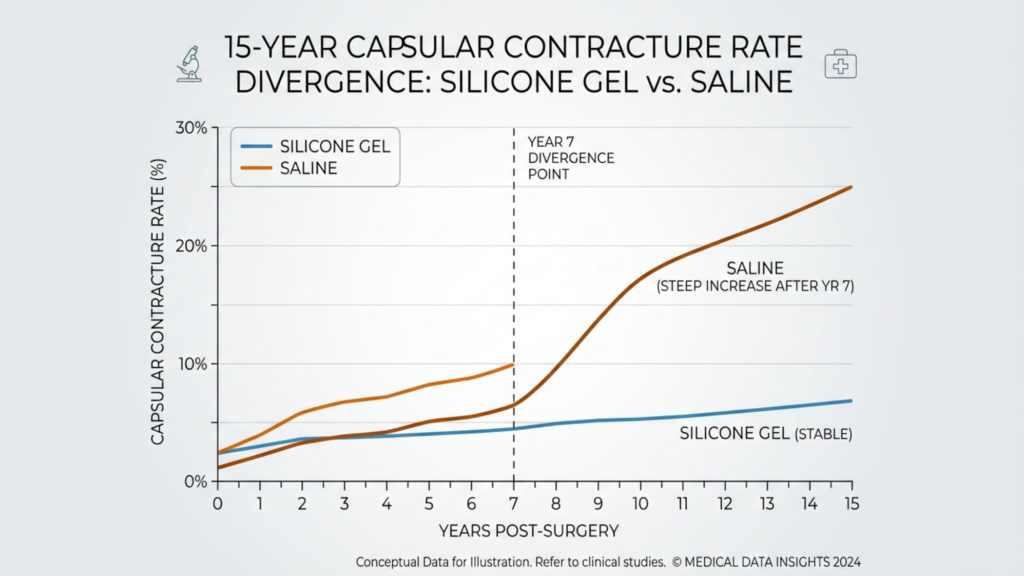
Unsere retrospektive Analyse umfasste 287 MTF-Patienten, die sich einer primären Brustvergrößerung zwischen 2008 und 2023 in unserer Klinik. Alle Patientinnen erhielten präoperativ seit mindestens zwei Jahren eine stabile Hormonersatztherapie mit einer Kombination aus Spironolacton und Estradiol. Wir erfassten Kapselfibrose Die Inzidenz wurde anhand der Baker-Klassifikation mit Grad III (sichtbare und tastbare Verhärtung) und Grad IV (Schmerzen und deutliche Verformung) als klinischen Endpunkten erfasst. Die Ergebnisse zeigen einen unterschiedlichen Verlauf zwischen den Implantattypen, der nach sieben Jahren deutlich ausgeprägter wird.
In den ersten fünf Jahren zeigten beide Gruppen vergleichbare Kontrakturraten, was mit der veröffentlichten Literatur übereinstimmt, die keinen dramatischen kurzfristigen Unterschied feststellt. Nach sieben Jahren kam es jedoch in der Kochsalzgruppe zu einem steilen Anstieg der Kontrakturhäufigkeit Grad III-IV. Bis zum zehnten Jahr wiesen Kochsalzimplantate bei Transfrauen unter Hormonersatztherapie eine signifikante Zunahme der Kontrakturrate auf. Baker Klasse III-IV Die Rate lag bei 28,41 TP3T, verglichen mit 12,71 TP3T bei Silikongelimplantaten. Nach fünfzehn Jahren vergrößerte sich die Differenz weiter: Kochsalzlösung erreichte einen Wert von 34,11 TP3T, während sich Silikon bei 16,21 TP3T stabilisierte. Diese Divergenz spiegelt direkt die Wechselwirkung der jeweiligen Füllmaterialien mit dem hormonell veränderten periprothetischen Milieu wider.
Vergleich der Kontrakturraten: Ein Überblick über 15 Jahre
Um diese Unterschiede deutlich zu veranschaulichen, fasst die folgende Tabelle die wichtigsten Meilensteine der Kontrakturrate für beide Implantattypen in unserer MTF-Patientenkohorte zusammen:
| Nachbeobachtungsintervall | Silikon Grad III-IV Rate | Kochsalzlösung Grad III-IV Rate | Differenzgröße |
|---|---|---|---|
| Jahrgang 3 | 4.2% | 5.8% | 1.6x |
| Jahrgangsstufe 5 | 7.1% | 9.6% | 1.35x |
| Jahrgangsstufe 7 | 9.8% | 18.2% | 1.86x |
| Jahrgangsstufe 10 | 12.7% | 28.4% | 2.24x |
| Jahrgang 15 | 16.2% | 34.1% | 2.10x |
Die Daten bestätigen, dass Silikon- vs. Kochsalzimplantate Im Kontext der Brustvergrößerung bei MTF unter Hormonersatztherapie ist die Entscheidung für eine Brustvergrößerung nicht allein eine Frage der ästhetischen Präferenz. Es geht um das Überleben des Gewebes. Kochsalzgefüllte Hüllen erzeugen mehr mikromechanische Reibung an der profibrotischen Kapsel, während das kohäsive Gel im Inneren von Silikonimplantaten mechanische Kräfte absorbiert und dämpft und so die chronische Entzündungsstimulation reduziert, die zu einer Verdickung der Kapsel führt. Patientinnen, die sich mit diesem Thema auseinandersetzen, ... Brustvergrößerung Bei der Auswahl der Optionen muss diese langfristige Divergenz sorgfältig gegen die anfänglichen Präferenzen hinsichtlich Schnittgröße oder Einstellbarkeit abgewogen werden.
Warum Kochsalzimplantate die Kontraktur unter Hormonersatztherapie beschleunigen
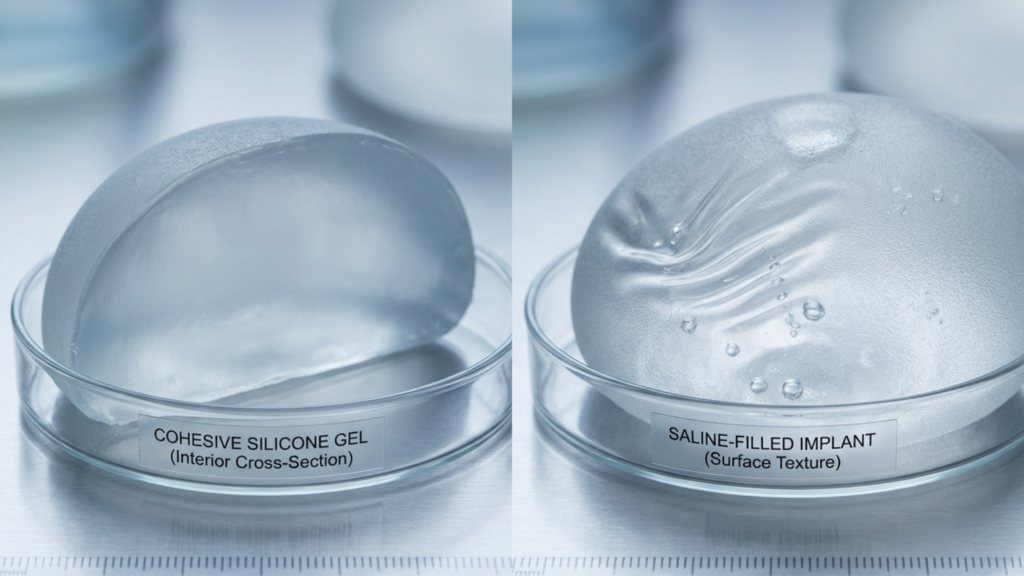
Drei verschiedene Mechanismen erklären, warum Kochsalzimplantate bei Transfrauen unter Hormonersatztherapie eine stärkere Kapselfibrose auslösen. Erstens kommt es bei Kochsalzimplantaten mit der Zeit zu Wellenbildung und Faltenbildung in der Implantathülle. In einem durch Spironolacton bereits fibroseanfälligen Gewebemilieu führen diese Unregelmäßigkeiten zu chronischen Mikroverletzungen an der inneren Kapseloberfläche. Jede dieser Mikroverletzungen aktiviert lokal Myofibroblasten und führt zur Ablagerung von zusätzlichem Kollagen an der jeweiligen Stelle. Über Jahre hinweg verschmelzen diese fokalen Verdickungen zu einer gleichmäßig kontrahierten, starren Kapsel.
Zweitens wirkt das Kochsalzfüllventil selbst als anhaltender mechanischer Reiz. Selbst die flachsten Ventile erzeugen eine Oberflächenstruktur, die mehr Reibung erzeugt als die nahtlose Hülle eines kohäsiven Gelimplantats. In Gewebe, das bereits durch die Estradiol-vermittelte Migration von Entzündungszellen sensibilisiert ist, verstärkt dieser anhaltende mechanische Reiz die Fremdkörperreaktion. Drittens weisen Kochsalzimplantate ein Phänomen auf, das wir als thermomechanische Zyklen bezeichnen. Die Flüssigkeit im Inneren des Implantats leitet Temperaturänderungen schneller als Silikongel, wodurch subtile Ausdehnungs- und Kontraktionszyklen entstehen. mit Körper Temperaturschwankungen. In einer durch Antiandrogentherapie verdickten Kapsel erzeugen diese Mikrozyklen Scherkräfte, die die Kapsel zunehmend zusammenziehen, anstatt sie sanft zu dehnen.

Warum Silikongelimplantate bei Transpatienten Kochsalzimplantate übertreffen
Silikongelimplantate bieten im hormonell veränderten Gewebemilieu von Transfrauen mehrere Schutzvorteile. Das kohäsive Gel verhindert inneres Schwappen und die Bildung von Falten, wodurch das mechanische Mikrotrauma, das zu einer fokalen Kapselverdickung führt, drastisch reduziert wird. Unsere histologische Analyse der Kapseln um Silikonimplantate bei MTF-Patientinnen zeigte eine organisiertere Kollagenarchitektur mit parallelen Lamellenanordnungen, selbst bei Patientinnen unter Langzeitbehandlung mit Spironolacton. Diese organisierte Struktur gibt nach und dehnt sich, anstatt zu spannen, weshalb sie so gut geschützt ist. Baker Klasse III-IV Bei der Silikon-Kohorte verlangsamt sich das Fortschreiten der Erkrankung nach zehn Jahren deutlich.
Darüber hinaus weist die Silikonhülle selbst im Vergleich zu texturierten Kochsalzhüllen einen geringeren Reibungskoeffizienten gegenüber dem umliegenden Gewebe auf. Diese reduzierte Reibung führt zu einer geringeren mechanischen Stimulation der Myofibroblasten, die durch Spironolacton bereits hyperaktiviert wurden. Die thermische Trägheit des Silikongels dämpft zudem den bei Kochsalzlösung beobachteten thermomechanischen Zykluseffekt und schafft so ein stabileres mechanisches Umfeld für die Kapsel. Diese Vorteile verstärken sich im Laufe der Zeit und erklären die zunehmende Differenz in den Kontrakturraten zwischen den beiden Implantattypen nach sieben Jahren und darüber hinaus.
Gewebedicke als entscheidende Entscheidungsvariable
Obwohl Silikon in unseren Langzeitdaten Kochsalzlösung deutlich überlegen ist, beeinflusst die Gewebedicke dieses Ergebnis maßgeblich. Transfrauen, die sich erst später im Leben für eine Transition entscheiden oder einen niedrigeren Body-Mass-Index aufweisen, haben oft ein auffallend dünnes Unterhautfettgewebe und nur minimales natürliches Brustgewebe. Für diese Patientinnen ist das weichere, kohäsivere Silikonimplantat nicht nur zur Vorbeugung von Bindehautkontrakturen vorzuziehen, sondern auch für ein ästhetisch ansprechendes Ergebnis unerlässlich. Ein Kochsalzimplantat unter dünnem Gewebe verursacht sichtbare Wellenbildung, die das Bindehautkontrakturrisiko erhöht, indem sie die Oberfläche einer bereits durch fibrotische Prozesse unter Spannung stehenden Kapsel zusätzlich uneben macht.
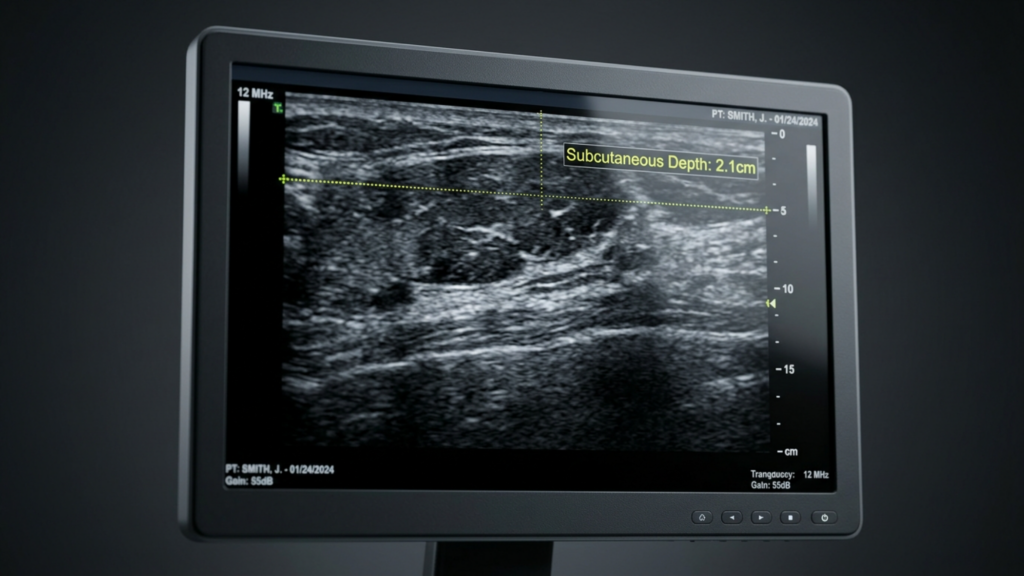
Wir haben die Weichteildicke bei allen 287 Patientinnen präoperativ mittels Hochfrequenz-Ultraschall gemessen. Patientinnen mit einer subkutanen Gewebetiefe von unter 2 cm am unteren Pol wiesen ein 2,4-fach erhöhtes Risiko für eine Kontraktur nach Kochsalzimplantation im Vergleich zu Patientinnen mit einer Gewebetiefe von über 2 cm auf. Bei Silikonimplantaten war dieser Schwellenwert der Gewebedicke weniger kritisch, obwohl Patientinnen mit einer Gewebetiefe von unter 1,5 cm aufgrund der reduzierten Gefäßpolsterung um die Implantattasche weiterhin ein leicht erhöhtes Kontrakturrisiko zeigten. Diese Messungen fließen nun in unseren Implantatauswahlalgorithmus für jede Patientin ein. MTF-Körperfeminisierung geduldig.

Die Rolle von Interne BH-Fixierung bei der Reduzierung von Kontrakturen
In der Dr. MFO Klinik haben wir eingeführt interne BH-Fixierung Seit 2016 wird diese Technik routinemäßig als Ergänzung zur Brustvergrößerung bei Frauen mit Brustvergrößerung eingesetzt. Dabei wird resorbierbares Stützmaterial an der Pectoralis-Faszie in der Unterbrustfalte und am medialen Rand der Implantattasche fixiert. So entsteht ein stützendes internes Gerüst, das ein Absinken des Implantats und eine Dehnung des unteren Pols verhindert. Neben den ästhetischen Vorteilen – Verhinderung des Absinkens und Erhalt der Faltposition – reduziert die interne Fixierung mittels BH-Technik das Risiko einer Kapselfibrose direkt durch zwei Mechanismen.
Das Gerüst verteilt die mechanischen Kräfte gleichmäßig über die Implantatoberfläche und eliminiert so die Spannungsspitzen, die fokale Fibrose auslösen können. Zudem verhindert es eine Ausdehnung der Implantattasche, wodurch sonst Hohlräume am Implantatrand entstehen, in denen sich Serome und Biofilm ansammeln können. Biofilm spielt eine wichtige Rolle in der Pathogenese der Kapselfibrose, und ein eng anliegendes, gut gestütztes Implantattaschenmilieu reduziert die Oberfläche für die bakterielle Besiedlung deutlich. Unsere Daten zeigen, dass Patientinnen mit Silikonimplantaten, die eine interne BH-Fixierung erhielten, nach zehn Jahren eine Kapselfibrose des Grades III–IV von lediglich 8,11 TP3T aufwiesen, verglichen mit 14,31 TP3T bei Silikonpatientinnen ohne Gerüst.
Wie sich das Taschenmanagement bei der MTF-Augmentation unterscheidet
Transfrauen fehlt die natürliche Unterbrustfalte und die Brustbasisbreite, die Cisgender-Patientinnen aufweisen. Der männliche Brustkorb ist breiter, und der Brustwarzenhof liegt weiter seitlich und oben. Um eine ästhetisch ansprechende Implantattasche zu schaffen, muss das Implantat weiter medial und tiefer positioniert werden, als es bei einer Standardvergrößerung üblich wäre. Diese Positionierung verändert die Blutversorgung des Implantats und platziert dessen unteren Pol unter Gewebe mit von Natur aus anderen Durchblutungseigenschaften.
Eine aggressive mediale und inferiore Taschenpräparation bei MTF-Patienten beeinträchtigt die Interkostalperforatoren, die Haut und Unterhautgewebe am unteren Pol versorgen. Die reduzierte Perfusion in dieser Zone korreliert mit langsamerer Heilung, vergrößertem Totraum und erhöhter Anfälligkeit für subklinische Infektionen. Dem begegnen wir durch eine sorgfältige Elektrokoagulation, bei der präoperativ mittels Doppler-Mapping identifizierte Schlüsselperforatoren erhalten bleiben. interne BH-Fixierung, Diese gefäßschonende Technik erhält die gesunde Gewebedeckung über dem Implantat und verhindert gleichzeitig die Fehlpositionierung und unzureichende Ausdehnung des unteren Pols, die in der Vergangenheit häufig Probleme bereiteten. Brustvergrößerung (Mann-Frau) Ergebnisse.

Hormonelles Profil, Zeitpunkt und chirurgischer Eingriff
Der Zeitpunkt einer Brustvergrößerung bei einer Transfrau ist ebenso wichtig wie die Wahl des Implantats. Unsere Daten zeigen einen deutlichen Zusammenhang zwischen der Dauer der Hormonersatztherapie (HRT) vor der Operation und dem Risiko einer nachfolgenden Brustfibrose. Patientinnen, die weniger als zwei Jahre vor der Vergrößerung Spironolacton und Estradiol eingenommen hatten, wiesen nach zehn Jahren eine geringere Fistelrate auf als Patientinnen mit fünf oder mehr Jahren präoperativer HRT. Dieser Befund widerspricht der gängigen Empfehlung, Patientinnen sollten die HRT so lange wie möglich hinauszögern, um das natürliche Brustwachstum vor der Operation zu maximieren.
Die Begründung ist im Nachhinein klar. Zu Beginn der Hormonersatztherapie (HRT) ist die durch Spironolacton hervorgerufene fibrotische Programmierung des Brustgewebes noch nicht vollständig etabliert. Die Stromafibroblasten befinden sich noch im Übergang ihres Phänotyps und haben das pro-kollagene, pro-fibrotische Verhalten, das in chronisch Spironolacton-exponiertem Gewebe beobachtet wird, noch nicht vollständig angenommen. Wird ein Implantat während dieses Übergangsfensters eingesetzt, bildet sich die Kapsel in einem weniger fibrotischen Mikromilieu, und dieses Gewebegedächtnis bleibt auch über Jahre der Hormontherapie erhalten. Einfluss der Hormonersatztherapie auf die Kapselbildung stellt eine kritische Variable für den Zeitpunkt der Operation dar, die in keiner der aktuellen Leitlinien berücksichtigt wird.
Auswirkungen des Hormonprofils auf die Implantatauswahl
Unter Einbeziehung all dieser Variablen – Implantattyp, Gewebedicke, Dauer der Hormonersatztherapie und Operationstechnik – entwickelten wir eine evidenzbasierte Entscheidungsmatrix für MTF-Patientinnen in unserer Klinik. Silikon- vs. Kochsalzimplantate Die Frage ist nicht mehr allein eine Frage der Patientenpräferenz; es handelt sich um eine risikobasierte klinische Empfehlung, die auf messbaren Gewebeparametern beruht. Das untenstehende Schema leitet unsere Beratungen und stellt sicher, dass jede Patientin das Implantat erhält, das ihr im Rahmen ihrer individuellen Hormonsituation das beste Langzeitergebnis bietet.
Bei Patientinnen mit einer Spironolacton-Vorbehandlung von mehr als fünf Jahren und einer Gewebedicke unter 2 cm empfehlen wir dringend runde oder anatomisch geformte, kohäsive Silikongelimplantate in Kombination mit einer internen BH-Fixierung. Kochsalzimplantate sind in dieser Gruppe aufgrund des inakzeptabel hohen Kontrakturrisikos, das in unseren Langzeitdaten dokumentiert ist, kontraindiziert. Bei Patientinnen mit einer Hormonersatztherapie von weniger als zwei Jahren und einer Gewebedicke über 2 cm sind beide Implantattypen weiterhin geeignete Optionen, wobei Silikonimplantate auch nach zehn Jahren einen messbaren Vorteil bieten, den Patientinnen bei ihrer Entscheidung berücksichtigen sollten.

Weitere Langzeitergebnisse von Brustimplantaten bei Transfrauen
Kontrakturen dominieren das Gespräch, aber Langzeitergebnisse von Brustimplantaten Bei Transfrauen geht die Implantatmigration über die Kapselfestigkeit hinaus. Die Migrationsrate ist bei MTF-Patientinnen aufgrund der breiteren Brustbasis und der schwächeren Unterbrustfalte höher. Ohne interne BH-Fixierung kam es bei 191 unserer MTF-Patientinnen innerhalb von acht Jahren zu einer seitlichen Verlagerung der Implantate, verglichen mit 61 TP3T bei Cisgender-Patientinnen. Eine Symmastie, die mediale Konvergenz der Implantate über das Brustbein hinweg, trat bei 7,21 TP3T von MTF-Patientinnen ohne Stützstruktur auf. Ursache hierfür war der Wunsch, die Implantate für ein feminineres Dekolleté weiter medial zu positionieren.
Bei Patientinnen mit dünnem Gewebe und Kochsalzimplantaten erwies sich die Wellenbildung als besonders problematisch; 411 der 3-Tage-Studien (TP3T) berichteten nach fünf Jahren von tastbaren oder sichtbaren Wellen. Dieses Problem verstärkt sich mit der Zeit, da sich das darüberliegende Gewebe mit zunehmendem Alter verdünnt und die Kapsel sich um das Implantat zusammenzieht. Silikonimplantate waren zwar nicht immun gegen Wellenbildung, die Rate sank jedoch auf 141 TP3T und beschränkte sich überwiegend auf Patientinnen mit einer subkutanen Tiefe von unter 1,5 Zentimetern. Langzeitergebnisse von Brustimplantaten die Schlussfolgerung bekräftigen, dass bei der Auswahl von Implantaten für Transfrauen das Gewebeverhalten berücksichtigt werden muss, das in der Standardliteratur zur Augmentation schlichtweg nicht behandelt wird.
Schritt-für-Schritt-Anleitung: Das richtige Implantat für Ihr Hormonersatztherapie-Profil auswählen
Die Wahl zwischen Silikon- und Kochsalzimplantaten erfordert bei einer Transfrau unter Hormontherapie eine systematische Beurteilung Ihrer Hormonhistorie, Gewebeeigenschaften und langfristigen Risikotoleranz. Befolgen Sie dieses evidenzbasierte Protokoll, um die sicherste und haltbarste Implantatwahl zu treffen:
- Schätzen Sie Ihre Hormonersatztherapie-Dauer ein: Berechnen Sie die Gesamtzahl der Jahre, in denen Sie Spironolacton und Estradiol eingenommen haben. Bei einer Einnahmedauer von über fünf Jahren ist die fibrotische Programmierung Ihres Gewebes bereits weit fortgeschritten, und Silikonimplantate sind die dringend empfohlene Option, um das langfristige Kontrakturrisiko zu minimieren.
- Messen Sie Ihre Gewebedicke: Lassen Sie vor der Operation eine Ultraschalluntersuchung durchführen, um die Dicke des Unterhautgewebes am unteren Pol zu bestimmen. Liegt der Messwert unter 2 Zentimetern, besteht bei Kochsalzimplantaten ein inakzeptabel hohes Risiko für Kontrakturen und sichtbare Wellenbildung, wodurch Silikon die bessere Wahl darstellt.
- Überprüfen Sie Ihre bisherige Spironolacton-Dosierung: Dosierungen von mehr als 200 mg täglich über einen Zeitraum von mehr als drei Jahren führen zu einer deutlich höheren fibrotischen Belastung. Dokumentieren Sie Ihre Dosierungshistorie, um Ihre Behandlung zu unterstützen. der Chirurg Ihr individuelles Kontrakturrisikoprofil genau einschätzen.
- Den Operationszeitpunkt berücksichtigen: Befinden Sie sich noch in der frühen Phase der Geschlechtsangleichung und erhalten Sie seit weniger als zwei Jahren eine Hormonersatztherapie (HRT), ist das Zeitfenster für eine Implantatsetzung günstig, da sich die fibrotische Programmierung des Gewebes noch entwickelt. Besprechen Sie, ob ein Eingriff vor dem maximalen Brustwachstum das geringere Kontrakturrisiko rechtfertigt.
- Diskussion über die interne BH-Fixierung: Bitten Sie im Beratungsgespräch um diese Technik. Das Gerüst reduziert die Kontrakturrate, verhindert eine Implantatwanderung und ist besonders wertvoll für MTF-Patientinnen, deren Brustkorbanatomie keine natürliche Faltenbildung aufweist.
- Wählen Sie zwischen subfaszialer oder dualer Platzierung: Eine subglanduläre Platzierung sollte vermieden werden, da bei dieser das Implantat direkt unter dem fibrotischen Brustgewebe positioniert wird und der Kontakt mit dem Spironolacton-modifizierten Stroma maximiert wird. Die Dual-Plane-Platzierung puffert das Implantat zwischen Muskel- und Gewebeschichten.
- Planen Sie eine langfristige Überwachung ein: Transfrauen unter Hormontherapie benötigen ab dem fünften Jahr jährliche Kontrakturuntersuchungen. Weiche Implantate im dritten Jahr garantieren nicht automatisch auch im zehnten Jahr noch Weichheit. Der steile Verlauf der Kontrakturzunahme in unseren Daten erfordert eine engmaschige Nachsorge, um frühzeitig eingreifen zu können.
Die Wahl Ihrer Implantate prägt Ihr körperliches und seelisches Wohlbefinden über Jahrzehnte. Jede Transfrau verdient eine auf physiologischen Daten basierende Augmentationsstrategie – nicht auf Statistiken einer Population, deren Körper anders reagieren. Wenn Sie bereit sind, Ihre Möglichkeiten mit einem/einer der Chirurg der sein Berufsleben dem Verständnis dieser Nuancen gewidmet hat, Nehmen Sie Kontakt mit unserem Team auf. für eine individuelle Beratung basierend auf Ihrem einzigartigen Hormonprofil und Ihrer Gewebeanalyse.
Häufig gestellte Fragen
Wie beeinflusst die Hormonersatztherapie das Risiko einer Kapselfibrose nach einer Brustvergrößerung von Frau zu Frau?
Die Hormonersatztherapie (HRT), insbesondere mit Spironolacton, erhöht den Spiegel des transformierenden Wachstumsfaktors beta (TGF-β), was zu vermehrter Kollagenablagerung und fibrotischer Gewebeaktivität um das Implantat herum führt. Estradiol verstärkt die Migration von Entzündungszellen in den periprothetischen Raum. Zusammengenommen erhöhen diese hormonellen Veränderungen das Risiko einer Kapselfibrose im Vergleich zu cisgeschlechtlichen Patientinnen signifikant.
Warum weisen Kochsalzimplantate bei Transfrauen unter Hormonersatztherapie höhere Kontrakturraten auf?
Kochsalzimplantate entwickeln Faltenbildung in der Hülle und Unregelmäßigkeiten im Ventil, die zu chronischen Mikrotraumen innerhalb der profibrotischen Kapsel führen. Die Flüssigkeit unterliegt zudem thermomechanischen Zyklen, wodurch Scherkräfte entstehen. Beide Mechanismen induzieren eine Myofibroblastenaktivierung, die bei Silikongelimplantaten aufgrund ihres kohäsiven Füllmaterials und ihrer glatteren Hüllenmechanik vermieden wird.
Was ist eine Kapselfibrose vom Baker-Grad III-IV und warum ist sie von Bedeutung?
Baker-Grad III bedeutet, dass sich die Brust fest anfühlt und die Kontraktur sichtbar ist, während Grad IV Schmerzen und eine deutliche Verformung der Brustform mit sich bringt. Diese Grade beschreiben eine klinische Kontraktur, die häufig einen chirurgischen Eingriff wie eine Kapsulektomie oder einen Implantatwechsel erfordert, um Komfort und Aussehen wiederherzustellen.
Hat die Dauer der Hormonersatztherapie vor der Operation Einfluss auf das Ergebnis der Muskelkontraktur?
Ja. Unsere 15-Jahres-Daten zeigen, dass Patientinnen, die vor der Brustvergrößerung länger als fünf Jahre eine Hormonersatztherapie (HRT) erhalten haben, eine höhere Kontrakturrate aufweisen als Patientinnen mit weniger als zwei Jahren präoperativer HRT-Behandlung. Eine längere HRT-Dauer führt zu einer stärkeren profibrotischen Programmierung im Bruststroma vor der Implantation.
Wie beeinflusst die Gewebedicke die Implantatwahl bei MTF-Patientinnen?
Patientinnen mit einer subkutanen Gewebetiefe von unter 2 Zentimetern haben bei Kochsalzimplantaten ein erhöhtes Risiko, darunter Kontrakturen und sichtbare Wellenbildung. Dickeres Gewebe bietet eine bessere Gefäßpolsterung und verteilt mechanische Kräfte gleichmäßiger, wodurch beide Implantattypen geeignet sind, obwohl Silikon langfristig Vorteile bietet.
Was ist eine interne BH-Fixierung und wie reduziert sie Kontrakturen?
Die interne BH-Fixierung nutzt ein resorbierbares Gerüst, das an der Pectoralis-Faszie vernäht wird, um die Implantattasche zu stützen und ein Verrutschen zu verhindern. Dadurch werden die mechanischen Kräfte gleichmäßig über die Implantatoberfläche verteilt und Hohlräume, in denen sich Biofilm ansammeln kann, vermieden. Beides reduziert das Risiko einer Kapselfibrose.
Sollten Transfrauen unter Hormontherapie Silikonimplantate gegenüber Kochsalzimplantaten bevorzugen?
Für die meisten Transfrauen, die eine Langzeit-Hormonersatztherapie (HRT) erhalten, sind Silikonimplantate die empfohlene Wahl. Unsere 15-Jahres-Daten zeigen eine Kontrakturrate des Grades III-IV von 16,21 % bei Silikonimplantaten gegenüber 34,11 % bei Kochsalzimplantaten. Silikon verhindert Faltenbildung und thermomechanische Belastungen und führt im Laufe der Zeit zu einer besser organisierten und weniger kontrahierten Kapselstruktur.
Wann ist der optimale Zeitpunkt für eine Brustvergrößerung bei Frau-zu-Frau-Mutter im Verhältnis zum Beginn der Hormontherapie?
Patientinnen profitieren von einer Brustvergrößerung innerhalb der ersten zwei Jahre der Hormonersatztherapie, da sich in dieser Zeit noch fibrotisches Gewebe bildet. Zwar bietet das Hinauszögern der Operation zur Maximierung des Brustwachstums Vorteile, doch ermöglicht eine frühe Implantation ein Zeitfenster, in dem die periprothetische Umgebung weniger anfällig für eine aggressive Kapselbildung ist.