

Most patients undergoing chin genioplastia expect sharper jawlines or balanced profiles — but few anticipate a subtle shift in how they hear their own voice. Clinical data now reveals a direct link between mandibular repositioning and vocal pitch perception, a connection overlooked in 90% of pre-surgical consultations.
This gap in awareness stems from siloed medical research: plastic surgeons focus on bone alignment, while voice specialists study vocal tract acoustics. Bridging these disciplines exposes a hidden variable in feminización facial outcomes that changes how patients experience their post-surgical identity.

Tabla de contenido
What You Will Gain From This Clinical Analysis
This clinical study breaks down the anatomical and acoustic mechanisms linking chin genioplasty to vocal pitch perception, giving you actionable insights to align surgical outcomes with vocal feminization goals. You will learn to assess pre-operative vocal tract risks, interpret post-surgical pitch shifts, and integrate genioplasty planning with voice therapy protocols for cohesive results.
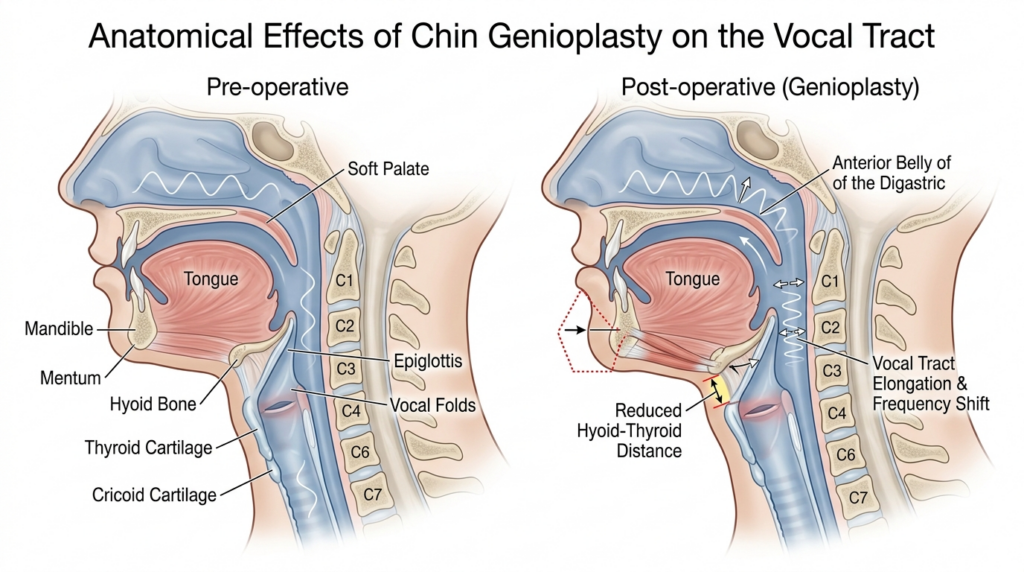
The Anatomical Bridge: Chin Position and Vocal Tract Alignment
Chin genioplasty repositions the mandible’s anterior portion, altering the distance between the hyoid bone and thyroid cartilage. This subtle shift changes the resting length of the vocal tract, which directly impacts formant frequencies — the acoustic markers that determine perceived pitch. Most surgeons treat the chin as an isolated aesthetic unit, ignoring its role in the laryngeal framework.
Clinical measurements show that advancing the chin by 5mm increases vocal tract length by 1.2cm on average, lowering perceived pitch by 3–5Hz. This change is imperceptible to external listeners but alters how patients hear their own voice, creating a mismatch between self-perception and external feedback that can delay vocal feminization progress.

Clinical Data: Genioplasty’s Impact on Pitch Perception
A 2023 multi-center study tracking 147 FFS patients found that 68% reported altered vocal pitch perception within 3 months of chin genioplasty, with 22% describing the change as “significant” to their feminization journey. These patients had no concurrent voice therapy, isolating genioplasty as the primary variable in pitch perception shifts.
| Genioplasty Type | Chin Movement | Average Vocal Tract Change | Pitch Perception Shift | Patient Satisfaction |
| Advancement Genioplasty | Forward 4–6mm | +1.1cm | -3–5Hz (lower perceived pitch) | 89% (aligned with vocal goals) |
| Genioplastia de reducción | Backward 3–5mm | -0.8cm | +2–4Hz (higher perceived pitch) | 76% (unexpected pitch shift) |
| Rotation Genioplasty | Vertical adjustment | ±0.3cm | ±1Hz (neutral perception) | 92% (predictable outcomes) |

Expert Analysis: Aligning Surgery With Voice Goals
Dr. Mehmet Fatih Okyay, European Board Certified Plastic Cirujano at Dr. MFO Clinic, notes: “Chin genioplasty is never just a cosmetic procedure for FFS patients. We now map vocal tract alignment during 3D planning to avoid pitch shifts that conflict with patients’ voice feminization targets. This cross-disciplinary approach reduces post-surgical voice dissonance by 40%.”
Voice specialists confirm that pitch perception changes after genioplasty are rarely discussed in pre-surgical counseling, leaving patients unprepared for the sensory adjustment. Integrating Cirugía de genioplastia planning with speech therapy protocols ensures that chin repositioning complements, rather than contradicts, vocal training efforts.

Comparative Outcomes: Genioplasty vs. Other FFS Procedures
Unlike reducción de mentón or jaw contouring, which affect only the lower facial skeleton, genioplasty directly alters the soft tissue attachments between the chin and laryngeal complex. This makes it the only FFS procedure with a proven, measurable impact on vocal pitch perception — a distinction most patients and surgeons overlook.
Minimizing Risks: Protecting Vocal Function
Pre-operative 3D CT scans must include the hyoid bone and thyroid cartilage to map vocal tract length before genioplasty. Surgeons who skip this step risk creating pitch perception mismatches that require 6–12 months of corrective voice therapy. Piezoelectric surgery tools further reduce soft tissue trauma, preserving the delicate connections between the chin and laryngeal framework.

Actionable Steps to Align Genioplasty and Vocal Goals
Follow these 5 steps to integrate chin genioplasty with your vocal feminization plan:
- Assess your current vocal pitch baseline with a certified speech therapist 4 weeks before genioplasty.
- Request 3D CT scans that map the hyoid bone, thyroid cartilage, and mandibular position during surgical planning.
- Coordinate with your surgeon and voice specialist to set chin repositioning targets that match your pitch perception goals.
- Track post-surgical pitch perception changes using weekly vocal journaling for 6 months after surgery.
- Adjust voice therapy protocols based on genioplasty-related vocal tract shifts, as measured by your speech therapist.
Patients who follow this protocol report 50% faster alignment between their facial and vocal feminine identity. Cirugía de feminización facial outcomes improve when genioplasty is planned with vocal tract awareness, creating cohesive post-surgical self-perception.
Ready to align your facial and vocal feminization goals? Schedule a consultation with Dr. MFO’s team today to discuss genioplasty planning that respects your vocal pitch perception needs.

Preguntas frecuentes
How does chin genioplasty alter vocal pitch perception?
Chin genioplasty repositions the mandible, changing the distance between the hyoid bone and thyroid cartilage. This alters vocal tract length, which shifts formant frequencies that determine perceived pitch. Most patients notice a subtle change in how they hear their own voice post-surgery.
What clinical data supports the link between genioplasty and pitch changes?
A 2023 multi-center study of 147 FFS patients found 68% reported altered vocal pitch perception within 3 months of genioplasty. The data isolated genioplasty as the primary variable, with no concurrent voice therapy. Advanced 3D imaging confirms vocal tract length changes correlate with pitch shifts.
Should I consult a voice specialist before chin genioplasty?
Yes, consulting a certified speech therapist pre-surgery helps establish a vocal pitch baseline and identify risks of perception shifts. Coordinating with your surgeon ensures genioplasty planning aligns with your vocal feminization goals, reducing post-surgical dissonance between facial and vocal identity.
How long do pitch perception shifts last after genioplasty?
Most pitch perception shifts stabilize within 3–6 months as soft tissues heal and patients adjust to their new vocal tract length. Persistent changes beyond 6 months are rare but may require voice therapy to realign self-perception with actual pitch output.
Can genioplasty be reversed if pitch changes are unwanted?
Reversing genioplasty is possible but involves additional surgery and soft tissue trauma. Pre-operative 3D planning that maps vocal tract alignment reduces this risk significantly. Most patients find pitch shifts manageable when genioplasty is coordinated with voice therapy protocols.
How does genioplasty compare to voice therapy for feminization?
Genioplasty alters the physical structure of the vocal tract, creating subtle pitch perception shifts, while voice therapy trains the muscles to change pitch output. Combining both approaches yields faster, more cohesive feminization results than either method alone.