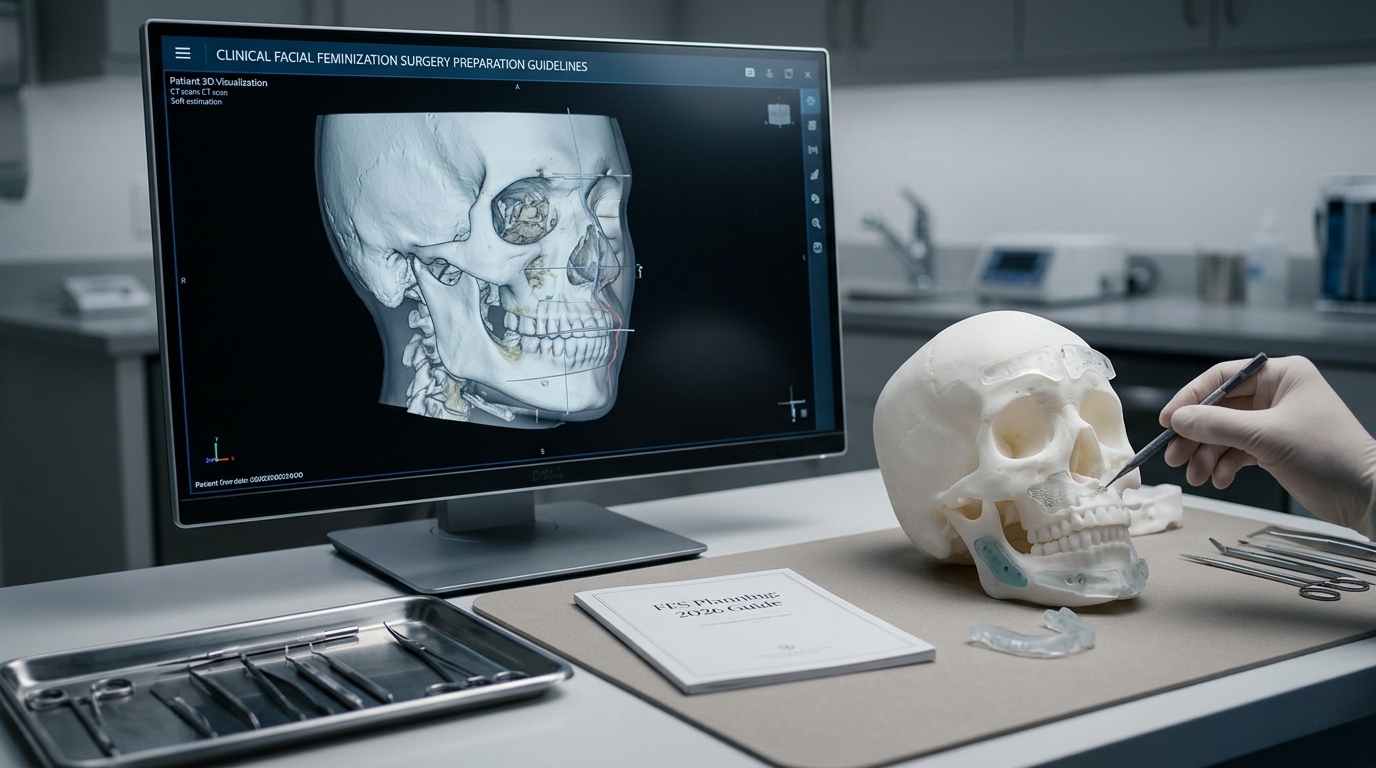

Et si l'intervention de chirurgie esthétique du menton que vous choisissez aujourd'hui déterminait si votre mâchoire paraîtra naturelle ou visiblement modifiée dans sept ans ? Une réalité frappante à laquelle est confrontée chaque femme transgenre qui envisage cette option. Chirurgie de remodelage du menton avecen soins du visage Chirurgie de féminisation : l’écart entre la satisfaction initiale et le résultat à long terme est bien plus important que ce que la plupart des cliniques admettent. Une revue systématique de 2023 publiée dans la Journal de chirurgie craniofaciale Il a été rapporté que les alloplasties implant de mentonCes dispositifs présentent un taux de complications à long terme pouvant atteindre 26,5 % (TP4T), avec résorption osseuse, migration et modifications des tissus mous apparaissant des années après leur pose. (Journal de chirurgie craniofaciale, 2023). Glissant génioplastie, en revanche, troque une intervention chirurgicale initiale plus coûteuse contre une permanence osseuse — mais l'héritage en termes de coussinet mentonnier des tissus mous de chaque méthode diverge considérablement au fil du temps.
Cet article présente une comparaison directe, rigoureuse et fondée sur des données probantes, des systèmes de glissement génioplastie contre implant de menton pour chirurgie de remodelage du menton Chez les femmes trans, vous découvrirez précisément comment chaque option évolue sur sept ans, comment la mentonnière réagit différemment, pourquoi la résorption osseuse compromet silencieusement les résultats des implants, et quelle anatomie initiale du menton oriente le choix d'une méthode plutôt qu'une autre. Pas de généralités vagues : uniquement des résultats mesurables pour vous aider à prendre la décision structurelle la plus importante de votre transition faciale.
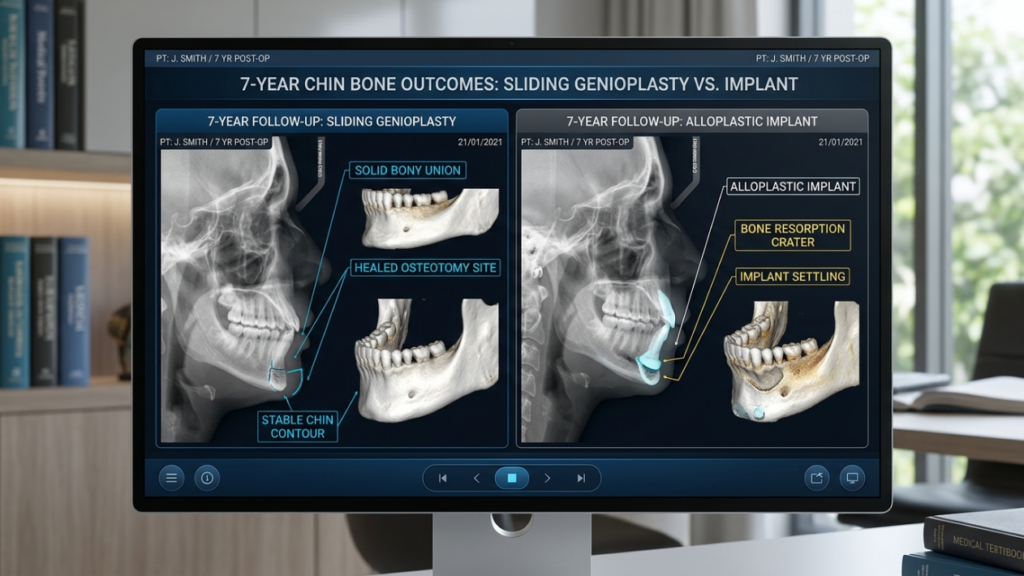
Table des matières
Pourquoi votre choix de chirurgie de remodelage du menton aujourd'hui définira votre visage à sept ans
Le menton constitue le point d'ancrage structurel du bas du visage. Chez les femmes transgenres, un menton proéminent ou allongé verticalement est souvent perçu comme un trait masculin que l'hormonothérapie seule ne peut corriger. chirurgie de remodelage du menton demeure donc l'une des procédures les plus importantes au sein de Féminisation faciale La chirurgie. Or, c'est là que réside le problème dont la plupart des patients n'entendent jamais parler : les deux techniques dominantes…génioplastie par glissement aL'implant mentonnier alloplastique et la prothèse mentonnière ne se contentent pas d'emprunter des chemins différents pour atteindre le même objectif. Ils produisent des réalités à long terme fondamentalement différentes pour les tissus mous sus-jacents.
La génioplastie par glissement déplace votre propre os, préservant ainsi sa vascularisation et créant une union biologique qui se renforce avec le temps. implant de menton, cependant, se situe entre l'os et le mentonnière en tissu mou, générant une pression mécanique chronique qui érode lentement la mandibule sous-jacente, ces mécanismes divergents produisent, après sept ans, des résultats visuellement et au toucher totalement différents : l’un s’intègre, l’autre s’impose. Comprendre cette distinction est essentiel avant de s’engager dans une démarche qui redéfinit votre identité.
Génioplastie par glissement : l’os qui guérit, les tissus mous qui gardent leur mémoire
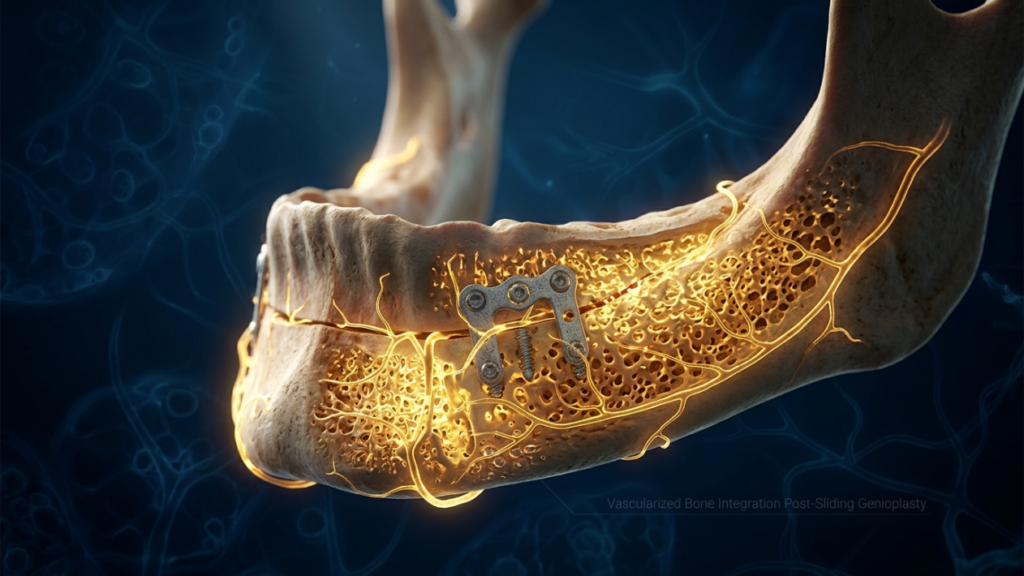
Génioplastie coulissante est une procédure basée sur une ostéotomie. chirurgien On pratique une incision osseuse horizontale sous le foramen mentonnier, on repositionne le segment mentonnier vers l'avant, l'arrière, le haut ou le bas, et on le fixe à l'aide de miniplaques en titane ou de vis résorbables. Le segment osseux conservant son insertion sur les tissus mous linguaux — notamment les muscles génioglosse et génio-hyoïdien —, l'os reste vascularisé et vivant.
Cette continuité biologique est extrêmement importante pour les femmes trans. Lorsque le menton est repositionné pendant la transition mentoplastie, Le coussinet mentonnier, recouvert de tissus mous, se redépose sur une structure osseuse vivante. Au cours des douze premiers mois, le muscle mentonnier et le tissu adipeux sous-cutané se contractent et épousent le nouveau contour. À trois ans, les tissus mous ont “ mémorisé ” leur nouvelle position. À sept ans, la consolidation osseuse est complète et stable, et l’enveloppe des tissus mous se comporte comme si elle avait toujours été là.
Un avantage crucial pour génioplastie transgenre L'avantage principal pour les patients réside dans l'absence de corps étranger. Ni silicone ni polyéthylène poreux ne se trouvent sous la mentonnière et ne compriment les tissus. Le muscle mentonnier se réattache naturellement, sans barrière. Ainsi, le menton conserve toute sa mobilité et son expressivité : sourire, parler et expressions émotionnelles restent naturels, car les tissus mous suivent les mouvements du squelette au lieu de glisser sur une coque rigide.
De plus, la génioplastie d'avancement permet une réduction verticale simultanée, souvent nécessaire chez les femmes transgenres présentant un tiers inférieur du visage allongé. Un implant ne peut qu'augmenter la projection ; il ne peut pas raccourcir le menton. Cette polyvalence anatomique fait de la génioplastie la solution structurelle la plus complète, notamment lorsque l'anatomie initiale du menton présente à la fois une hauteur verticale excessive et une projection sagittale excessive.
Implant de menton : projection instantanée, érosion invisible
UN implant de menton Elle permet une projection antérieure immédiate, avec une durée opératoire plus courte et une convalescence apparemment plus simple. Fabriqué en silicone, en polyéthylène poreux (Medpor) ou en ePTFE, l'implant est inséré par une incision sous-mentale ou intra-orale et positionné directement contre la symphyse mandibulaire. Pour les femmes transgenres souhaitant une augmentation mammaire rapide, sans l'œdème et la convalescence associés à une ostéotomie, cette technique semble idéale. attractif.
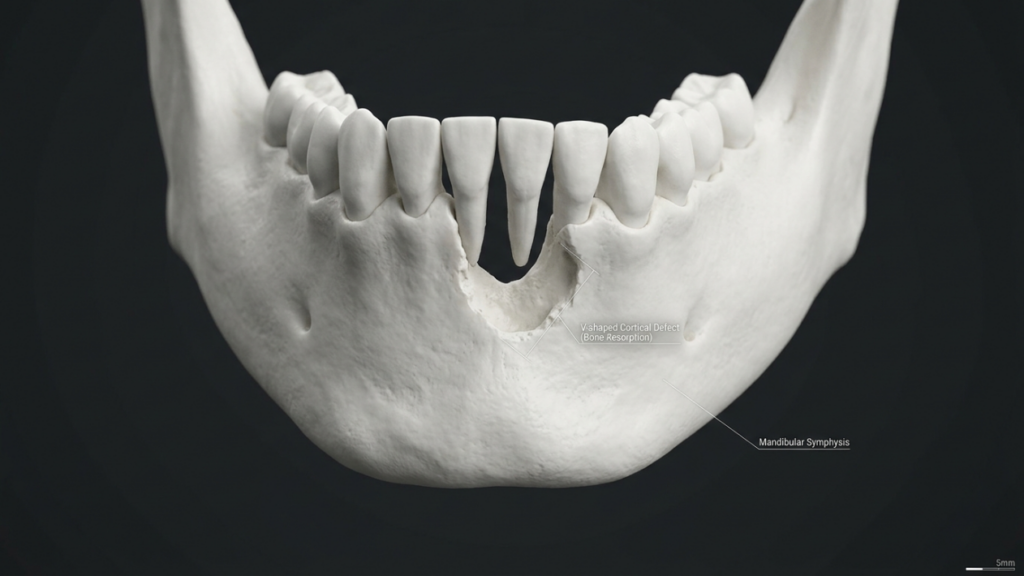
Pourtant, la complication silencieuse de implant de résorption osseuse La pose de l'implant fragilise progressivement les fondations mêmes sur lesquelles il repose. Une revue systématique publiée dans le Journal of Craniofacial Surgery a démontré qu'une résorption osseuse sous les implants mentonniers alloplastiques survient chez un pourcentage significatif de patients, sa gravité allant d'une simple encoche corticale à une pénétration médullaire profonde qui fragilise la structure de la mandibule. (Journal de chirurgie craniofaciale, 2023). Ce n'est pas un événement rare ; c'est une conséquence biomécanique prévisible. La pression constante exercée par un implant rigide sur l'os vivant déclenche l'activité ostéoclastique, et l'os se résorbe lentement.
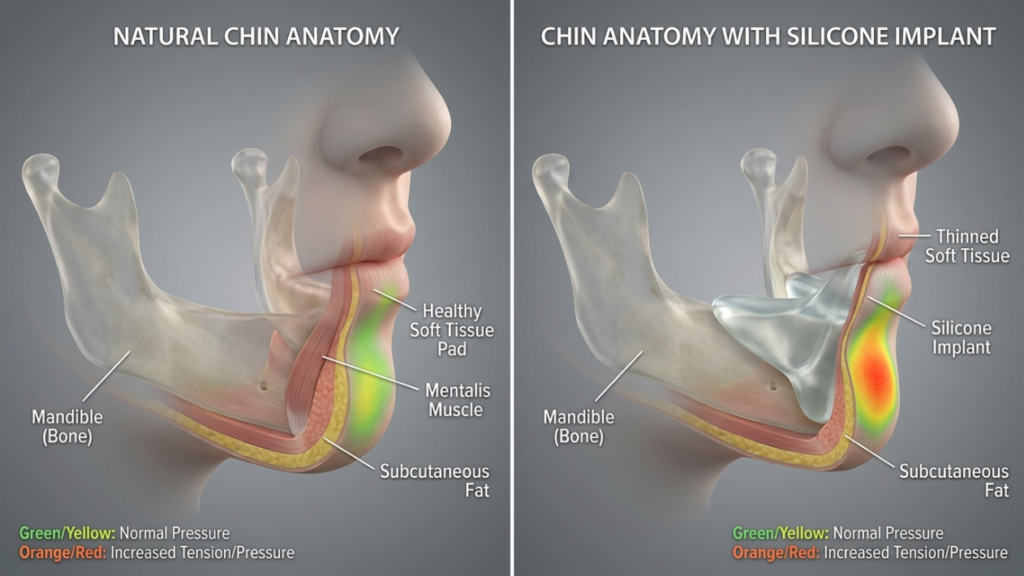
Au cours de la première année, le patient constate le volume prévu. À la troisième année, un léger tassement se produit avec le début de la résorption osseuse. À la cinquième année, l'implant peut sembler s'être légèrement enfoncé en raison de l'érosion de l'os sous-jacent. À la septième année, l'augmentation initiale est partiellement perdue, l'implant se trouve dans un creux osseux et… mentonnière en tissu mou L'épaisseur du coussinet s'est amincie sous l'effet d'une compression chronique. La palpation augmente à mesure que le coussinet s'amincit et les bords de l'implant deviennent visibles à travers la peau, notamment lors des mouvements.
Les conséquences vont au-delà de l'esthétique. La résorption osseuse complique la reprise chirurgicale. Le retrait de l'implant révèle une symphyse pubienne déficiente qui nécessite désormais une reconstruction, soit par un implant plus volumineux, soit par une génioplastie de sauvetage avec greffe osseuse. Ce qui devait être une intervention simple s'est transformé en un défi reconstructif plus complexe. contouring du menton transgenre Chez les patients qui recherchaient une stabilité à long terme, cette trajectoire exige une réflexion préopératoire sérieuse.
Mentonnière en tissu mou : le facteur décisif dont personne ne parle
Le mentonnière en tissu mouL'épaisseur du tissu sous-cutané, composé du muscle mentonnier, du tissu adipeux sous-cutané et de la peau sus-jacente, détermine si le résultat final paraîtra naturel ou chirurgical. Ce tissu mesure en moyenne de 10 à 15 millimètres d'épaisseur chez la plupart des personnes, mais les femmes transgenres présentent souvent des tissus mous plus fins après une hormonothérapie prolongée qui réduit le volume de tissu adipeux sous-cutané. La finesse du tissu influence considérablement le choix de la technique chirurgicale.
Grâce à la génioplastie par glissement, la mentonnière n'est soumise à aucune compression chronique. Le segment osseux avancé crée un support autour duquel la mentonnière adhère et se remodèle. La vascularisation est préservée. Le muscle mentonnier se réinsère sur l'os repositionné sans corps étranger. Pendant plus de sept ans, la mentonnière conserve son épaisseur et sa fonction dynamique. Les irrégularités de contour sont rares car les tissus s'adaptent à une surface vivante qui se remodèle en conséquence.
Avec un implant de menton, La situation s'inverse alors complètement. L'implant comprime le coussinet adipeux contre l'os par le dessous et la peau par le dessus. Le flux sanguin est chroniquement réduit dans la zone située directement au-dessus de l'implant. Au fil des années, la couche de graisse s'amincit, le muscle mentonnier s'atrophie dans la région adjacente à l'implant et la peau adhère davantage à la capsule implantaire. Ceci engendre la fameuse “ visibilité de l'implant ”, qui devient de plus en plus apparente à partir de la cinquième année. La palpabilité et la visibilité des bords de l'implant lors des expressions faciales ne sont pas des complications tardives ; ce sont des conséquences normales du phénomène biomécanique.
Les patients qui envisagent implant de menton Il est important de comprendre que la finesse des tissus mous amplifie ces effets. Une femme transgenre avec seulement 8 millimètres de tissu mou verra les bords de l'implant apparaître bien plus tôt qu'une femme avec 14 millimètres. C'est là que le choix de la technique la plus adaptée à long terme entre en jeu : l'épaisseur de vos tissus détermine en partie la technique qui vous conviendra le mieux.

Données comparatives sur sept ans : génioplastie d’avancement versus implant mentonnier
Les données longitudinales sur les interventions craniofaciales modernes restent malheureusement rares, mais les études rétrospectives et les séries d'experts permettent des comparaisons pertinentes. Le tableau ci-dessous synthétise les résultats publiés par les centres spécialisés en génioplastie orthognathique et esthétique, ainsi que les résultats d'études d'augmentation mammaire par implants alloplastiques réalisées sur des périodes comparables.
| Paramètre de résultat (7 ans) | Génioplastie coulissante | Implant de menton |
|---|---|---|
| Stabilité structurelle | Consolidation osseuse définitive en 12 mois | Diminution ; cratère de résorption progressive |
| préservation de l'épaisseur de la mentonnière en tissu mou | 90–95% d'épaisseur d'origine conservée | 30–50% amincissement dans la zone au-dessus de l'implant |
| taux de résorption osseuse | Minimale (moins de 1 mm au niveau de l'ostéotomie) | 1 à 5 mm sous l'implant ; progressif |
| Palpabilité au repos | Zéro (os natif) | Augmentation à partir de la 3e année |
| Palpabilité pendant l'animation | Aucune ; continuité naturelle muscle-os | Bords d'implants visibles chez les patients présentant des tissus fins |
| Réglage vertical du menton | Capacité maximale (raccourcir ou allonger) | Aucune capacité de réduction verticale |
| Taux de révision | 3–8% (principalement pour l'asymétrie) | 15–26% (résorption, déplacement, extrusion) |
| Risque d'infection | Faible (l'ostéotomie guérit grâce à l'apport sanguin) | Faible initialement ; risque tardif de biofilm 2–5% |
| Troubles des nerfs sensitifs | Temporaire dans les cas 20 à 30% ; permanent dans les cas inférieurs à 5% | Rare initialement ; augmente en cas de révision nécessaire |
| Trajectoire de vieillissement | Stable ; âges avec squelette natif | Détérioration ; l’interface implant-os se dégrade |
Les données révèlent une vérité dérangeante. Féminisation du menton à long terme Les résultats sont fondamentalement asymétriques entre les deux approches. L'implant, initialement solide, finit par s'affaiblir. La génioplastie, quant à elle, entraîne un gonflement et une convalescence plus importants au début, mais le résultat s'améliore avec le temps. Si vous évaluez ces interventions uniquement sur la base des six premiers mois, vous passez à côté de l'essentiel. La décision ne devient pertinente qu'à partir de la septième année et au-delà.

Résorption osseuse sous implants : l’architecte silencieux de la révision
implant de résorption osseuse La pose d'implants n'est pas une complication aléatoire ; elle suit un processus biomécanique prévisible. Lorsqu'un objet alloplastique rigide exerce une pression sur l'os cortical, la loi de Wolff stipule que l'os se remodèle en réponse aux modifications des contraintes. Les zones de pression concentrée subissent une dominance ostéoclastique, et l'os se rétracte. Les implants en silicone, dont la face inférieure lisse crée des points de pression localisés, produisent fréquemment des défauts corticaux en forme de V visibles sur les radiographies céphalométriques.
Les implants en polyéthylène poreux ont été conçus pour atténuer ce problème grâce à la repousse tissulaire, qui, en théorie, répartit la pression. En pratique, cette repousse est partielle et irrégulière, et des zones de pression se développent toujours le long des bords de l'implant, là où le contact est le plus ferme. L'étude systématique réalisée par Journal de chirurgie craniofaciale Aucun matériau n'a été trouvé totalement immunisé contre la résorption ; la variable réside dans la gravité et le moment de la résorption plutôt que dans sa présence ou son absence. (Journal de chirurgie craniofaciale, 2023).
Chez les femmes trans, ce phénomène a un effet cumulatif. Nombre d'entre elles souhaitent une génioplastie car leur symphyse mandibulaire naturelle est proéminente, tant sur le plan sagittal que vertical – une morphologie masculine classique. Lorsqu'un implant repose sur une symphyse proéminente et provoque une résorption osseuse par pression, le défaut osseux qui en résulte peut modifier le tiers inférieur du visage et, paradoxalement, remasculiniser le contour. L'implant s'enfonce dans son propre creux, le menton s'amincit et le résultat visible s'éloigne de l'idéal féminin initialement visé.
La révision de ce scénario est techniquement exigeante. chirurgien Il faut retirer l'implant, évaluer la profondeur du cratère et décider entre le remplacement par un implant plus petit, la mise en place d'une greffe osseuse structurelle ou la conversion en génioplastie coulissante. Chaque option comporte ses propres risques et incertitudes. La prévention, grâce à un choix initial judicieux de la méthode, demeure bien plus fiable que les tentatives de réparation effectuées des années plus tard.

Palpabilité et animation : ce que les miroirs et les caméras ne peuvent pas cacher
La palpabilité figure parmi les plaintes à long terme les plus pénibles après une greffe alloplastique. mentoplastie. Un implant mentonnier, invisible au bout de six mois, peut devenir nettement perceptible au bout de quatre ans, à mesure que le coussinet de tissu mou s'amincit. Les patients rapportent sentir les bords de l'implant en touchant leur menton, remarquer des décalages au niveau de ses marges et observer un léger déplacement de l'implant lorsqu'ils parlent ou sourient.
La perception par la caméra ajoute une dimension supplémentaire. La vidéo et la photographie haute définition captent des irrégularités de surface invisibles à l'œil nu. Une fine mentonnière recouvrant un implant en silicone crée une ligne d'ombre subtile mais perceptible au niveau de l'implant. Cette ligne s'accentue avec l'âge et l'atrophie des tissus. Pour les femmes transgenres qui doivent composer avec la visibilité sociale et professionnelle, ce signe qui apparaît progressivement peut ébranler la confiance en l'intervention même censée la renforcer.
La génioplastie par glissement ne produit pas ce genre d'artefact. L'os repositionné est votre propre tissu. Il bouge avec votre musculature. Aucun bord ne capte la lumière, aucune marge ne crée de lignes d'ombre et aucune structure étrangère ne se déplace sous la peau amincie. chirurgie de génioplastie Le résultat est, en pratique, indiscernable d'un menton naturel qui se trouve avoir le contour que vous avez toujours souhaité.

Évolution des options : l’écart sur sept ans
Le vieillissement affecte toutes les structures du visage, mais son interaction diffère selon qu'il s'agisse d'implants osseux autologues ou alloplastiques. Le vieillissement naturel du visage se produit au cours des sept années suivantes. féminisation du menton à long terme Ces interventions entraînent une perte progressive de volume du tissu adipeux sous-cutané, une diminution de l'élasticité cutanée et un remodelage osseux continu. Ces processus mettent à l'épreuve la durabilité des résultats obtenus lors d'une chirurgie de remodelage du menton.
Après une génioplastie d'avancement, le vieillissement se déroule normalement. L'os repositionné s'intègre à la mandibule et participe au remodelage physiologique. Les tissus mous sus-jacents vieillissent en même temps que le squelette, préservant ainsi une harmonie visuelle. La perte de volume affecte uniformément l'ensemble du bas du visage, et le résultat de la génioplastie reste proportionné. En résumé, votre menton, après avoir été remodelé, vieillit comme votre menton naturel, car, structurellement, il l'est.
Après la pose d'implants mentonniers, le vieillissement aggrave les problèmes existants. La fonte graisseuse au-dessus de l'implant le rend plus visible. Le relâchement cutané fait disparaître la tension de la jeunesse qui masquait autrefois les contours de l'implant. La résorption osseuse sous l'implant s'accélère à mesure que les tissus de soutien s'érodent. L'implant se retrouve progressivement enfoncé dans un creux plus profond tandis que la couche superficielle s'amincit. Au bout de sept ans, l'effet combiné produit un résultat nettement différent de celui de la première année – généralement moins esthétique, et non mieux.
Les femmes transgenres trentenaires et quadragénaires sont les plus durement touchées par cette divergence. Le processus de vieillissement coïncide avec la dégradation des implants, créant une convergence de facteurs négatifs autour de la cinquième à la septième année. Les patientes qui ont choisi les implants pour leur rapidité et leur simplicité se retrouvent confrontées à une chirurgie de révision précisément à l'âge où elles espéraient profiter pleinement du résultat. féminisation du menton à long terme Une réalité qui apparaît rarement dans les supports marketing.

Algorithme de décision : Associer votre anatomie à la procédure appropriée
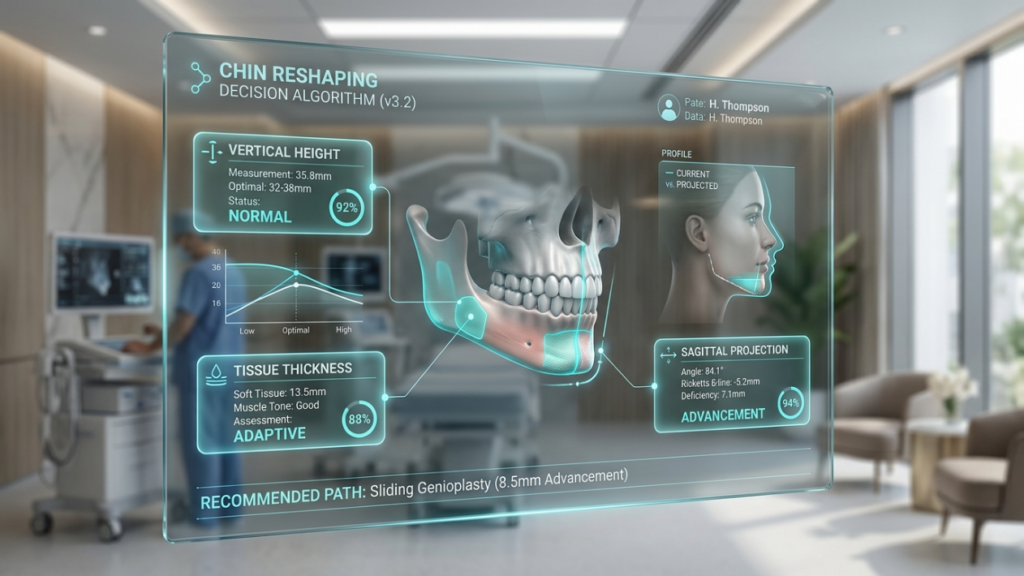
Ni la génioplastie d'avancement ni l'implant mentonnier ne sont systématiquement supérieurs ; le choix optimal dépend de votre anatomie initiale. L'algorithme suivant guide la décision en fonction de trois variables anatomiques clés : la hauteur verticale du menton, l'épaisseur du coussinet mentonnier et la différence de projection sagittale.
Variable anatomique n° 1 : Hauteur du menton verticale
Les femmes transgenres présentant un excès de menton vertical (où la hauteur du bas du visage dépasse l'idéal esthétique) bénéficient presque toujours de génioplastie coulissante. Un implant ne peut pas réduire la dimension verticale ; il ne peut qu’augmenter la projection sagittale. Tenter de camoufler un menton long verticalement à l’aide d’un implant donne un aspect allongé et projeté de façon artificielle. La génioplastie d’avancement permet un raccourcissement vertical en repositionnant le segment du menton vers le haut et en redessinant le contour inférieur, ce qui corrige simultanément l’excès de hauteur et de projection.
Variable anatomique n° 2 : Épaisseur du coussinet mentonnier (tissus mous)
Les patients présentant moins de 10 millimètres de mentonnière en tissu mou Les patients présentant une génioplastie d'épaisseur importante ont un risque accru de palpabilité et de visibilité des implants. Un tissu fin ne permet pas de masquer les marges de l'implant, et l'atrophie induite par la compression accélère leur visibilité au fil des ans. Chez ces patients, la génioplastie d'avancement est fortement recommandée car l'os natif élimine complètement le problème de la visibilité du corps étranger. Les patients dont l'épaisseur de la couche cornée est de 12 millimètres ou plus peuvent envisager la pose d'implants, mais ils doivent néanmoins évaluer la vitesse de résorption osseuse au regard de leurs attentes en matière de longévité.
Variable anatomique n° 3 : Besoins en projection sagittale
Lorsque la déformation principale est une rétrogénie légère (déficit inférieur à 5 mm) sans excès vertical, et que le coussinet des tissus mous est adéquat, un implant mentonnier peut permettre une augmentation acceptable. Cependant, chez les femmes transgenres dont le menton masculin présente à la fois un excès osseux et une rétrusion nécessitant une avancée supérieure à 5 mm, génioplastie coulissante Offre un meilleur contrôle et une plus grande stabilité. Les implants de très grande taille présentent des risques de résorption et de déplacement proportionnellement plus élevés, car la surface de contact avec l'os sous pression augmente.
Remodelage du menton chez les personnes transgenres : considérations spécifiques au-delà des résultats obtenus chez les personnes cisgenres
La plupart des données publiées sur la génioplastie et l'augmentation du menton proviennent de patients cisgenres souhaitant une amélioration esthétique. Les femmes transgenres présentent des points de départ anatomiques fondamentalement différents, et l'application sans adaptation des données relatives aux résultats chez les personnes cisgenres conduit à des décisions erronées.
Le menton typique d'une femme transgenre présente une hauteur verticale plus importante, une dimension transversale plus large, un os cortical plus épais et une proéminence mentonnière plus marquée. Ces caractéristiques nécessitent une modification squelettique plus importante que chez les personnes cisgenres. Un implant modeste, donnant un résultat acceptable chez une femme cisgenre présentant une rétrogénie légère, sera moins performant chez une femme transgenre dont le menton requiert une modification dimensionnelle significative sur plusieurs plans.
contouring du menton chez les personnes transgenres Par conséquent, la plupart des centres craniofaciaux spécialisés en chirurgie faciale faciale privilégient fortement les approches basées sur l'ostéotomie. La capacité de repositionnement multiplan de génioplastie coulissanteL’ajustement de la hauteur, de la largeur et de la projection en une seule intervention correspond à la réalité anatomique de la plupart des femmes trans. Les implants ne concernent qu’une petite partie d’entre elles : celles présentant une rétrogénie légère et isolée, une couverture adéquate des tissus mous et une absence d’excès vertical.
En tant que chirurgien plasticien certifié par les instances européennes et turques et possédant une vaste expérience en féminisation faciale, j'ai observé que les patientes ayant subi féminisation faciale procédures combinant la génioplastie par glissement avec réduction de la mâchoire et modelage du front On obtient des résultats plus cohérents et harmonieux que ceux obtenus avec des solutions à base d'implants assemblés de façon disparate. Le squelette s'intègre comme une structure unifiée plutôt que comme un ensemble de volumes ajoutés.

Reprises de mentoplastie : quand le premier choix était une erreur
Révision mentoplastie Elle est beaucoup plus fréquente après une intervention avec implants qu'après une génioplastie d'avancement. Les reprises chirurgicales liées aux implants représentent la majorité des interventions secondaires au menton dans les séries publiées. Les raisons sont prévisibles : résorption osseuse progressive entraînant une instabilité, déplacement de l'implant dû à une contracture capsulaire ou à un traumatisme, infection avec formation de biofilm, extrusion à travers un tissu aminci et palpabilité inacceptable.
La conversion d'un implant défaillant en génioplastie par glissement est possible, mais plus complexe qu'une génioplastie primaire. La résorption osseuse peut s'avérer insuffisante pour une fixation par ostéotomie standard, nécessitant une greffe osseuse pour combler le creux. Le coussinet mentonnier, préalablement comprimé, peut être trop fin pour épouser naturellement le nouveau contour osseux. Les adhérences de la capsule prothétique peuvent déformer les plans chirurgicaux, augmentant ainsi le risque de neuropathie du nerf mentonnier.
À l'inverse, la révision d'une génioplastie d'avancement consiste généralement en des ajustements mineurs : un repositionnement de quelques millimètres ou la correction d'un décalage. L'os est vivant et cicatrise de nouveau de façon fiable. Le coussinet adipeux reste sain et s'adapte à la nouvelle position. La génioplastie de révision présente une morbidité plus faible et une prévisibilité plus élevée que la conversion d'un implant en génioplastie, ce qui confirme l'intérêt de choisir la procédure initiale appropriée.
Résultats de la génioplastie chez les personnes transgenres : que montrent les données probantes ?
Preuves publiées sur génioplastie transgenre Les résultats cliniques restent limités, mais s'améliorent. Des études rétrospectives menées dans des centres spécialisés en chirurgie faciale font état de taux de satisfaction élevés après une génioplastie d'avancement, avec un maintien stable des contours des tissus mous pendant plus de cinq ans. La récupération neurosensorielle suit la même évolution que celle observée chez les patients ayant subi une chirurgie orthognathique : une hypoesthésie initiale touchant 20 à 30 % des patients, avec un retour à l'état initial chez plus de 95 % d'entre eux en 18 mois.
Une observation notable dans les séries de génioplasties spécifiques à la chirurgie de féminisation faciale est le redrapage supérieur des tissus mous lorsque la génioplastie est combinée à des interventions adjacentes telles que réduction de la mâchoire. L'approche squelettique combinée crée un contour facial inférieur unifié qui permet mentonnière en tissu mou Il s'agit de redraper la ligne de la mâchoire en continu plutôt que de corriger une simple projection du menton. On obtient ainsi un résultat naturellement féminin, sans effet chirurgical, ce que recherchent précisément les femmes trans.
Les données spécifiques aux implants chez les personnes transgenres sont encore plus rares, car la plupart des études proviennent de populations ayant recours à la chirurgie esthétique et présentant des besoins d'augmentation mammaire moins importants. Extrapoler à partir de données cisgenres sous-estime le taux de complications chez les femmes transgenres, car les contraintes anatomiques — et donc la taille des implants et les forces en jeu — sont plus importantes. Journal de chirurgie craniofaciale Le taux de complications à long terme rapporté par l'étude (26,5%) sous-estime probablement le taux réel chez les patients transgenres recevant des implants plus volumineux. (Journal de chirurgie craniofaciale, 2023).
Guide de décision étape par étape pour votre chirurgie de remodelage du menton
Utilisez les étapes concrètes suivantes pour déterminer lequel chirurgie de remodelage du menton Cette option correspond à votre anatomie et à vos objectifs à long terme.
- Mesure La hauteur du tiers inférieur du visage est mesurée à l'aide d'une photographie faciale standardisée. Si ce tiers inférieur représente plus d'un tiers de la hauteur totale du visage, une génioplastie d'avancement pour réduction verticale est indiquée ; les implants ne peuvent pas corriger ce problème.
- Évaluer Épaisseur de la mentonnière (tissus mous) mesurée par téléradiographie de profil ou échographie. Une épaisseur inférieure à 10 mm plaide fortement en faveur d'une génioplastie afin d'éviter la visibilité de l'implant. Au-delà de 12 mm, la pose d'implants devient envisageable.
- Calculer Le déficit ou l'excès sagittal. Une rétrogénie inférieure à 5 mm avec une couverture tissulaire adéquate permet d'envisager la pose d'un implant. Un déficit supérieur à 5 mm ou un déficit combiné à un excès vertical impose une génioplastie.
- Examen Votre horizon temporel est de sept ans. Si vous avez moins de 40 ans et prévoyez plusieurs décennies de vieillissement naturel, la stabilité de l'évolution des implants lors du vieillissement protège votre investissement. La dégradation des implants s'accélère avec le temps.
- Demande Planification chirurgicale 3D. Les deux interventions bénéficient de la simulation virtuelle, mais les résultats de la génioplastie s'améliorent considérablement lorsque la position de l'ostéotomie et la fixation par plaque sont planifiées en préopératoire.
- Vérifier L'expérience spécifique de votre chirurgien en matière de féminisation faciale. Remodelage du menton Les femmes transgenres nécessitent des changements d'ampleur et de dimensions différents de ceux requis pour une mentoplastie esthétique chez les personnes cisgenres. Demandez des exemples de résultats de féminisation faciale et les taux de réintervention.
- Commettre Choisissez la procédure adaptée à votre anatomie, et non celle qui offre la convalescence la plus courte. Privilégier la facilité à l'intégrité structurelle vous coûtera, sur sept ans, une chirurgie de révision, des implants aux bords visibles et un menton qui s'éloigne de votre idéal féminin.
Votre menton est la clé de voûte architecturale de votre visage. La méthode de construction que vous choisissez détermine si cette clé de voûte restera solide pendant des décennies ou si elle s'érode progressivement sous le poids d'un élément qu'elle n'a jamais été conçue pour supporter. Soumettez votre demande de consultation dès aujourd'hui et laissez Dr MFO Nous évaluons l'anatomie de votre menton avec une précision tridimensionnelle afin de vous recommander la procédure qui vous offrira une féminisation durable et naturelle.
Questions fréquemment posées
Comment évolue la résorption osseuse sous un implant mentonnier sur une période de sept ans ?
La résorption osseuse débute par une encoche corticale au cours des deux premières années et progresse vers une atteinte médullaire plus profonde à partir de la cinquième année. À la septième année, un cratère mesurable se forme sous l'implant, entraînant son affaissement et réduisant l'effet d'augmentation initial.
Pourquoi la génioplastie par glissement est-elle privilégiée pour la réduction verticale du menton chez les femmes transgenres ?
La génioplastie d'avancement permet au chirurgien de repositionner le menton vers le haut, réduisant ainsi la hauteur du tiers inférieur du visage. Les implants mentonniers, quant à eux, ne peuvent qu'augmenter la projection antérieure et non réduire la dimension verticale, ce qui les rend inadaptés à ce trait masculin courant.
Que devient le coussinet mentonnier en tissu mou après la pose d'un implant au menton ?
Sous l'effet de la compression chronique de l'implant, le tissu mou du menton s'amincit progressivement. La graisse s'atrophie, le muscle mentonnier s'affaiblit partiellement et la peau adhère davantage à la capsule de l'implant. Ceci augmente progressivement la palpabilité et la visibilité de l'implant sur une période de cinq à sept ans.
Quand un implant mentonnier est-il approprié pour la correction du menton chez les personnes transgenres ?
Un implant mentonnier peut convenir aux femmes transgenres présentant une rétrogénie légère et isolée inférieure à 5 mm, une épaisseur de tissu mou suffisante supérieure à 12 mm, une absence d'excès vertical du menton et acceptant une éventuelle réintervention dans les dix ans. Ces candidates représentent un sous-groupe restreint de patientes ayant subi une féminisation faciale.
Comment la génioplastie par glissement préserve-t-elle l'animation faciale naturelle ?
La génioplastie par glissement repositionne l'os vivant avec ses insertions musculaires intactes, permettant ainsi au muscle mentonnier et aux muscles environnants de se rattacher naturellement. Aucun corps étranger ne vient perturber la continuité os-muscle-peau ; le sourire, la parole et les expressions émotionnelles paraissent donc parfaitement naturels.
Est-il possible de convertir un implant mentonnier raté en génioplastie d'avancement ?
La conversion est possible, mais complexe. La résorption osseuse peut nécessiter une greffe, l'amincissement des tissus mous peut nuire à l'adhérence et la formation de tissu cicatriciel augmente le risque de lésion nerveuse. La génioplastie primaire évite ces complications ; un choix initial judicieux est donc essentiel pour un succès à long terme.
Quels examens d'imagerie préopératoires sont essentiels pour prendre des décisions concernant une chirurgie de remodelage du menton ?
Une téléradiographie de profil, une radiographie panoramique et un scanner 3D sont indispensables. Ces images permettent de quantifier la hauteur du menton, l'épaisseur des tissus mous, le volume osseux cortical et le déficit sagittal, autorisant ainsi un choix précis de la procédure et une planification chirurgicale virtuelle.