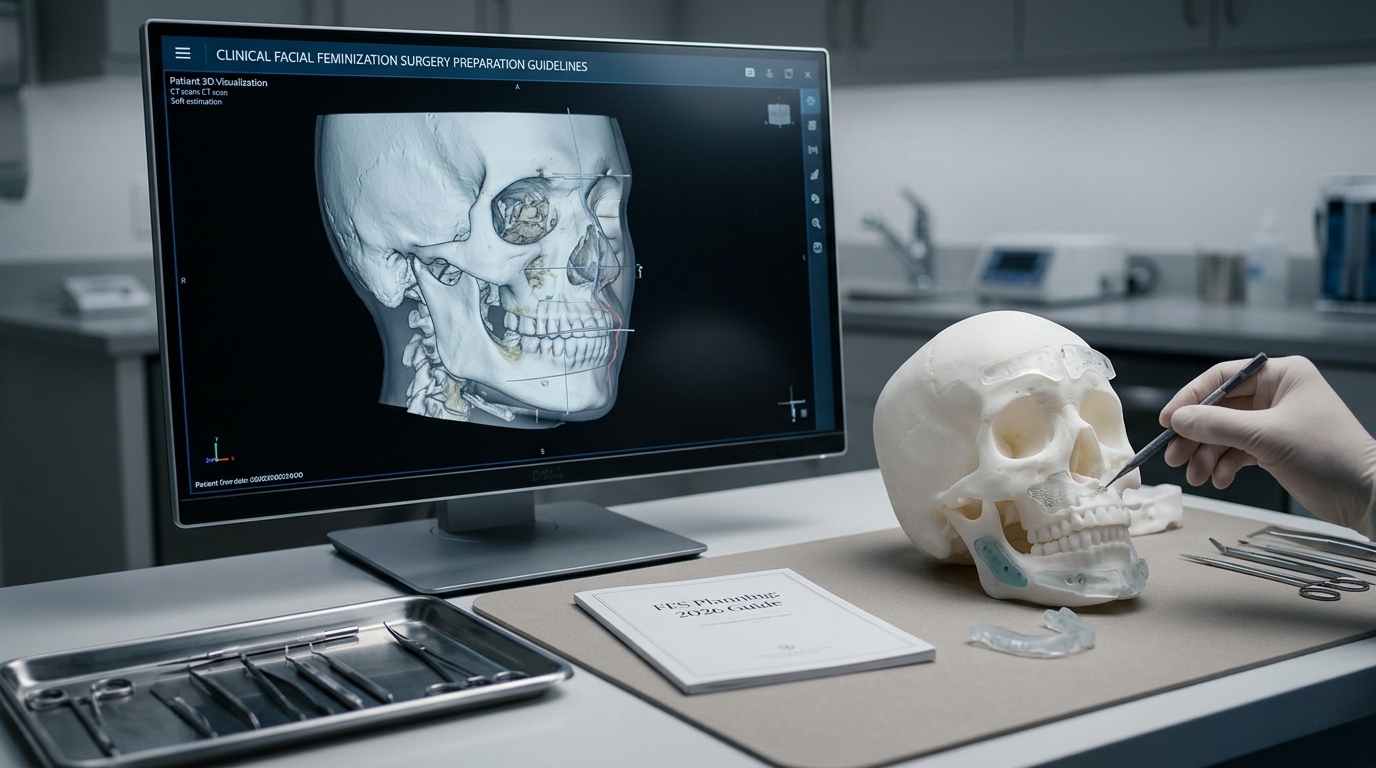

Wat als de kincontouringprocedure die je vandaag kiest, bepaalt of je kaaklijn er over zeven jaar natuurlijk uitziet of zichtbaar veranderd? Een confronterende realiteit waar elke transvrouw die dit overweegt mee geconfronteerd wordt. kincorrectie metin Gezicht Feminisatiechirurgie: de kloof tussen aanvankelijke tevredenheid en het resultaat op lange termijn is veel groter dan de meeste klinieken toegeven. Een systematische review uit 2023 in de Tijdschrift voor Craniofaciale Chirurgie meldde dat alloplastisch kin implantaatDeze implantaten hebben een langdurig complicatiepercentage dat kan oplopen tot 26,51 TP4T, waarbij botresorptie, migratie en veranderingen in het weke weefsel jaren na plaatsing kunnen optreden. (Tijdschrift voor craniofaciale chirurgie, 2023). Schuiven genioplastiek, Daarentegen vereist de ene methode een hogere chirurgische ingreep vooraf, maar ruilt deze in voor een blijvende oplossing voor het skelet. De effecten van de kinversteviging op het weefsel van de twee methoden verschillen echter aanzienlijk in de loop der tijd.
Dit artikel biedt een grondige, op bewijs gebaseerde vergelijking van verschillende glijsystemen. genioplastiek versus kin implantaat voor Kincorrectie Bij transvrouwen. Je ontdekt precies hoe elke optie er in de loop van zeven jaar uitziet, hoe het zachte weefsel van de kin anders reageert, waarom botresorptie de resultaten van implantaten stilletjes ondermijnt en welke initiële kinanatomie de doorslag geeft bij de keuze voor de ene methode boven de andere. Geen vage generalisaties, maar meetbare resultaten die je kunt gebruiken om de belangrijkste structurele beslissing van je gezichtstransitie te nemen.
Inhoudsopgave
Waarom de kincorrectie die u vandaag kiest, uw gezicht over zeven jaar bepaalt.
De kin is het structurele ankerpunt van het onderste deel van het gezicht. Bij transgender vrouwen wordt een prominente of verticaal verlengde kin vaak gezien als een mannelijk kenmerk dat niet alleen met hormoontherapie verholpen kan worden. Kincorrectie blijft daarom een van de meest impactvolle procedures binnen Gezichtsfeminisering Chirurgie. Maar hier schuilt het probleem waar de meeste patiënten nooit van horen: de twee meest gebruikte technieken—glijdende genioplastiek aEen alloplastisch kinimplantaat leidt niet simpelweg via verschillende wegen naar dezelfde bestemming. Het creëert fundamenteel verschillende langetermijngevolgen voor het omliggende zachte weefsel.
Bij een glijdende genioplastiek wordt uw eigen bot verplaatst, waardoor de levende bloedtoevoer behouden blijft en een biologische verbinding ontstaat die in de loop der tijd sterker wordt. kin implantaat, bevindt zich echter tussen het bot en de kinkussen van zacht weefsel, Dit genereert chronische mechanische druk die de onderliggende kaak langzaam uitholt. Na zeven jaar leveren deze uiteenlopende mechanismen resultaten op die er totaal anders uitzien en aanvoelen: het ene integreert, het andere dringt binnen. Het is essentieel om dit onderscheid te begrijpen voordat u een beslissing neemt die uw identiteit verandert.
Glijdende genioplastiek: Bot dat geneest, zacht weefsel dat het onthoudt.
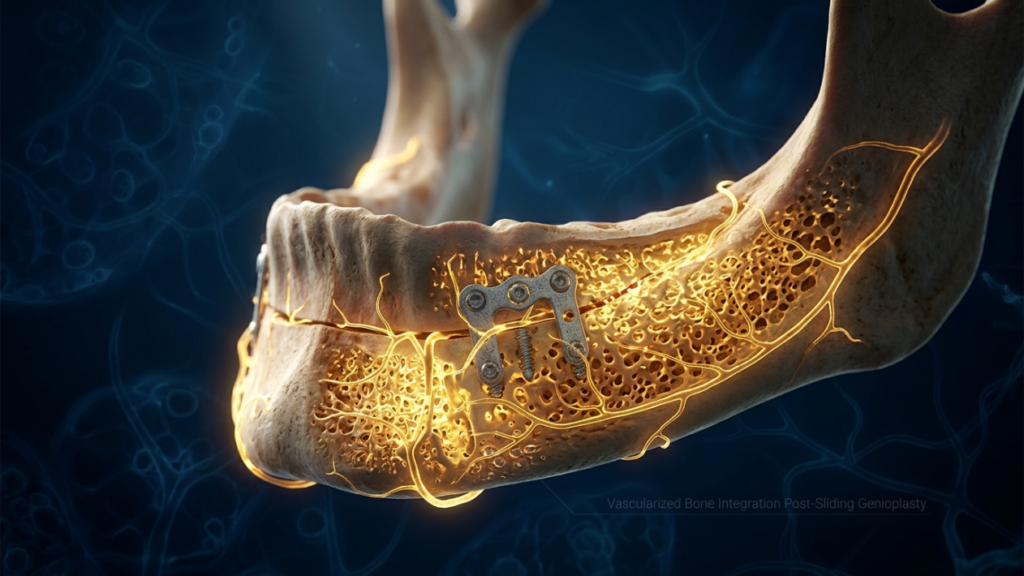
Glijdende genioplastiek Het is een procedure gebaseerd op een osteotomie. chirurg Hierbij wordt een horizontale botsnede gemaakt onder het foramen mentale, het kinsegment wordt naar voren, naar achteren, naar boven of naar beneden verplaatst en vastgezet met titanium miniplaatjes of resorbeerbare schroeven. Omdat het botsegment zijn aanhechting aan het linguale zachte weefsel behoudt – met name de genioglossus- en geniohyoïde spieren – blijft het bot doorbloed en levend.
Deze biologische continuïteit is enorm belangrijk voor transvrouwen. Wanneer het kinsegment wordt verplaatst tijdens mentoplastiek, Het bovenliggende zachte weefsel van de kin vormt zich opnieuw over een levend skelet. Gedurende de eerste 12 maanden trekken de kinspieren (musculus mentalis) en het onderhuidse vetkussen samen en passen zich aan de nieuwe contouren aan. Na drie jaar heeft het zachte weefsel de nieuwe positie als het ware "onthouden". Na zeven jaar is de botverbinding compleet en stabiel, en gedraagt het zachte weefsel zich alsof het er altijd al is geweest.
Een cruciaal voordeel voor genioplastie transgender Een belangrijk voordeel voor patiënten is de afwezigheid van een vreemd lichaam. Er bevindt zich geen siliconen of poreus polyethyleen onder het kinkussen dat het weefsel samendrukt. De kinmusculus mentalis hecht zich op natuurlijke wijze weer vast zonder tussenliggende barrière. Dit betekent dat de kin zijn dynamische expressiviteit behoudt: glimlachen, spreken en emotionele expressie zien er allemaal natuurlijk uit, omdat het zachte weefsel meebeweegt met het skelet in plaats van over een stijve implantaatschaal te glijden.
Bovendien maakt een glijdende genioplastiek een gelijktijdige verticale reductie mogelijk, wat vaak nodig is bij transvrouwen met een verlengde ondergezichtshoogte. Een implantaat kan alleen projectie toevoegen; het kan de kin niet verkorten. Deze anatomische veelzijdigheid maakt genioplastiek de meest complete structurele oplossing, met name wanneer de oorspronkelijke kinanatomie zowel een overmatige verticale hoogte als een overmatige sagittale projectie vertoont.
Kinimplantaat: Directe projectie, onzichtbare erosie
A kin implantaat Het implantaat zorgt voor een onmiddellijke voorwaartse projectie met een kortere operatietijd en een ogenschijnlijk eenvoudiger herstel. Het implantaat, gemaakt van siliconen, poreus polyethyleen (Medpor) of ePTFE, wordt geplaatst via een submentale of intraorale incisie en direct tegen de kaakverbinding gepositioneerd. Voor transvrouwen die een snelle augmentatie zoeken zonder de zwelling en het herstel dat gepaard gaat met een osteotomie, lijkt dit een aantrekkelijke optie. aantrekkelijk.
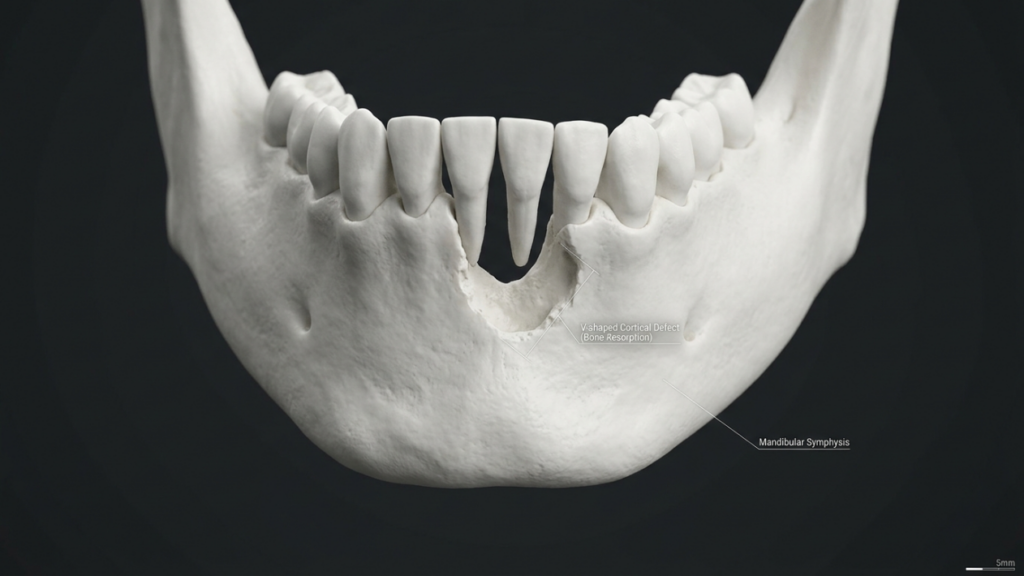
Toch is de stille complicatie van botresorptie-implantaat De plaatsing ondermijnt geleidelijk de fundering waarop het implantaat rust. Een systematische review in het Journal of Craniofacial Surgery documenteerde dat botresorptie onder alloplastische kinimplantaten bij een aanzienlijk percentage patiënten voorkomt, met een ernst variërend van oppervlakkige corticale inkepingen tot diepe medullaire penetratie die de kaakstructuur verzwakt. (Tijdschrift voor craniofaciale chirurgie, 2023). Dit is geen zeldzaam verschijnsel, maar een voorspelbaar biomechanisch gevolg. Constante druk van een stijf implantaat op levend bot zet osteoclastische activiteit in gang, waardoor het bot langzaam afbreekt.
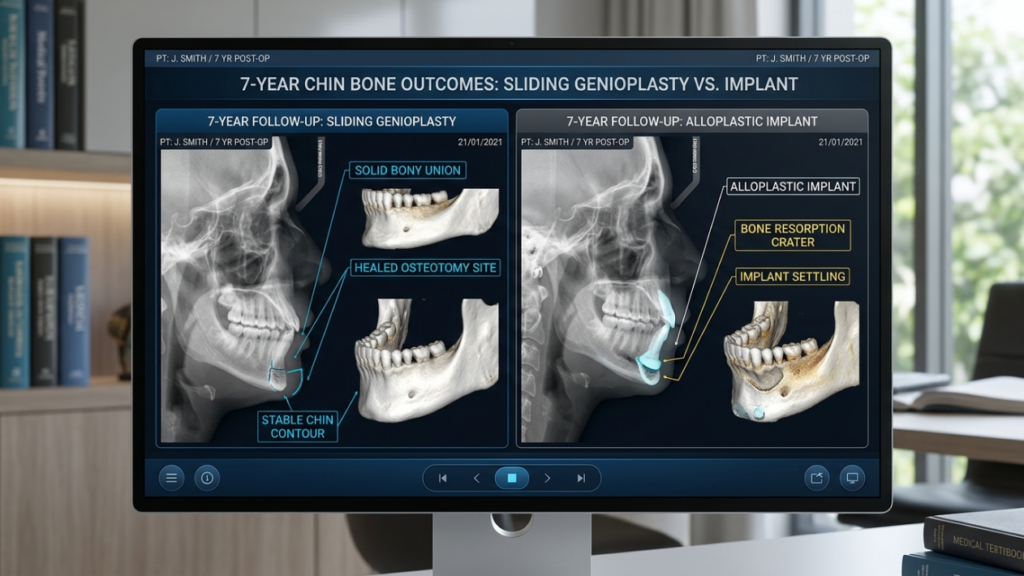
In het eerste jaar ziet de patiënt het verwachte volume. In het derde jaar treedt een subtiele verzakking op naarmate de botresorptie begint. In het vijfde jaar kan het implantaat enigszins "ingezakt" lijken doordat het onderliggende bot is geërodeerd. In het zevende jaar is de oorspronkelijke augmentatie gedeeltelijk verdwenen, bevindt het implantaat zich in een botkuil en is de kinkussen van zacht weefsel is dunner geworden door chronische compressie. De voelbaarheid neemt toe naarmate het kussen dunner wordt en de randen van het implantaat door de huid heen zichtbaar worden, vooral tijdens bewegingen.
De gevolgen reiken verder dan alleen esthetiek. Botresorptie maakt een revisieoperatie lastig. Het verwijderen van het implantaat onthult een gebrekkige symfyse die nu reconstructie vereist – ofwel met een groter implantaat, ofwel met een genioplastiek met bottransplantatie. Wat begon als een eenvoudige ingreep is uitgegroeid tot een complexere reconstructieve uitdaging. kincontouren voor transgender personen Bij patiënten die gamen met het oog op stabiliteit op de lange termijn, vereist dit traject serieuze preoperatieve overwegingen.
Kinbescherming van zacht weefsel: de doorslaggevende factor waar niemand het over heeft.
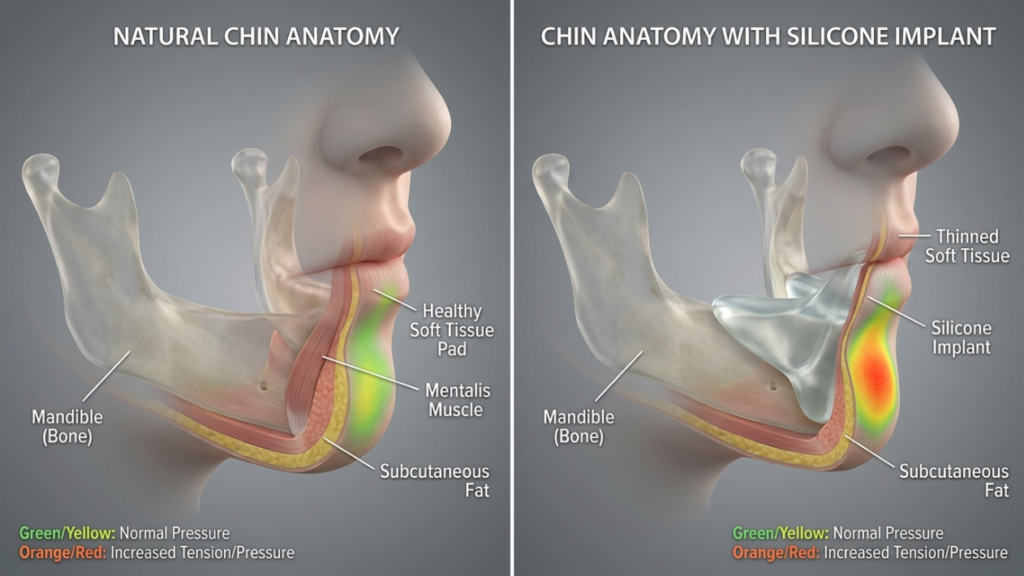
De kinkussen van zacht weefsel—bestaande uit de musculus mentalis, onderhuids vet en de bovenliggende huid—bepaalt of het uiteindelijke resultaat er natuurlijk of chirurgisch uitziet. Deze laag is bij de meeste patiënten gemiddeld 10 tot 15 millimeter dik, maar transvrouwen hebben vaak een dunnere laag zacht weefsel nadat langdurige hormoontherapie het volume van het onderhuidse vet heeft verminderd. Dun weefsel verandert alles aan de keuze van de procedure.
Bij een glijdende genioplastiek wordt het kinweefsel niet langer chronisch samengedrukt. Het naar voren geplaatste botsegment vormt een steiger waaraan het kinweefsel zich hecht en omheen remodelleert. De bloedtoevoer blijft intact. De musculus mentalis hecht zich opnieuw aan het verplaatste bot zonder tussenkomst van een vreemd lichaam. Gedurende zeven jaar behoudt het kinweefsel zijn dikte en dynamische functie. Contourafwijkingen komen zelden voor, omdat het weefsel zich aanpast aan een levend oppervlak dat zich op dezelfde manier remodelleert.
Met een kin implantaat, De situatie keert zich volledig om. Het implantaat drukt het kussentje van onderaf tegen het bot en van bovenaf tegen de huid. De bloedtoevoer in het gebied direct boven het implantaat is chronisch verminderd. In de loop der jaren wordt de vetlaag dunner, atrofeert de kinspier in het gebied naast het implantaat en hecht de huid zich meer aan het implantaatkapsel. Dit veroorzaakt de kenmerkende "zichtbaarheid van het implantaat" die vanaf vijf jaar steeds duidelijker wordt. Voelbaarheid en zichtbare implantaatranden tijdens gezichtsuitdrukkingen zijn geen complicaties in een laat stadium, maar verwachte gevolgen van de biomechanische realiteit.
Patiënten die overwegen kin implantaat Mensen die voor een ingreep kiezen, moeten begrijpen dat dun weefsel deze effecten versterkt. Bij een transvrouw met 8 millimeter weefsel zullen de randen van implantaten veel eerder zichtbaar zijn dan bij een vrouw met 14 millimeter. Hier begint het beslissingsalgoritme: de dikte van je weefsel bepaalt mede welke techniek op de lange termijn het beste bij je past.

Vergelijkende gegevens over zeven jaar: glijdende genioplastiek versus kinimplantaat
Longitudinale gegevens over moderne craniofaciale ingrepen blijven helaas schaars, maar retrospectieve onderzoeken en studies van experts maken zinvolle vergelijkingen mogelijk. De onderstaande tabel vat gepubliceerde resultaten samen van centra die gespecialiseerd zijn in orthognatische en esthetische genioplastiek, gecombineerd met studies naar alloplastische augmentatie over vergelijkbare perioden.
| Resultaatparameter (7 jaar) | Glijdende genioplastiek | Kinimplantaat |
|---|---|---|
| Structurele stabiliteit | Permanent; botverbinding stevig na 12 maanden. | Afnemend; progressieve resorptiekrater |
| behoud van de dikte van het zachte weefsel van de kin. | 90–95% van de oorspronkelijke dikte behouden | 30–50%-verdunning in de zone boven het implantaat |
| Botresorptiesnelheid | Minimaal (minder dan 1 mm op de osteotomieplaats) | 1–5 mm onder het implantaat; progressief |
| Voelbaarheid in rust | Nul (natuurlijk bot) | vanaf het derde jaar |
| Tastbaarheid tijdens animatie | Geen; natuurlijke spier-botcontinuïteit | Zichtbare implantaatranden bij patiënten met dun weefsel |
| Verticale kinverstelling | Volledige functionaliteit (verkorten of verlengen) | Geen verticale reductiemogelijkheid |
| Revisiepercentage | 3–8% (voornamelijk voor asymmetrie) | 15–26% (resorptie, verplaatsing, extrusie) |
| Infectierisico | Laag (osteotomie geneest met bloedtoevoer) | Aanvankelijk laag; risico op biofilmvorming op latere leeftijd 2–5% |
| Sensorische zenuwstoornis | Tijdelijk in 20–30%; permanent in minder dan 5% | Aanvankelijk zeldzaam; neemt toe indien herziening nodig is. |
| Verouderingstraject | Stabiel; ouder wordt met behoud van het oorspronkelijke skelet. | Verslechtering; de interface tussen implantaat en bot degradeert. |
De gegevens onthullen een ongemakkelijke waarheid. kinvervrouwing op lange termijn De resultaten van beide benaderingen zijn fundamenteel asymmetrisch. Het implantaat begint sterk, maar tast zijn eigen fundament aan. Genioplastiek begint met meer zwelling en herstel, maar leidt tot een resultaat dat in de loop der tijd verbetert. Als u deze procedures alleen beoordeelt op basis van de eerste zes maanden, mist u het volledige plaatje. De beslissing wordt pas duidelijk wanneer u vooruitkijkt naar het zevende jaar en verder.

Botresorptie onder implantaten: de stille architect van revisie.
Botresorptie-implantaat Plaatsing is geen willekeurige complicatie, maar volgt een voorspelbaar biomechanisch traject. Wanneer een stijf, alloplastisch object tegen het corticale bot drukt, schrijft de wet van Wolff voor dat het bot zich remodelleert als reactie op veranderde spanningspatronen. Gebieden met geconcentreerde druk ervaren osteoclastische dominantie en het bot trekt zich terug. Siliconenimplantaten, waarvan de gladde onderkant geconcentreerde drukpunten creëert, veroorzaken vaak V-vormige corticale defecten die zichtbaar zijn op cefalometrische röntgenfoto's.
Poreuze polyethyleenimplantaten zijn ontworpen om dit te verminderen door middel van weefselingroei, wat theoretisch de druk verdeelt. In de praktijk is de ingroei echter gedeeltelijk en ongelijkmatig, en ontstaan er nog steeds drukzones langs de randen van het implantaat waar het contact het stevigst is. De systematische review door de Tijdschrift voor Craniofaciale Chirurgie Er werd geen materiaal gevonden dat volledig immuun was voor resorptie; de variabele factor is de ernst en het tijdstip, niet de aanwezigheid of afwezigheid. (Tijdschrift voor craniofaciale chirurgie, 2023).
Voor transvrouwen heeft dit een versterkend effect. Velen zoeken een kincorrectie omdat hun natuurlijke kaakbeenverbinding zowel in de sagittale als verticale richting prominent is – een klassieke mannelijke kinmorfologie. Wanneer een implantaat op een prominente kaakbeenverbinding wordt geplaatst en drukresorptie veroorzaakt, kan het resulterende botdefect het onderste deel van het gezicht zodanig veranderen dat de contouren juist mannelijker worden. Het implantaat zakt weg in zijn eigen holte, het kinweefsel wordt dunner en het zichtbare resultaat wijkt af van het vrouwelijke ideaal dat het beoogde te bereiken.
Het herzien van dit scenario is technisch ve veeleisend. chirurg Het implantaat moet worden verwijderd, de diepte van de krater moet worden beoordeeld en er moet worden besloten of het implantaat moet worden vervangen door een kleiner implantaat, er moet een structureel bottransplantaat worden geplaatst of er moet een conversie naar een ander implantaat plaatsvinden. glijdende genioplastiek. Elke optie brengt zijn eigen risico's en onzekerheden met zich mee. Preventie door de juiste initiële methodekeuze blijft veel betrouwbaarder dan een poging tot reparatie jaren later.

Tastbaarheid en levendigheid: wat spiegels en camera's niet kunnen verbergen
Voelbaarheid behoort tot de meest hinderlijke langetermijnklachten na een alloplastische ingreep. mentoplastiek. Een kinimplantaat dat na zes maanden nog onzichtbaar aanvoelt, kan na vier jaar duidelijk voelbaar worden doordat het zachte weefsel rond de kin afneemt. Patiënten melden dat ze de randen van het implantaat voelen wanneer ze hun kin aanraken, dat ze oneffenheden bij de randen van het implantaat opmerken en dat het implantaat subtiel verschuift tijdens het praten en lachen.
De perceptie van de camera voegt nog een extra dimensie toe. Video en fotografie in hoge resolutie leggen oneffenheden in het oppervlak vast die met het blote oog niet zichtbaar zijn. Een dun kinstukje over een siliconenimplantaat creëert een subtiele, maar waarneembare schaduwlijn aan de rand van het implantaat. Deze lijn wordt met de leeftijd en door weefselatrofie duidelijker zichtbaar. Voor transvrouwen die zich een weg banen in hun sociale en professionele zichtbaarheid, kan dit langzaam opkomende teken hun zelfvertrouwen ondermijnen in de ingreep die juist bedoeld is om hun zichtbaarheid te vergroten.
Bij een glijdende genioplastiek ontstaan dergelijke artefacten niet. Het verplaatste bot is uw eigen weefsel. Het beweegt mee met uw spieren. Er zijn geen randen die het licht weerkaatsen, geen randen die schaduwlijnen creëren en geen vreemde structuur die onder de dunner gemaakte huid verschuift. genioplastiek operatie Het resultaat is, in de praktijk, niet te onderscheiden van een natuurlijke kin die toevallig de gewenste vorm heeft.

Hoe elke optie zich ontwikkelt: de zevenjarige divergentie
Veroudering beïnvloedt elke gezichtsstructuur, maar de interactie met eigen botweefsel verschilt van die met alloplastische implantaten. Natuurlijke gezichtsveroudering gedurende de zeven jaar na kinvervrouwing op lange termijn De procedure omvat een geleidelijk verlies van onderhuids vetweefsel, een afname van de huidelasticiteit en voortdurende botremodellering. Deze processen stellen de duurzaamheid van elk resultaat van een kincontouringbehandeling op de proef.
Na een glijdende genioplastiek verloopt het verouderingsproces normaal. Het verplaatste bot integreert in de onderkaak en neemt deel aan fysiologische veranderingen. Het bovenliggende zachte weefsel veroudert mee met het skelet, waardoor een consistente verhouding behouden blijft. Volumeverlies treft het gehele onderste deel van het gezicht gelijkmatig en het resultaat van de genioplastiek blijft proportioneel. In wezen veroudert uw gefeminiseerde kin alsof het uw natuurlijke kin is – omdat dat structureel gezien ook zo is.
Na het plaatsen van een kinimplantaat verergeren verouderingsverschijnselen bestaande problemen. Vetverlies boven het implantaat maakt het verder zichtbaar. Huidverslapping zorgt ervoor dat de jeugdige spanning die de randen van het implantaat ooit verborg, verdwijnt. Botresorptie onder het implantaat versnelt naarmate het ondersteunende weefsel afneemt. Het implantaat komt in een steeds diepere holte te liggen, terwijl de bovenliggende laag dunner wordt. Na zeven jaar leidt het gecombineerde effect tot een resultaat dat er aanzienlijk anders uitziet dan in het eerste jaar – meestal slechter, niet beter.
Transvrouwen van in de dertig en veertig ervaren deze divergentie het meest acuut. Het verouderingsproces kruist met de afbraak van implantaten, waardoor er rond het vijfde tot zevende jaar een samenloop van negatieve factoren ontstaat. Patiënten die voor implantaten kozen vanwege de snelheid en eenvoud ervan, zien zich geconfronteerd met een revisieoperatie precies op de leeftijd waarop ze verwachtten van het resultaat te kunnen genieten. Dit is de kinvervrouwing op lange termijn Een realiteit die zelden in marketingmateriaal naar voren komt.

Beslissingsalgoritme: Uw anatomie koppelen aan de juiste procedure
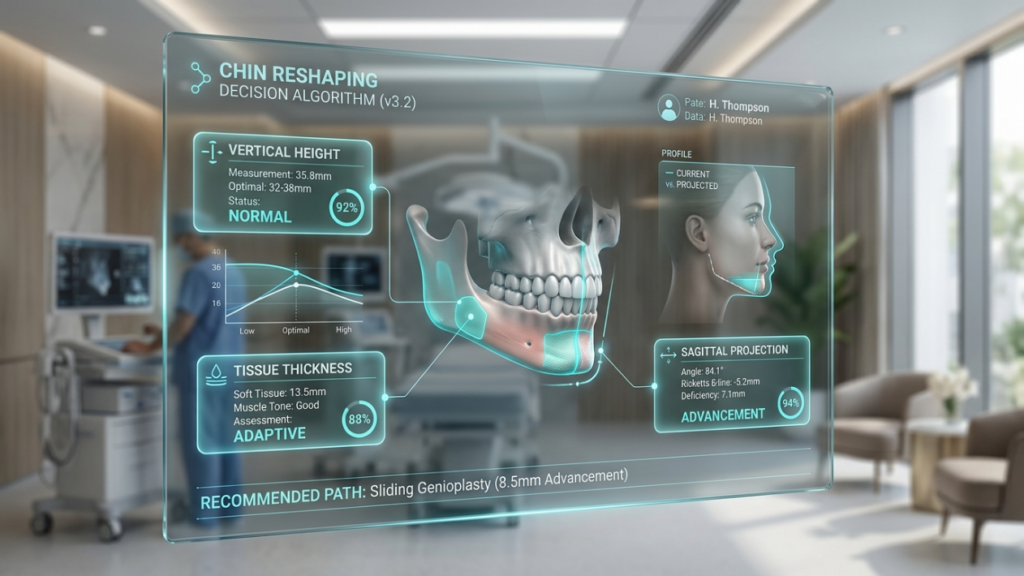
Noch een glijdende genioplastiek, noch een kinimplantaat is universeel superieur; de juiste keuze hangt af van uw oorspronkelijke anatomie. Het volgende algoritme helpt bij de beslissing op basis van drie belangrijke anatomische variabelen: verticale kinhoogte, dikte van het kinweefsel en het verschil in sagittale projectie.
Anatomische variabele 1: Verticale kinhoogte
Transvrouwen met een verticale kinovermaat – waarbij de hoogte van het onderste deel van het gezicht de esthetische norm overschrijdt – hebben bijna altijd baat bij glijdende genioplastiek. Een implantaat kan de verticale dimensie niet verkleinen; het kan alleen de sagittale projectie vergroten. Het camoufleren van een verticaal lange kin met een implantaat resulteert in een onnatuurlijk geprojecteerde, maar nog steeds langgerekte uitstraling. Met een glijdende genioplastiek kan de verticale dimensie worden verkort door het kinsegment naar boven te verplaatsen en de onderrand te contouren, waardoor zowel de overmatige hoogte als de projectie tegelijkertijd worden aangepakt.
Anatomische variabele twee: Dikte van het kinweefsel
Patiënten met minder dan 10 millimeter kinkussen van zacht weefsel Patiënten met een tepelhofdikte lopen een verhoogd risico op voelbaarheid en zichtbaarheid van implantaten. Dun weefsel kan de randen van implantaten niet camoufleren en door compressie veroorzaakte atrofie versnelt de zichtbaarheid jaar na jaar. Bij deze patiënten heeft een glijdende genioplastiek sterk de voorkeur, omdat het eigen bot het probleem van de zichtbaarheid van het vreemde lichaam volledig elimineert. Patiënten met een tepelhofdikte van 12 millimeter of meer kunnen implantaten overwegen, maar zij moeten de resorptiesnelheid nog steeds afwegen tegen hun verwachte levensduur.
Anatomische variabele drie: Sagittale projectiebehoeften
Wanneer de primaire misvorming een milde retrogenie is (minder dan 5 mm tekort) zonder verticaal overschot, en het zachte weefsel voldoende is, kan een kinimplantaat een acceptabele augmentatie bieden. Echter, voor transvrouwen bij wie de mannelijke kin zowel overtollig bot als een teruggetrokken kin omvat, die een voorwaartse verplaatsing van meer dan 5 mm vereisen, glijdende genioplastiek Biedt meer controle en stabiliteit. Zeer grote implantaten brengen proportioneel hogere risico's op botresorptie en -verplaatsing met zich mee, omdat het contactoppervlak met het bot onder druk groter wordt.
Kincontouring bij transgender personen: specifieke aandachtspunten die verder gaan dan de resultaten bij cisgender personen.
De meeste gepubliceerde gegevens over genioplastiek en kinvergroting zijn afkomstig van cisgender patiënten die een esthetische verbetering zoeken. Transvrouwen hebben fundamenteel andere anatomische uitgangspunten, en het toepassen van gegevens over de uitkomsten bij cisgender personen zonder aanpassing leidt tot onjuiste beslissingen.
De typische kin van een transvrouw kenmerkt zich door een grotere verticale hoogte, een bredere dwarsrichting, dikker botweefsel en een meer uitgesproken kinuitsteeksel. Deze kenmerken vereisen een ingrijpendere botcorrectie dan bij cisgender patiënten doorgaans nodig is. Een bescheiden implantaat dat een acceptabel resultaat oplevert bij een cisgender vrouw met een lichte retrogenie, zal onvoldoende presteren bij een transvrouw wiens kin een aanzienlijke dimensionale verandering in meerdere richtingen vereist.
Kincontouren voor transgender personen Daarom neigt de behandeling in de meeste craniofaciale centra met ervaring in FFS sterk naar benaderingen gebaseerd op osteotomie. De mogelijkheid tot herpositionering in meerdere vlakken van glijdende genioplastiek—het aanpassen van hoogte, breedte en projectie in één enkele ingreep— sluit aan bij de anatomische realiteit die de meeste transvrouwen vertonen. Implantaten zijn geschikt voor een kleine groep: vrouwen met geïsoleerde, milde retrogenie, voldoende bedekking met zacht weefsel en geen verticale overmaat.
Als Europees en Turks gecertificeerd specialist in plastische chirurgie met uitgebreide ervaring in FFS, heb ik geconstateerd dat patiënten die een FFS-behandeling ondergingen gezichtsfeminisering procedures die glijdende genioplastiek combineren met kaakverkleining En voorhoofd contouren bereiken coherentere en harmonieuzere resultaten dan degenen die oplossingen op basis van implantaten hebben samengesteld. Het skelet integreert als een uniforme structuur in plaats van een verzameling van toegevoegde volumes.
Mentoplastie-revisies: Wanneer de eerste keuze verkeerd was
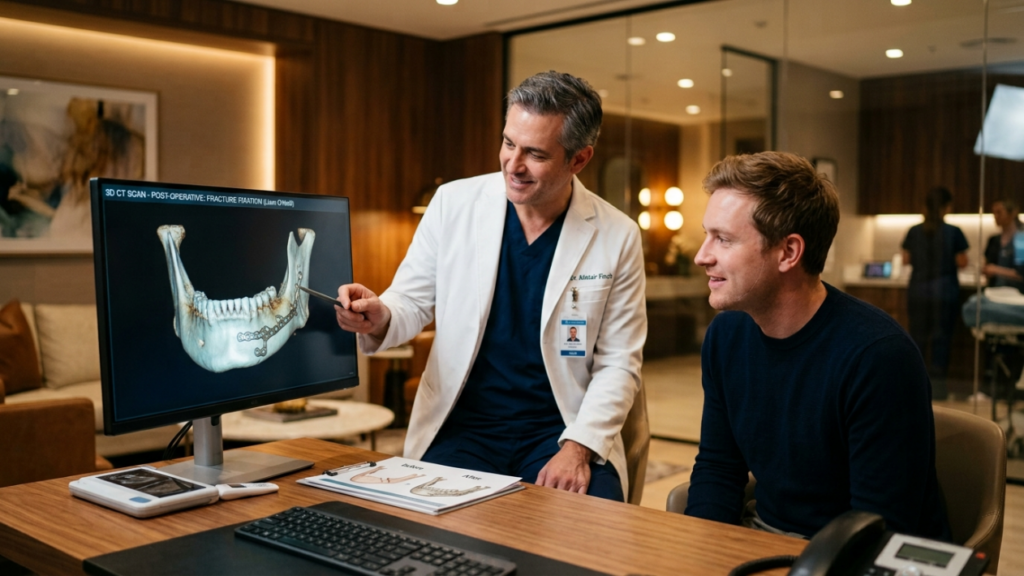
Herziening mentoplastiek Revisies komen veel vaker voor na implantaatbehandelingen dan na een glijdende genioplastiek. Implantaatgerelateerde revisies vormen het grootste deel van de secundaire kinoperaties in gepubliceerde studies. De redenen zijn voorspelbaar: progressieve botresorptie die instabiliteit veroorzaakt, verplaatsing van het implantaat door kapselcontractuur of trauma, infectie met biofilmvorming, extrusie door dunner weefsel en onacceptabele palpabiliteit.
Het omzetten van een mislukt implantaat naar een glijdende genioplastiek is mogelijk, maar complexer dan een primaire genioplastiek. Het geresorbeerde bot kan onvoldoende zijn voor standaard osteotomiefixatie, waardoor bottransplantatie nodig is om de krater te herstellen. Het zachte weefsel van de kin, dat voorheen samengedrukt was, kan te dun zijn om op natuurlijke wijze over de nieuwe botcontour te vallen. Littekenweefsel van het implantaatkapsel vervormt de chirurgische vlakken, waardoor het risico op neuropraxie van de nervus mentalis toeneemt.
Omgekeerd omvat een revisie van een glijdende genioplastiek doorgaans slechts kleine aanpassingen – het bijstellen van de positie met enkele millimeters of het corrigeren van een oneffenheid. Het bot blijft levend en geneest betrouwbaar. Het zachte weefsel blijft gezond en past zich aan de nieuwe positie aan. Een revisie van een genioplastiek gaat gepaard met minder complicaties en een hogere voorspelbaarheid dan een conversie van implantaat naar genioplastiek, wat het belang van de juiste initiële procedure onderstreept.
Resultaten van genioplastiek bij transgenderpersonen: wat het bewijs aantoont
Gepubliceerd bewijsmateriaal over genioplastie transgender De resultaten zijn nog beperkt, maar er is wel sprake van groei. Retrospectieve studies van FFS-centra rapporteren een hoge tevredenheid na sliding genioplastiek, waarbij de contouren van het zachte weefsel langer dan vijf jaar stabiel blijven. Het neurosensorisch herstel volgt hetzelfde patroon als bij patiënten die een orthognatische operatie ondergaan: aanvankelijke hypoesthesie treft 20 tot 30 procent van de patiënten, met herstel tot het oorspronkelijke niveau bij meer dan 95 procent binnen 18 maanden.
Een opmerkelijke bevinding in FFS-specifieke genioplastieseries is de superieure herpositionering van het zachte weefsel wanneer genioplastie wordt gecombineerd met aangrenzende procedures zoals... kaakverkleining. De gecombineerde skeletale benadering creëert een uniforme contour van het onderste deel van het gezicht, waardoor het mogelijk wordt om... kinkussen van zacht weefsel Het doel is om de contouren aan te passen aan een continu gewijzigde kaaklijn in plaats van aan een geïsoleerde kinprojectie. Dit levert een resultaat op dat er natuurlijk vrouwelijk uitziet, in plaats van chirurgisch vergroot – precies het resultaat dat transvrouwen nastreven.
Specifieke gegevens over implantaten bij transgenderpersonen zijn nog schaarser, omdat de meeste studies afkomstig zijn van populaties die esthetische chirurgie ondergaan en waarbij kleinere borstvergrotingen nodig zijn. Extrapolatie van gegevens van cisgenderpersonen leidt tot een onderschatting van het complicatiepercentage bij transvrouwen, omdat de anatomische eisen – en daarmee de implantaatgroottes en de krachten die erop inwerken – groter zijn. Tijdschrift voor Craniofaciale Chirurgie Het in het onderzoek gerapporteerde percentage van 26,51 TP3T-complicaties op lange termijn onderschat waarschijnlijk het werkelijke percentage bij transgenderpatiënten die grotere implantaten krijgen. (Tijdschrift voor craniofaciale chirurgie, 2023).
Stapsgewijze beslissingsgids voor uw kincorrectie
Gebruik de volgende concrete stappen om te bepalen welke kin reconstructieve chirurgie De optie sluit aan bij uw anatomie en langetermijndoelen.
- Meeteenheid De hoogte van uw ondergezicht wordt bepaald aan de hand van een gestandaardiseerde gezichtsfoto. Als het onderste derde deel meer dan een derde van de totale gezichtshoogte beslaat, is een glijdende genioplastiek voor verticale reductie geïndiceerd; implantaten bieden hiervoor geen oplossing.
- Schatten De dikte van het kinweefsel wordt bepaald met behulp van een laterale cefalogram of echografie. Bij een dikte van minder dan 10 millimeter is een genioplastiek sterk aan te raden om zichtbaar implantaat te voorkomen. Bij een dikte van meer dan 12 millimeter kan een implantaat overwogen worden.
- Berekenen Het sagittale tekort of overschot. Bij een retrogenie van minder dan 5 mm met voldoende weefselbedekking kan een implantaat worden overwogen. Een tekort van meer dan 5 mm of een gecombineerd tekort met een verticaal overschot vereist een genioplastiek.
- Beoordeling Uw tijdlijn van zeven jaar. Als u jonger bent dan 40 en nog tientallen jaren van natuurlijke veroudering verwacht, beschermt het stabiele verouderingsproces van een genioplastie uw investering. De afbraak van implantaten versnelt met de tijd.
- Vraag 3D-chirurgische planning. Beide procedures profiteren van virtuele simulatie, maar de resultaten van genioplastiek verbeteren aanzienlijk wanneer de positie van de osteotomie en de plaatfixatie preoperatief worden gepland.
- Verifiëren De specifieke ervaring van uw chirurg met FFS. Kincorrectie in Bij transvrouwen zijn andere veranderingen in omvang en dimensie nodig dan bij cisgender personen. Vraag naar portfolio's met resultaten van gezichtsverjongingsoperaties en naar het percentage heroperaties.
- Verbinden Kies voor de procedure die het beste bij uw anatomie past, niet voor de procedure met het kortste herstel. De prijs die u zeven jaar lang betaalt voor gemak in plaats van structurele integriteit, is een revisieoperatie, zichtbare implantaatranden en een kin die verder van uw vrouwelijke ideaal afwijkt in plaats van er dichterbij te komen.
Je kin is de architectonische hoeksteen van je ondergezicht. De constructiemethode die je kiest, bepaalt of die hoeksteen tientallen jaren stevig blijft of geleidelijk afbrokkelt onder een object waarvoor hij nooit ontworpen was. Dien vandaag nog uw consultatieaanvraag in. en laat Dokter MFO Uw kinanatomie wordt driedimensionaal nauwkeurig geanalyseerd om de procedure aan te bevelen die zorgt voor een blijvende, natuurlijke vervrouwing.
Veelgestelde vragen
Hoe verloopt de botresorptie onder een kinimplantaat gedurende zeven jaar?
Botresorptie begint als inkepingen in de cortex binnen de eerste twee jaar en breidt zich uit naar diepere medullaire botafbraak tegen het vijfde jaar. Tegen het zevende jaar vormt zich een meetbare krater onder het implantaat, waardoor het verzakt en het oorspronkelijke augmentatie-effect afneemt.
Waarom wordt een glijdende genioplastiek de voorkeur gegeven voor verticale kinverkleining bij transvrouwen?
Met een glijdende genioplastiek kan de chirurg het kinsegment naar boven verplaatsen, waardoor de verticale hoogte van het onderste deel van het gezicht direct wordt verkort. Kinimplantaten kunnen alleen de voorwaartse projectie vergroten en de verticale dimensie niet verminderen, waardoor ze ongeschikt zijn voor dit veelvoorkomende mannelijke kinkenmerk.
Wat gebeurt er met het zachte weefsel van de kin na het plaatsen van een kinimplantaat?
Het zachte weefsel van de kin wordt geleidelijk dunner onder chronische compressie door het implantaat. Vetweefsel atrofeert, de kinmusculus mentalis verzwakt gedeeltelijk en de huid hecht zich strakker aan het implantaatkapsel. Hierdoor wordt het implantaat in de loop van vijf tot zeven jaar steeds voelbaarder en zichtbaarder.
Wanneer is een kinimplantaat geschikt voor het contouren van de kin bij transgender personen?
Een kinimplantaat kan geschikt zijn voor transvrouwen met een geïsoleerde, lichte retrogenie van minder dan 5 mm, een voldoende dikte van het weke weefsel van meer dan 12 mm, geen verticale kinovermaat en die een mogelijke revisie binnen tien jaar accepteren. Deze kandidaten vormen een kleine subgroep van de typische FFS-patiënten.
Hoe zorgt een glijdende genioplastiek ervoor dat de natuurlijke gezichtsuitdrukkingen behouden blijven?
Omdat bij een glijdende genioplastiek uw eigen levende bot met intacte spieraanhechtingen wordt verplaatst, hechten de kinspieren en de omliggende spieren zich op natuurlijke wijze weer vast. Er is geen vreemd voorwerp dat de verbinding tussen bot, spier en huid verstoort, waardoor glimlachen, spreken en emotionele uitingen er volkomen natuurlijk uitzien.
Kan een mislukt kinimplantaat worden omgezet in een glijdende genioplastiek?
Een ombouw is mogelijk, maar wel een uitdaging. Geresorbeerd bot kan een transplantatie vereisen, dunner wordend zacht weefsel sluit mogelijk niet optimaal aan en littekenweefsel vergroot het risico op zenuwletsel. Een primaire genioplastiek vermijdt deze complicaties, waardoor een juiste initiële selectie cruciaal is voor succes op lange termijn.
Welke preoperatieve beeldvorming is essentieel voor het nemen van beslissingen over een kincorrectie?
Een laterale cefalogram, panoramische röntgenfoto en 3D CT-scan zijn essentieel. Deze beelden kwantificeren de verticale kinhoogte, de dikte van het weke-delenkussen, het volume van het corticale bot en het sagittale tekort, waardoor een nauwkeurige procedurekeuze en virtuele chirurgische planning mogelijk zijn.