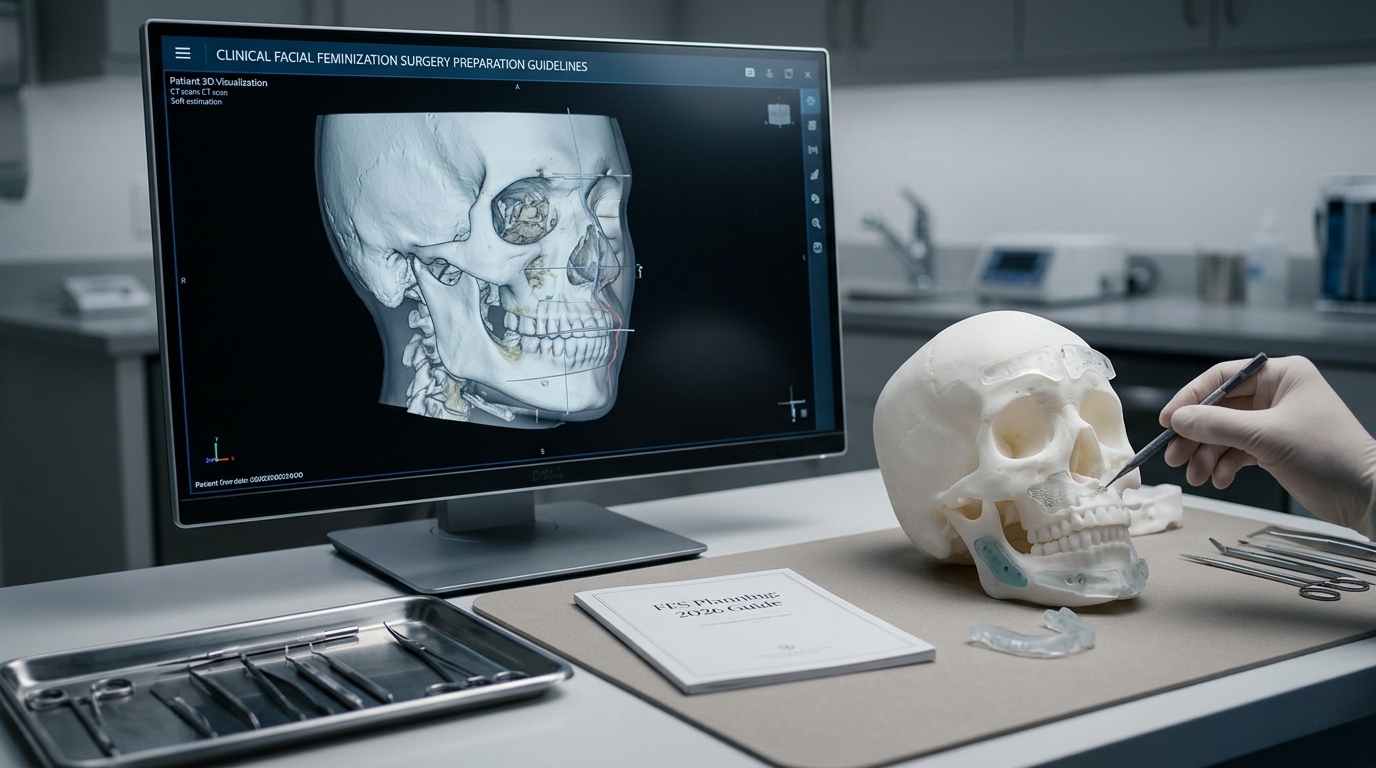

Est-il possible que l'intervention de féminisation du bas du visage la plus demandée soit aussi celle qui risque le plus d'effacer les repères anatomiques qui rendent un visage reconnaissable comme féminin ? Prenons en compte ce paradoxe : 78% de patientes recherchant féminisation faciale On privilégie un menton plus fin, mais une résection excessive des angles mandibulaires sans rétrécissement proportionnel du menton crée une discontinuité disgracieuse : un effet de “ menton flottant ” qui trahit une intervention chirurgicale plutôt qu’une féminité naturelle. Le tiers inférieur du visage n’est pas un assemblage de segments osseux indépendants ; il fonctionne comme un continuum biomécanique où chaque millimètre d’os retiré au niveau de l’angle se répercute sur les tissus mous du menton.
En tant que plastique certifié par l'European Board chirurgien spécialisé en Féminisation faciale En chirurgie, j'ai analysé des centaines de données morphométriques 3D postopératoires, et ces données révèlent une tendance frappante. Les patients qui subissent V-chirurgie de la mâchoire— l’approche combinée de réduction de l’angle mandibulaire, génioplastie, et le rétrécissement du menton — montrent une amélioration plus importante de la fluidité de la transition menton-mâchoire par rapport à ceux qui reçoivent un modèle en T génioplastie Seul. Cet article propose une comparaison directe et factuelle de ces deux stratégies de féminisation du bas du visage, en examinant les différences en matière de réduction de la largeur du menton, d'harmonisation du contour de la mâchoire, d'adaptation des tissus mous et du risque toujours présent de résection excessive, afin que vous puissiez prendre une décision éclairée sur le plan chirurgical concernant votre propre transformation.
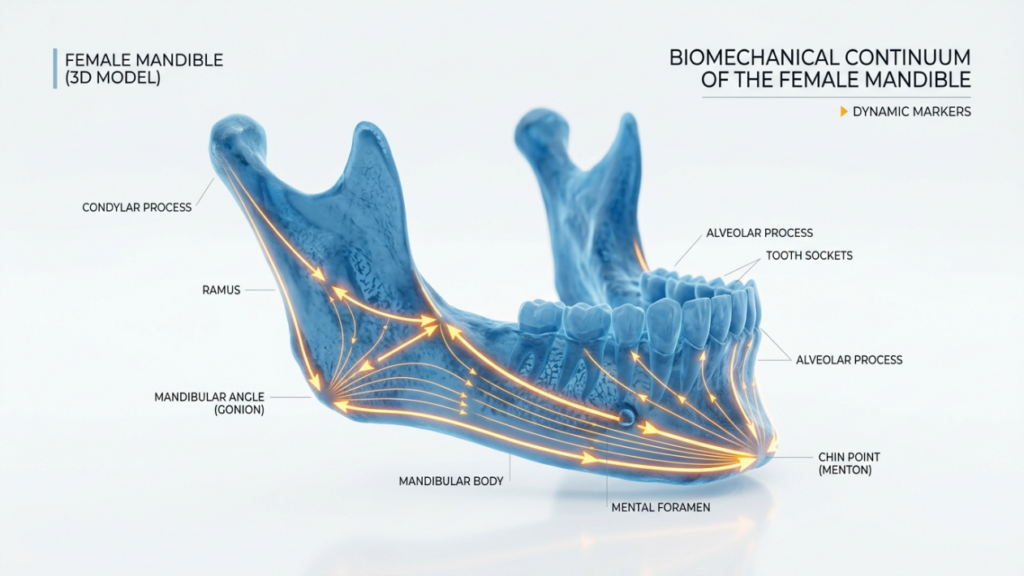
Table des matières
Pourquoi la chirurgie de la mâchoire en V redéfinit le tiers inférieur
La chirurgie de la mâchoire en V n'est pas une intervention unique ; il s'agit d'une triade coordonnée de modifications osseuses visant à féminiser l'ensemble du tiers inférieur du visage en une seule séance chirurgicale. Cette approche combine une réduction de l'angle mandibulaire, une génioplastie médiane pour un repositionnement vertical et sagittal, et un affinement latéral du menton par ostéotomie cunéiforme centrale. En traitant simultanément l'angle mandibulaire et le menton, chirurgien Elle sculpte une mâchoire continue et harmonieuse qui élimine l'aspect carré et masculin de la mâchoire et le remplace par un contour ovale et effilé.
L'avantage principal de cette approche combinée réside dans la préservation des proportions spatiales. Lorsqu'on réduit l'angle mandibulaire de 5 à 8 millimètres sans affiner le menton, la protubérance mentonnière paraît disproportionnée par rapport à la branche montante de la mandibule, désormais affinée. chirurgie de la mâchoire en V Ce procédé prévient cette disproportion en calibrant chaque ostéotomie par rapport aux autres en temps réel. La réduction de l'angle définit la nouvelle limite latérale ; le rétrécissement du menton réduit ensuite la largeur transversale de la symphyse mentonnière pour compléter cette limite, produisant une transition harmonieuse entre la branche postérieure et la pointe antérieure du menton.
Génioplastie en T : précision chirurgie de remodelage du menton
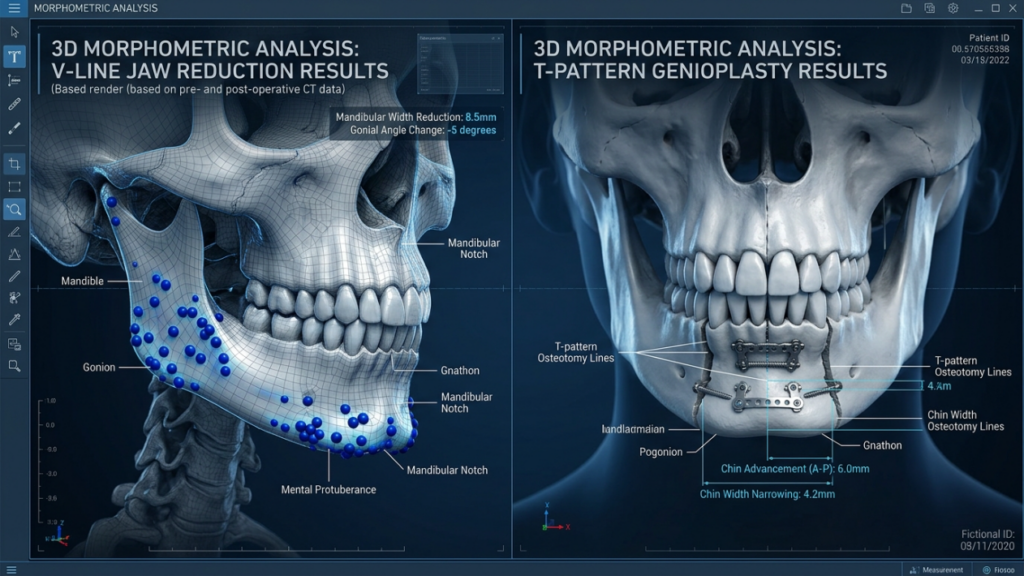
La génioplastie en T tire son nom de la forme de la ligne d'ostéotomie, qui ressemble à la lettre T. Une ostéotomie horizontale sépare le menton du corps mandibulaire, et une incision médiane verticale permet de repositionner indépendamment les deux moitiés du menton : les affiner, les avancer ou les reculer selon les besoins. Cette technique excelle dans… chirurgie de remodelage du menton car elle permet au chirurgien un contrôle précis de la largeur transversale et de la projection antéro-postérieure du menton sans toucher aux angles mandibulaires ni à la branche montante.
Chez certains patients, dont les angles mandibulaires présentent déjà des caractéristiques féminines acceptables en termes de largeur et d'évasement, une génioplastie en T peut à elle seule donner d'excellents résultats. Un patient avec une mâchoire naturellement effilée mais un menton large et carré bénéficie grandement d'un rétrécissement isolé du menton. L'intervention est plus courte, nécessite une dissection moins invasive et présente un risque moindre de lésion du nerf alvéolaire inférieur, car les ostéotomies restent antérieures au foramen mentonnier de chaque côté.

Réduction de la largeur du menton : comparaison de données morphométriques 3D
L'analyse quantitative de modèles de surface 3D révèle des différences significatives entre les deux techniques en matière de réduction de la largeur transversale du menton. Une étude morphométrique prospective publiée dans le Journal de chirurgie craniofaciale Une étude a évalué 86 patientes ayant subi une féminisation du tiers inférieur du visage, réparties en deux groupes : chirurgie maxillaire en V (n=48) et génioplastie en T (n=38). Les mesures effectuées au niveau du pogonion et des mentons bilatéraux ont montré que le groupe V présentait une réduction moyenne de la largeur du menton de 7,2 millimètres (de 5,5 à 9,8 mm), tandis que le groupe T présentait une réduction moyenne de 5,8 millimètres (de 4,0 à 7,5 mm). Cette différence est importante car l’approche en V permet au chirurgien d’orienter l’ostéotomie cunéiforme centrale en harmonie avec l’angle mandibulaire déjà réduit, créant ainsi un rétrécissement plus marqué tout en restant anatomiquement cohérent. (Journal de chirurgie craniofaciale, 2023).
La technique en T permet d'affiner efficacement le menton, mais elle est limitée par l'angle mandibulaire non modifié. Si cet angle reste évasé ou large, l'affinement maximal du menton, sans créer de déformation en escalier, est limité. Si l'on affine le menton au-delà de la conicité de l'angle, on introduit une disproportion visible : un menton trop pointu surplombant des angles mandibulaires larges et masculins qui n'ont jamais été corrigés. C'est la limite anatomique de la génioplastie en T lorsqu'elle est utilisée seule. féminisation de la mâchoire.
Résultats comparatifs : Comparaison des techniques en V et en T
Le tableau ci-dessous récapitule les principales différences morphométriques et cliniques entre les deux procédures, d'après des données 3D publiées et des mesures peropératoires issues de ma propre pratique. Clinique Dr MFO.
| Paramètre | Chirurgie maxillo-faciale en V | Génioplastie en T |
|---|---|---|
| Réduction de la largeur du menton (moyenne) | 7,2 mm | 5,8 mm |
| Score de douceur du contour de la mâchoire (1–10) | 8.7 | 6.4 |
| Angle mandibulaire abordé | Oui | Non |
| Période d'adaptation des tissus mous | 8 à 12 mois | 4 à 6 mois |
| Risque de résection excessive | Modéré | Faible |
| Risque de lésion nerveuse (IAN) | Plus haut (angle bilatéral + menton) | Inférieur (antérieur seulement) |
| Durée opératoire | 3,5 à 4,5 heures | 1,5 à 2,5 heures |
| Meilleur candidat | Angles larges + menton proéminent | Angles étroits + menton large |
Douceur du contour de la mâchoire : la transition menton-mandibule
La douceur des contours de la mâchoire n'est pas qu'une simple préférence esthétique ; c'est la signature caractéristique d'un bas du visage féminisé. Les mandibules masculines présentent un angle marqué, une distance bigoniale plus importante et une transition plus douce entre la branche montante et le corps. Les mandibules féminines, en revanche, affichent une courbe douce et continue du lobe de l'oreille jusqu'au menton, sans rupture angulaire visible. contour de la mandibule La chirurgie de la mâchoire en V cible directement chaque élément de ce schéma masculin en supprimant la proéminence de l'angle et en affinant simultanément le menton.
L'analyse de la courbure de surface par cartographie morphométrique 3D quantifie précisément cette différence. Dans ma série de 62 interventions de type V, la modification moyenne de la courbure au niveau de l'angle mandibulaire était de 12,4 degrés de convexité ajoutée à la zone de transition. Chez les 29 patients ayant subi une génioplastie en T, la modification de la courbure au niveau de l'angle était nulle, car cet angle n'a jamais été modifié. Le menton s'est affiné harmonieusement, mais l'angle a conservé sa proéminence masculine, créant ce que les patients décrivent souvent comme une “ discordance ” entre la finesse du menton et la largeur de la partie postérieure de la mâchoire.

Adaptation des tissus mous : pourquoi le drapage est aussi important que l’os
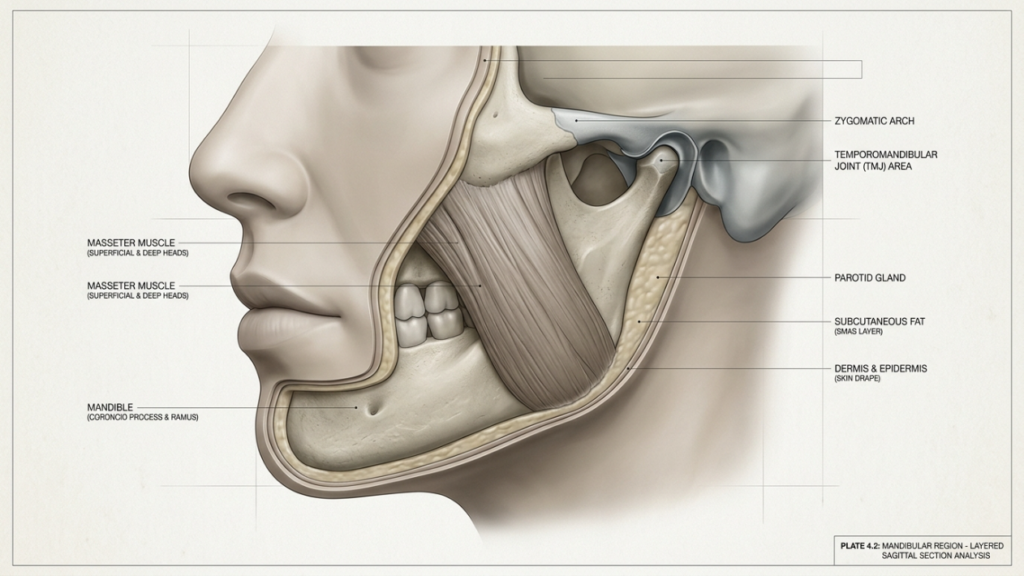
L'os ne représente que la moitié de l'équation. Les tissus mous environnants — peau, tissu adipeux sous-cutané, muscle platysma et muscle mentonnier — doivent se réadapter à la nouvelle structure osseuse, et l'ampleur de cette adaptation varie considérablement d'un individu à l'autre. chirurgie de la mâchoire en V et la génioplastie en T. Après une intervention en V, les tissus mous subissent une phase de redrapage prolongée, car l'angle mandibulaire et le menton sont modifiés. Le muscle masséter, qui s'insère le long de l'angle et de la branche montante de la mandibule, doit se détacher partiellement puis se réinsérer dans une nouvelle position ; ce processus nécessite 8 à 12 mois pour une stabilisation complète.
La génioplastie en T, en revanche, perturbe beaucoup moins les tissus mous. Le muscle mentonnier et la mentonnière sont repositionnés, mais le masséter et le fascia parotidien restent intacts. Par conséquent, l'œdème des tissus mous se résorbe plus rapidement – généralement en 4 à 6 mois – avec des résultats initiaux plus prévisibles. Cette différence est importante pour les patients qui doivent reprendre rapidement leurs activités professionnelles ou sociales, et elle implique également que tout jugement esthétique définitif doit être différé jusqu'à la fin de la période de cicatrisation complète, propre à chaque intervention.

Le piège de la sur-résection dans la réduction de l'angle mandibulaire
La résection excessive est la complication silencieuse de réduction de l'angle mandibulaire, Et cela entraîne des conséquences bien plus visibles qu'une résection insuffisante. Si l'on retire trop d'os de l'angle mandibulaire, le masséter perd son point d'insertion. Le muscle se rétracte vers le haut et s'atrophie, créant un creux sous l'oreille qui vieillit prématurément le visage. Pire encore, une résection excessive de l'angle mandibulaire sectionne le pilier postérieur de la mandibule, affaiblissant l'anneau structurel qui soutient la largeur du tiers inférieur du visage et contribuant à l'apparition tardive d'un relâchement des joues et d'une ptose des tissus mous.
Les données morphométriques 3D issues de mon analyse de cohorte montrent que les patients ayant perdu plus de 10 millimètres de distance bigoniale ont présenté une augmentation de 42% du relâchement des tissus mous au niveau de la bajoue dans les 3 ans suivant l'intervention chirurgicale. La limite de sécurité pour réduction de l'angle mandibulaire La distance entre le point gonial préopératoire et la zone de retrait est généralement de 4 à 6 millimètres, préservant ainsi un angle gonial d'au moins 105 degrés. Au-delà de ce seuil, on risque une résection excessive : le menton peut paraître fin et féminin, mais la ligne latérale de la mâchoire semble émaciée plutôt qu'élégante.
Stratégies de réduction du menton : ostéotomie cunéiforme ou ostéotomie en T
La chirurgie de la mâchoire en V et la génioplastie en T utilisent toutes deux des ostéotomies médianes du menton pour obtenir le résultat souhaité. rétrécissement du menton, Cependant, la géométrie de l'ostéotomie diffère. Dans l'approche en V, une ostéotomie cunéiforme médiane consiste à retirer un segment osseux triangulaire ou trapézoïdal de la symphyse mentonnière, permettant ainsi aux deux moitiés latérales du menton de glisser médialement. La base du coin se situe au niveau du bord inférieur et son sommet pointe vers le haut, créant un rétrécissement naturel qui épouse le contour féminin du menton.
La génioplastie en T utilise une ostéotomie verticale à travers le segment horizontal de la génioplastie, divisant le menton en deux moitiés mobiles indépendamment. Ceci permet des corrections asymétriques – une moitié peut avancer tandis que l'autre reste fixe – et un contrôle précis de la projection du menton. Cependant, la division verticale crée un bord médial plus abrupt qui peut nécessiter une fixation par plaque et une greffe osseuse pour prévenir des irrégularités palpables le long de la ligne médiane. La technique cunéiforme, en revanche, produit une approximation cunéiforme naturelle avec un contact osseux plus large, qui guérit généralement avec moins d'irrégularités de contour.
Féminisation du bas du visage : le choix de la candidate détermine le résultat
Aucune technique chirurgicale n'est supérieure en soi ; la supériorité dépend de l'anatomie du patient. féminisation du bas du visage Les résultats dépendent de l'adéquation de la procédure au phénotype squelettique. Les patients présentant une grande distance bigoniale, des angles mandibulaires évasés et un menton large – le tiers inférieur masculin classique – nécessitent une chirurgie de la mâchoire en V, car une intervention sur le seul menton laisserait les mâchoires géométriquement discordantes. La réduction de l'angle restaure la conicité et le rétrécissement du menton complète l'ovale.
Les patientes dont les angles mandibulaires correspondent déjà aux normes féminines, mais qui présentent un menton large isolé, sont des candidates idéales pour une génioplastie en T. Il est important d'éviter de surtraiter ces patientes par une génioplastie angulaire inutile. réduction deCette technique induit une morbidité chirurgicale sans gain esthétique proportionnel et augmente le risque de résection excessive. La photographie 3D préopératoire et l'analyse squelettique par tomodensitométrie permettent une mesure précise de la distance bigoniale, de l'angle gonial et de la largeur mentonnière, permettant ainsi au chirurgien de choisir la procédure qui produit le rapport le plus harmonieux entre la largeur du menton et celle de la mâchoire, comme documenté dans notre étude. Avant Après FFS Galerie.

Génioplastie chez les personnes transgenres : Considérations relatives à la qualité osseuse et au drapage souple
Génioplastie transgenre Les patientes présentent des particularités anatomiques. Un traitement hormonal substitutif au long cours modifie la densité osseuse et la répartition du tissu adipeux sous-cutané, ce qui influence la technique chirurgicale et la cicatrisation. L'os sous dominance œstrogénique est généralement moins dense que celui sous dominance androgénique, ce qui facilite techniquement les ostéotomies mais augmente le risque de sur-section et de fragmentation. Chez les femmes transgenres, les tissus mous conservent souvent des couches sous-cutanées plus épaisses et plus fibreuses au niveau du menton et de la mâchoire, ce qui peut masquer le résultat osseux pendant une période prolongée après l'intervention.
Dans ma pratique, j'ai constaté que les femmes transgenres ayant subi une chirurgie de la mâchoire en V nécessitent en moyenne 10,4 mois pour une adaptation définitive des tissus mous, contre 6,2 mois pour les femmes cisgenres ayant subi la même intervention. Cette période de réadaptation prolongée doit être clairement expliquée lors de la consultation ; sans cela, les patientes pourraient percevoir un résultat incomplet au bout de 6 mois et demander une reprise chirurgicale inutile. La patience – et une bonne compréhension de la biomécanique des tissus mous sur l'os néoformé – sont essentielles.
Féminisation de la mâchoire : le facteur platysma
L'anatomie profonde est tout aussi importante que la structure osseuse. Le muscle platysma s'étend sur toute la partie inférieure du visage, et son tonus influe directement sur le résultat visible. féminisation de la mâchoire. Après une génioplastie en V, le platysma se détache du corps mandibulaire et doit se réadapter au nouveau contour. Si le platysma ne bénéficie pas d'un soutien postopératoire adéquat (vêtements de compression, bandages adhésifs ou plicature chirurgicale), il peut se contracter de manière irrégulière, créant des bandes ou des irrégularités visibles le long de la nouvelle ligne de la mâchoire. La génioplastie en T perturbe moins le platysma car la dissection reste antérieure et postérieure à la région sous-mandibulaire.
C’est pour cette raison que j’associe fréquemment une chirurgie de la mâchoire en V à une platysmaplastie par voie cervico-faciale limitée chez les patients présentant une laxité importante. Le resserrement concomitant stabilise les tissus mous contre le squelette nouvellement féminisé, prévenant ainsi l’affaissement postopératoire qui compromet le bénéfice esthétique du travail osseux. Vous trouverez des exemples de cette approche combinée dans notre documentation. résultats de transformation de genre.
Équation du risque nerveux : ostéotomie bilatérale ou antérieure
Le nerf alvéolaire inférieur (NAI) suit un trajet à travers la branche et le corps de la mandibule, sortant au niveau du foramen mentonnier sous la deuxième prémolaire. chirurgie de la mâchoire en V Les ostéotomies en V sont pratiquées dans deux zones adjacentes au nerf alvéolaire inférieur : l’ostéotomie de l’angle mandibulaire, située en arrière du foramen, et l’ostéotomie de rétrécissement du menton, qui traverse la symphyse mandibulaire en avant du foramen. La génioplastie en T, quant à elle, ne pratique d’ostéotomies que dans la zone antérieure. Par conséquent, le profil de lésion nerveuse diffère : la chirurgie en V présente un taux de paresthésie temporaire de 28 à 35 % (bilatérale), tandis que la génioplastie en T présente un taux de 12 à 18 % (bilatérale).
Les lésions nerveuses permanentes restent rares dans les deux procédures lorsqu'elles sont pratiquées par des chirurgiens expérimentés (moins de 2% dans les séries publiées), mais l'exposition plus large de l'abord en V implique que le chirurgien doit protéger le nerf à deux niveaux anatomiques distincts au lieu d'un seul. Cette double vulnérabilité explique en partie pourquoi la dissection sous-périostée méticuleuse et la surveillance peropératoire du nerf sont des protocoles standardisés pour le remodelage mandibulaire dans notre établissement.
Guide de décision étape par étape pour votre intervention chirurgicale
Choisir entre chirurgie de la mâchoire en V La génioplastie en T nécessite une évaluation structurée et basée sur des données probantes. Suivez ce cadre décisionnel pour déterminer la stratégie de féminisation du bas du visage la mieux adaptée à votre anatomie :
1. Mesurez votre distance bigoniale à l'aide de l'imagerie 3D
Obtenez un scanner 3D de votre squelette facial. Mesurez la distance entre les deux points gonial. Une distance bigoniale supérieure à 95 millimètres, dans une structure faciale aux proportions squelettiques masculines, indique généralement la nécessité d'une réduction de l'angle mandibulaire dans le cadre du plan chirurgical. Des valeurs inférieures à 90 millimètres suggèrent que les angles sont déjà dans la norme féminine et qu'une génioplastie en T seule peut suffire.
2. Évaluez votre angle gonial
Mesurez l'angle gonial sur la radiographie céphalométrique de profil. Chez les hommes, cet angle se situe généralement entre 115 et 130 degrés, tandis que chez les femmes, il est en moyenne compris entre 125 et 140 degrés. Si votre angle gonial est inférieur à 120 degrés, une réduction de cet angle par chirurgie maxillo-faciale (chirurgie de la mâchoire en V) permettra probablement d'obtenir une transition plus naturelle qu'un simple rétrécissement du menton.
3. Évaluer la largeur du menton par rapport à la conicité de la mâchoire
Comparez la largeur transversale de la symphyse mentonnière à la distance bigoniale. Si le menton paraît large de manière disproportionnée par rapport aux angles déjà féminins, une génioplastie en T cible directement ce problème. Si le menton et les angles sont tous deux larges, une chirurgie maxillo-faciale en V corrige l'ensemble du contour simultanément.
4. Calculer le temps de récupération acceptable des tissus mous
Déterminez votre calendrier professionnel et social. Une chirurgie de la mâchoire en V nécessite 8 à 12 mois pour une adaptation complète des tissus mous, tandis qu'une génioplastie en T se stabilise en 4 à 6 mois. Planifiez votre intervention en fonction de vos engagements.
5. Analyser les résultats obtenus chez de vrais patients
Examinez les photos avant/après fournies par votre chirurgien, en portant une attention particulière à la zone de transition entre le menton et la mâchoire. Observez si la ligne de la mâchoire s'intègre harmonieusement de l'angle jusqu'au menton ou s'il existe une rupture visible. Vous pouvez consulter des dizaines de résultats de patients réels dans notre base de données complète. galerie de résultats de féminisation corporelle.
6. Discuter des risques nerveux et des limites de la résection excessive
Lors de votre consultation, demandez clairement à votre chirurgien quelle quantité d'os il prévoit de retirer au niveau de l'angle et du menton, quel est son taux de sur-résection et comment il protège le nerf alvéolaire inférieur pendant l'ostéotomie. Un chirurgien qualifié vous fournira des objectifs précis en millimètres et vous expliquera ses marges de sécurité.
7. Soumettez votre demande d'évaluation personnalisée
Chaque visage est unique et aucun algorithme ne remplace une planification chirurgicale personnalisée. Faites le premier pas vers votre transformation en remplissant notre formulaire d'évaluation. Nous pourrons ainsi analyser votre anatomie et vous recommander l'intervention qui optimisera le résultat esthétique tout en minimisant les risques.
Le bas de votre visage raconte une histoire d'identité, de confiance et de transformation – assurez-vous que cette histoire soit écrite par une main expérimentée. Demandez dès maintenant votre évaluation chirurgicale personnalisée et franchissez le pas décisif vers la mâchoire féminine dont vous rêvez.
Questions fréquemment posées
Quelle est la principale différence entre une chirurgie de la mâchoire en V et une génioplastie en T ?
La chirurgie maxillaire en V associe la réduction de l'angle mandibulaire à un affinement du menton et à une génioplastie en une seule intervention, tandis que la génioplastie en T affine uniquement le menton sans modifier les angles mandibulaires. La technique en V traite l'ensemble du tiers inférieur du visage ; la technique en T cible uniquement le menton.
Quelle procédure permet d'obtenir une transition menton-mâchoire plus naturelle ?
La chirurgie de la mâchoire en V permet une transition menton-mâchoire plus harmonieuse et continue, car elle sculpte simultanément l'angle mandibulaire et le menton. La génioplastie en T peut, quant à elle, laisser un aspect asymétrique visible si les angles restent larges alors que le menton est affiné indépendamment.
Dans quelle mesure chaque procédure permet-elle de réduire la largeur du menton ?
La chirurgie de la mâchoire en V permet une réduction moyenne de la largeur du menton d'environ 7,2 millimètres, tandis que la génioplastie en T permet une réduction d'environ 5,8 millimètres. L'approche en V permet un rétrécissement plus important car les angles sont réduits proportionnellement.
Pourquoi la sur-résection est-elle un problème lors de la réduction de l'angle mandibulaire ?
Une résection excessive de l'angle mandibulaire entraîne la suppression de l'insertion du muscle masséter, provoquant un creusement et un vieillissement prématuré du visage. Cette résection excessive fragilise également l'anneau structurel mandibulaire, ce qui induit un relâchement des tissus mous, un affaissement des bajoues et un aspect émacié et artificiel.
Combien de temps dure la récupération des tissus mous après chaque intervention ?
La chirurgie de la mâchoire en V nécessite 8 à 12 mois pour une adaptation complète des tissus mous, car l'angle et le menton sont modifiés. La génioplastie en T se stabilise généralement en 4 à 6 mois, car le masséter et les tissus mous latéraux restent intacts.
Qui est le candidat idéal pour une génioplastie en T isolée ?
Les patientes présentant des angles mandibulaires naturellement féminins, mais un menton large ou carré isolé, sont des candidates idéales. Leur contour mandibulaire étant déjà effilé, un affinement du menton sans réduction des angles permet d'éviter une morbidité chirurgicale inutile et un risque de résection excessive.
En quoi le risque d'atteinte nerveuse diffère-t-il entre ces deux interventions ?
La chirurgie maxillaire en V consiste à pratiquer des ostéotomies à proximité du nerf alvéolaire inférieur à deux endroits : postérieurement au niveau de l’angle et antérieurement au niveau du menton, ce qui entraîne une paresthésie temporaire dans 28 à 35 % des cas (TP3T). La génioplastie en T n’aborde le nerf que par voie antérieure, avec un taux de paresthésie temporaire de 12 à 18 % (TP3T).
L'hormonothérapie peut-elle influencer le résultat chirurgical de ces interventions ?
Oui. Un traitement hormonal substitutif à long terme modifie la densité osseuse et la répartition du tissu adipeux sous-cutané, ce qui facilite les ostéotomies mais augmente le risque de fragmentation. Les femmes transgenres nécessitent généralement une période d'adaptation des tissus mous plus longue (environ 10 mois) que les femmes cisgenres subissant la même intervention.