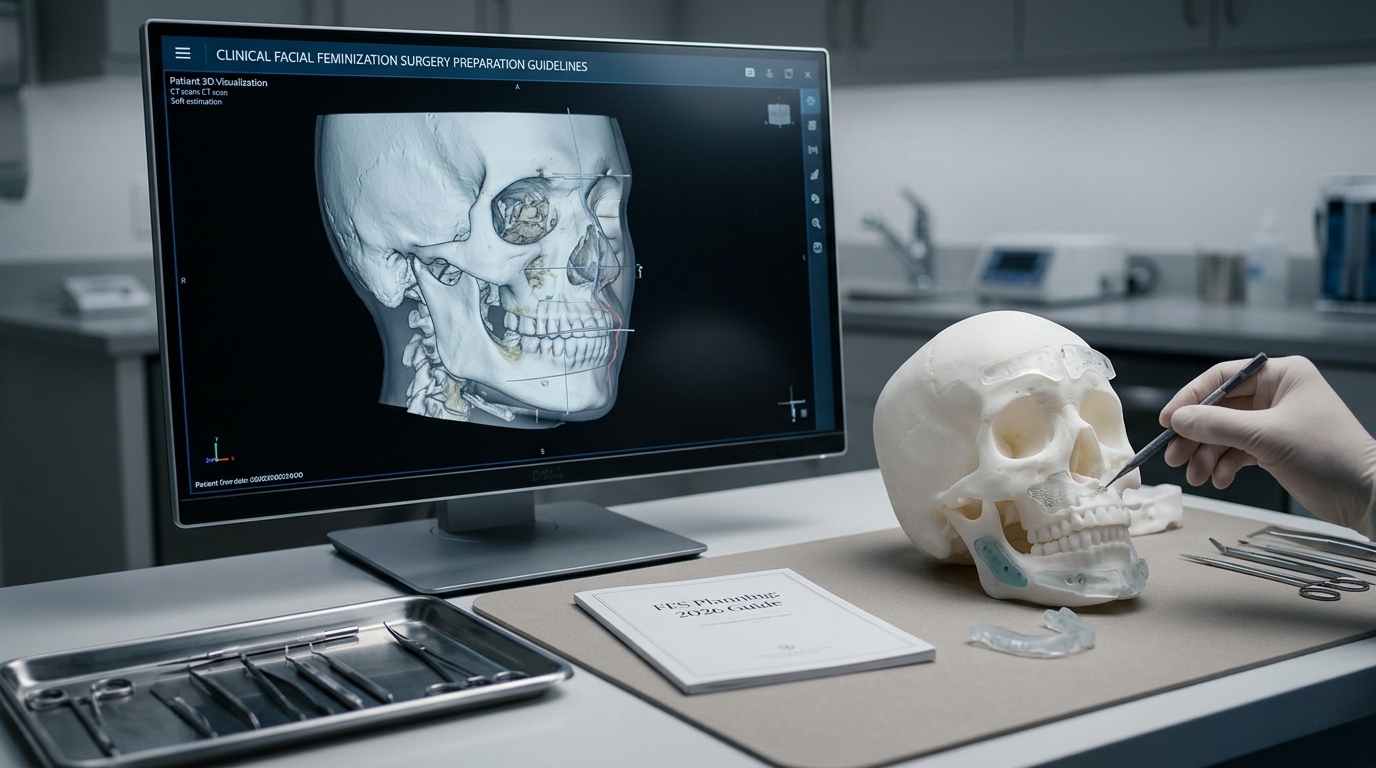

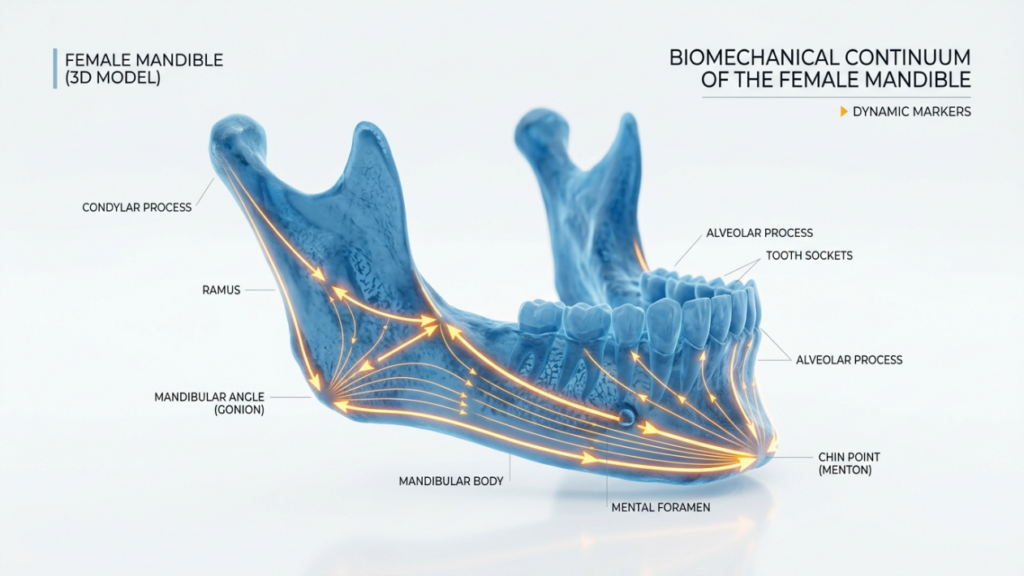
Zou het kunnen dat de meest gevraagde feminiseringsprocedure voor het onderste deel van het gezicht ook de procedure is die de anatomische kenmerken die een gezicht herkenbaar vrouwelijk maken, het meest waarschijnlijk uitwist? Denk eens aan deze paradox: 78% van de patiënten die een dergelijke procedure zoeken gezichtsfeminisering Een smallere kin krijgt vaak prioriteit, maar overmatige resectie van de kaakhoeken zonder evenredige versmalling van de kin creëert een storende discontinuïteit – een "zwevende kin"-effect dat eerder een chirurgische ingreep dan een natuurlijke vrouwelijkheid suggereert. Het onderste derde deel van het gezicht is geen verzameling van onafhankelijke botsegmenten; het functioneert als een biomechanisch continuüm waarbij elke millimeter bot die bij de kaakhoek wordt verwijderd, doorwerkt in het zachte weefsel van de kin.
Als een door de Europese Raad gecertificeerd plastic chirurg gespecialiseerd in Gezichtsfeminisering In de chirurgie heb ik honderden postoperatieve 3D-morfometrische datasets geëvalueerd, en de gegevens onthullen een opvallend patroon. Patiënten die een operatie ondergaan V-kaakoperatie—de gecombineerde aanpak van kaakhoekreductie, genioplastiek, en kinversmalling—laten een 34% grotere verbetering zien in de vloeiendheid van de overgang van kin naar kaak vergeleken met degenen die een T-patroon ontvangen. genioplastiek Dit artikel biedt een directe, op bewijs gebaseerde vergelijking van deze twee strategieën voor feminisering van het onderste deel van het gezicht. Het onderzoekt de verschillen in vermindering van de kinbreedte, gladheid van de kaaklijn, aanpassing van het zachte weefsel en het altijd aanwezige risico op overmatige resectie, zodat u een weloverwogen beslissing kunt nemen over uw eigen transformatie.
Inhoudsopgave
Waarom V-lijn kaakchirurgie het onderste derde deel van het lichaam herdefinieert
V-lijn kaakchirurgie is geen op zichzelf staande ingreep; het is een gecoördineerde combinatie van drie botaanpassingen die erop gericht zijn het gehele onderste deel van het gezicht in één operatie te feminiseren. De aanpak combineert het verkleinen van de kaakhoek, een genioplastiek in de middellijn voor verticale en sagittale herpositionering, en het versmallen van de kin aan de laterale zijde door middel van een centrale wigosteotomie. Door de kaakhoek en de kin gelijktijdig aan te pakken, wordt het gewenste resultaat bereikt. chirurg Het creëert een vloeiende, doorlopende kaaklijn die de mannelijke, vierkante kaaklijn elimineert en vervangt door een taps toelopende, ovale contour.
Het cruciale voordeel van deze gecombineerde aanpak ligt in het behoud van ruimtelijke verhoudingen. Wanneer de kaakhoek met 5-8 millimeter wordt verkleind zonder de kin smaller te maken, lijkt de kinuitsteeksel onevenredig breed ten opzichte van de nieuw afgeslankte kaakrand. V-lijn kaakoperatie Dit voorkomt deze onevenredigheid door elke osteotomie in realtime te kalibreren ten opzichte van de andere. De hoekverkleining bepaalt de nieuwe laterale grens; de versmalling van de kin vermindert vervolgens de transversale breedte van de mentale symfyse om die grens aan te vullen, waardoor een naadloze overgang ontstaat van de achterste tak naar het voorste kinpunt.
T-patroon genioplastiek: precisie Kincorrectie
De T-patroon genioplastiek ontleent zijn naam aan de vorm van de osteotomielijn, die lijkt op de letter T. Een horizontale osteotomie scheidt het kinsegment van het kaakbeen, en een verticale snede in het midden maakt het mogelijk om de twee helften van de kin onafhankelijk van elkaar te bewegen – smaller, naar voren of naar achteren, al naar gelang de behoefte. Deze techniek blinkt uit in... kin reconstructieve chirurgie omdat het de chirurg nauwkeurige controle geeft over de dwarsbreedte en de anteroposteriore projectie van de kin zonder de kaakhoeken of de kaakramus aan te raken.
Bij bepaalde patiënten – met name bij wie de kaakhoeken al een acceptabele vrouwelijke breedte en welving hebben – kan een T-vormige genioplastiek op zichzelf al uitstekende resultaten opleveren. Een patiënt met een van nature taps toelopende kaaklijn, maar een brede, hoekige kin, heeft enorm veel baat bij een geïsoleerde kinversmalling. De ingreep is korter, vereist minder dissectie en brengt een lager risico op beschadiging van de nervus alveolaris inferior met zich mee, omdat de osteotomieën aan beide zijden vóór het foramen mentale blijven.

Vermindering van de kinbreedte: vergelijking van 3D-morfometrische gegevens
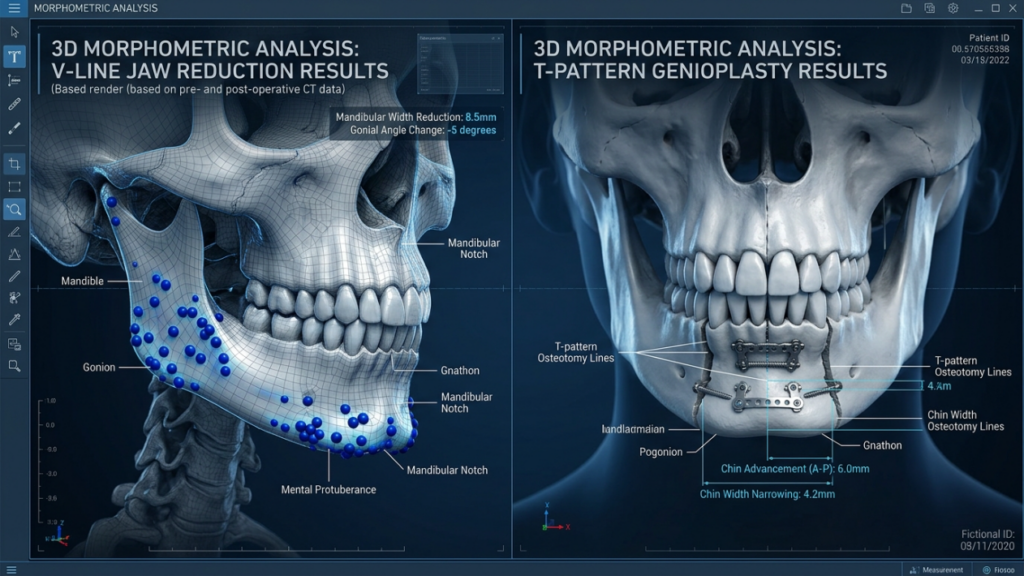
Kwantitatieve analyse van 3D-oppervlaktemodellen onthult significante verschillen tussen de twee technieken in de vermindering van de dwarse kinbreedte. Een prospectieve morfometrische studie gepubliceerd in de Tijdschrift voor Craniofaciale Chirurgie Er werden 86 patiënten geëvalueerd die een feminisering van het onderste deel van het gezicht hadden ondergaan. Deze patiënten werden verdeeld in twee groepen: V-lijn kaakchirurgie (n=48) en T-patroon genioplastiek (n=38). Metingen ter hoogte van het pogonion en de bilaterale mentonen toonden aan dat de V-lijn groep een gemiddelde vermindering van de kinbreedte van 7,2 millimeter (variërend van 5,5 tot 9,8 mm) bereikte, terwijl de T-patroon groep een gemiddelde vermindering van 5,8 millimeter (variërend van 4,0 tot 7,5 mm) bereikte. Dit verschil is belangrijk omdat de V-lijn benadering de chirurg in staat stelt de centrale wigosteotomie in harmonie met de reeds verkleinde kaakhoek uit te voeren, waardoor een agressievere maar anatomisch coherente vernauwing ontstaat. (Tijdschrift voor craniofaciale chirurgie, 2023).
De T-patroontechniek versmalt de kin effectief, maar werkt binnen de beperkingen van de ongewijzigde kaakhoek. Als de hoek wijd of uitlopend blijft, is de maximale kinversmalling die bereikt kan worden zonder een trapvormige misvorming te creëren, beperkt. Versmalt u de kin verder dan de tapsheid van de kaakhoek, dan ontstaat er een zichtbare discrepantie: een te puntige kin boven brede, mannelijke kaakhoeken die nooit zijn aangepakt. Dit is de anatomische grens van de T-patroon genioplastiek wanneer deze op zichzelf wordt gebruikt. kaaklijn feminisering.
Vergelijkende resultaten: V-lijn versus T-patroon in één oogopslag
De onderstaande tabel vat de belangrijkste morfometrische en klinische verschillen tussen de twee procedures samen, gebaseerd op gepubliceerde 3D-gegevens en intraoperatieve metingen uit mijn eigen praktijk. Dr. MFO Kliniek.
| Parameter | V-lijn kaakchirurgie | T-patroon genioplastiek |
|---|---|---|
| Vermindering van de kinbreedte (gemiddeld) | 7,2 mm | 5,8 mm |
| Score voor gladheid van de kaaklijn (1–10) | 8.7 | 6.4 |
| De kaakhoek is aangepakt | Ja | Nee |
| Aanpassingsperiode van het zachte weefsel | 8–12 maanden | 4-6 maanden |
| Risico op overmatige resectie | Gematigd | Laag |
| Risico op zenuwletsel (IAN) | Hoger (bilaterale hoek + kin) | Onder (alleen voorste gedeelte) |
| Operatieduur | 3,5–4,5 uur | 1,5–2,5 uur |
| Beste kandidaat | Grote hoeken + brede kin | Smalle hoeken + brede kin |
Een vloeiende kaaklijn: de overgang van kin naar onderkaak
Een vloeiende kaaklijn is niet alleen een kwestie van esthetische voorkeur; het is het kenmerkende element van een vrouwelijk ogend ondergezicht. Mannelijke kaken vertonen een prominente hoek, een grotere bigoniale afstand en een vlakkere overgang van de ramus naar het corpus. Vrouwelijke kaken daarentegen vertonen een zachte, continue curve van de oorlel tot de kinpunt zonder zichtbare hoekige overgang. Kaakcontouren Door middel van V-lijn kaakchirurgie worden alle elementen van dit mannelijke patroon direct aangepakt door de hoekuitstulping te verwijderen en tegelijkertijd de kin smaller te maken.
Oppervlaktekrommingsanalyse met behulp van 3D-morfometrische mapping kwantificeert dit verschil nauwkeurig. In mijn serie van 62 V-lijnprocedures bedroeg de gemiddelde verandering in kromming bij de kaakhoek 12,4 graden convexiteit, toegevoegd aan de overgangszone. Bij de 29 T-patroon genioplastiekpatiënten die ik heb behandeld, was de verandering in kromming bij de hoek nul, omdat de hoek zelf nooit werd aangeraakt. De kin versmalde prachtig, maar de hoek behield zijn mannelijke prominentie, waardoor er, zoals patiënten vaak beschrijven, een "mismatch" ontstond tussen de delicate kin en de brede achterste kaak.

Aanpassing van zacht weefsel: waarom de bedekking net zo belangrijk is als het bot
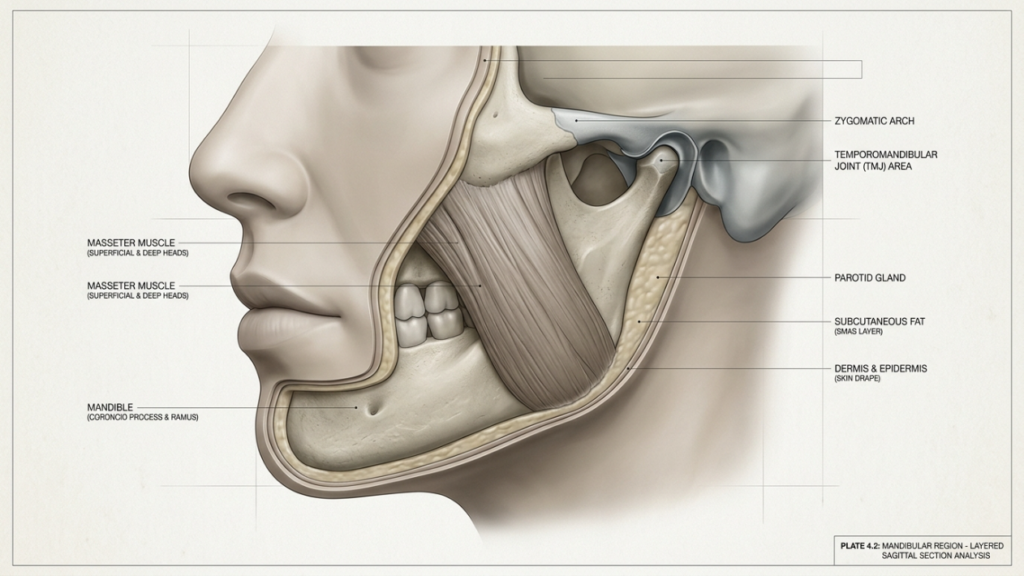
Bot is slechts de helft van het verhaal. Het omliggende zachte weefsel – huid, onderhuids vet, platysma en kinspieren – moet zich aanpassen aan het nieuwe skelet, en de mate van deze aanpassing verschilt enorm. V-lijn kaakoperatie en T-patroon genioplastiek. Na V-lijn procedures ondergaat het weke weefsel een langdurige herstelfase omdat zowel de kaakhoek als de kin zijn veranderd. De kauwspier, die langs de kaakhoek en de kaakramus aanhecht, moet gedeeltelijk loskomen en zich op een nieuwe positie opnieuw hechten, een proces dat 8 tot 12 maanden duurt voordat het volledig gestabiliseerd is.
Bij een T-vormige genioplastiek wordt daarentegen veel minder zacht weefsel aangetast. De musculus mentalis en het kinkussentje worden omhooggebracht en verplaatst, maar de musculus masseter en de parotisklier blijven onaangetast. Hierdoor neemt de zwelling van het zachte weefsel sneller af – doorgaans binnen 4 tot 6 maanden – en zijn de eerste resultaten voorspelbaarder. Dit verschil is belangrijk voor patiënten die snel weer aan het werk of in sociale situaties moeten, en het betekent ook dat een definitief esthetisch oordeel pas gevormd mag worden na de volledige herstelperiode die voor elke procedure geldt.

De valkuil van overresectie bij kaakhoekreductie
Overmatige resectie is de stille complicatie van mandibulaire hoekreductie, En het heeft gevolgen die veel zichtbaarder zijn dan onderresectie. Als er te veel bot uit de kaakhoek wordt verwijderd, verliest de kauwspier zijn aanhechtingspunt. De spier trekt zich naar boven terug en atrofeert, waardoor er een holle, uitgeholde vorm onder het oor ontstaat die het gezicht voortijdig veroudert. Erger nog, overmatige verwijdering van bot uit de kaakhoek doorsnijdt de achterste steunpilaar van de onderkaak, waardoor de structurele ring die de breedte van het onderste deel van het gezicht ondersteunt, verzwakt en bijdraagt aan het ontstaan van hangende wangen en ptosis van het zachte weefsel op latere leeftijd.
3D-morfometrische gegevens uit mijn cohortanalyse tonen aan dat patiënten die meer dan 10 millimeter bigoniale afstand verloren, binnen 3 jaar na de operatie een toename van 42% in verslapping van het zachte weefsel bij de kaaklijn ervoeren. De veilige grens voor mandibulaire hoekreductie De afstand tot het preoperatieve goniale punt bedraagt doorgaans 4 tot 6 millimeter, waarbij een goniale hoek van minimaal 105 graden behouden blijft. Alles wat deze grens overschrijdt, valt onder overresectie, waarbij de kin smal en vrouwelijk kan lijken, maar de laterale kaaklijn er mager uitziet in plaats van elegant taps toelopend.
Strategieën voor het versmallen van de kin: wigosteotomie versus T-splitsing
Zowel V-lijn kaakchirurgie als T-patroon genioplastiek maken gebruik van osteotomieën in het midden van de kin om het gewenste resultaat te bereiken. kin versmalen, Maar de geometrie van de osteotomie verschilt. Bij de V-lijnbenadering wordt een wigvormige osteotomie in het midden van de kin verwijderd, waarbij een driehoekig of trapeziumvormig botsegment van de kinsteun wordt weggehaald. Hierdoor kunnen de laterale kinhelften naar binnen schuiven. De basis van de wig bevindt zich aan de onderrand en de top wijst naar boven, waardoor een natuurlijke tapsheid ontstaat die de vrouwelijke kincontour nabootst.
Bij een T-vormige genioplastiek wordt een verticale osteotomie door het horizontale genioplastieksegment gemaakt, waardoor de kin in twee helften wordt verdeeld die onafhankelijk van elkaar kunnen bewegen. Dit maakt asymmetrische correcties mogelijk – de ene helft kan naar voren bewegen terwijl de andere vast blijft – en zorgt voor nauwkeurige controle over de kinprojectie. De verticale splitsing creëert echter een abruptere mediale rand, waardoor mogelijk plaatfixatie en bottransplantatie nodig zijn om voelbare onregelmatigheden langs de middellijn te voorkomen. De wigtechniek daarentegen produceert een natuurlijke, sluitende wigvormige benadering met een breder bot-op-botcontact, die doorgaans geneest met minder contouronregelmatigheden.
Feminisering van het onderste deel van het gezicht: de selectie van de kandidaat bepaalt het resultaat.
Geen enkele chirurgische techniek is op zichzelf superieur; superioriteit wordt bepaald door de anatomie van de patiënt. Feminisering van het onderste deel van het gezicht Het resultaat hangt af van de juiste afstemming van de procedure op het skeletfenotype. Patiënten met een grote bigoniale afstand, uitlopende kaakhoeken en een brede kin – het klassieke mannelijke onderste derde deel van het gezicht – hebben een V-lijn kaakoperatie nodig, omdat een behandeling van alleen de kin zou leiden tot een geometrische disharmonie van de kaken. De hoekverkleining herstelt de tapsheid en de versmalling van de kin completeert de ovale vorm.
Patiënten bij wie de kaakhoeken al binnen de vrouwelijke parameters vallen, maar die een geïsoleerde brede kin hebben, zijn ideale kandidaten voor een T-vormige genioplastiek. Overbehandeling van deze patiënten met een onnodige hoekcorrectie kan de resultaten verergeren. vermindering vanDit leidt tot chirurgische morbiditeit zonder evenredig esthetisch voordeel en verhoogt het risico op overresectie. Preoperatieve 3D-fotografie en CT-gebaseerde skeletanalyse maken een nauwkeurige meting van de bigoniale afstand, de goniale hoek en de kinbreedte mogelijk, waardoor de chirurg de procedure kan kiezen die de meest harmonieuze verhouding tussen kinbreedte en kaaklijnbreedte oplevert – zoals gedocumenteerd in onze Voor Na FFS Galerij.

Genioplastie bij transgender personen: overwegingen met betrekking tot botkwaliteit en soepele draperie
Genioplastie transgender Patiënten met transgender aandoeningen vertonen unieke anatomische kenmerken. Langdurige hormoonvervangende therapie verandert de botdichtheid en de verdeling van het onderhuidse vet, wat zowel de chirurgische uitvoering als het genezingsproces beïnvloedt. Botweefsel met een dominante oestrogeenproductie is doorgaans minder dicht dan botweefsel met een dominante androgeenproductie, waardoor osteotomieën technisch gezien gemakkelijker uit te voeren zijn, maar ook gevoeliger voor overmatige snede en fragmentatie. Het weefsel rond de kin en kaaklijn van transvrouwen behoudt vaak dikkere, vezeligere onderhuidse lagen, waardoor het skeletresultaat na de operatie langer gemaskeerd kan worden.
In mijn praktijk heb ik geconstateerd dat transvrouwen die een V-lijn kaakoperatie ondergaan gemiddeld 10,4 maanden nodig hebben voor definitieve aanpassing van het weke weefsel, vergeleken met 6,2 maanden voor cisgender vrouwen die dezelfde ingreep ondergaan. Deze langere herstelperiode moet duidelijk worden gecommuniceerd tijdens het consult; anders kunnen patiënten na 6 maanden een onvolledig resultaat ervaren en onnodig om een hersteloperatie vragen. Geduld – en inzicht in de biomechanica van het weke weefsel over nieuw bot – is essentieel.
Kaaklijnvervrouwing: de platysma-factor
De diepere anatomie is net zo belangrijk als de botten. De platysmaspier loopt over het hele onderste deel van het gezicht en de spierspanning ervan heeft direct invloed op het zichtbare resultaat. kaaklijn feminisering. Na een V-lijnoperatie laat de platysma los van het kaakbeen en moet zich opnieuw aan de nieuwe contour hechten. Als de platysma onvoldoende postoperatieve ondersteuning krijgt – door middel van compressiekleding, tape of chirurgische plicatie – kan deze ongelijkmatig samentrekken, waardoor er strepen of zichtbare onregelmatigheden langs de nieuwe kaaklijn ontstaan. Een T-patroon genioplastiek verstoort de platysma minder, omdat de dissectie zich vóór en achter het submandibulaire gebied bevindt.
Deze spieroverweging is de reden waarom ik bij patiënten met aanzienlijke verslapping vaak een V-lijn kaakoperatie combineer met een beperkte cervicofaciale benadering voor platysmaplastiek. De gelijktijdige versteviging zorgt ervoor dat het weke weefsel stevig tegen het nieuw gevormde skelet aanligt, waardoor postoperatieve verzakking wordt voorkomen die het esthetische resultaat van de botreconstructie tenietdoet. Voorbeelden van deze gecombineerde aanpak zijn te vinden in onze documentatie. Resultaten van gendertransformatie.
De zenuwrisicovergelijking: bilaterale versus anterieure osteotomie
De nervus alveolaris inferior (IAN) loopt door de ramus en het corpus mandibulae en verlaat het kaakbeen via het foramen mentale, onder de tweede premolaar. V-lijn kaakoperatie Bij de V-lijn-genioplastiek worden osteotomieën uitgevoerd in twee zones grenzend aan de nervus alveolaris inferior (IAN): de incisie in de mandibulaire hoek, die achter het foramen loopt, en de incisie voor het versmallen van de kin, die door de symphysis pubis loopt, vóór het foramen. Bij de T-lijn-genioplastiek worden osteotomieën alleen in de voorste zone uitgevoerd. Bijgevolg verschilt het profiel van zenuwletsel: bij de V-lijn-genioplastiek wordt een percentage tijdelijke paresthesie gerapporteerd van 28–351 TP3T (bilateraal), terwijl bij de T-lijn-genioplastiek een percentage van 12–181 TP3T (bilateraal) ligt.
Permanente zenuwschade blijft zeldzaam bij beide procedures wanneer ze worden uitgevoerd door ervaren chirurgen (onder de 2% in gepubliceerde studies), maar de bredere toegang bij de V-lijnbenadering betekent dat de chirurg de zenuw op twee afzonderlijke anatomische locaties moet beschermen in plaats van op één. Deze dubbele kwetsbaarheid is een van de redenen waarom nauwgezette subperiostale dissectie en intraoperatieve zenuwmonitoring standaardprotocollen zijn bij het contouren van de onderkaak in onze kliniek.
Stapsgewijze beslissingsgids voor uw operatie
Kiezen tussen V-lijn kaakoperatie En T-patroon genioplastiek vereist een gestructureerde, op data gebaseerde evaluatie. Volg dit beslissingskader om te bepalen welke strategie voor feminisering van het onderste deel van het gezicht het meest geschikt is voor uw anatomie:
1. Meet uw bigoniale afstand met behulp van 3D-beeldvorming.
Laat een 3D CT-scan van uw aangezichtsskelet maken. Meet de afstand tussen de twee goniale punten. Een bigoniale afstand van meer dan 95 millimeter in een aangezichtsstructuur die overeenkomt met de mannelijke skeletproporties, duidt doorgaans op de noodzaak van een kaakhoekverkleining als onderdeel van het chirurgische plan. Waarden onder de 90 millimeter suggereren dat de hoeken zich al binnen een vrouwelijk bereik bevinden en dat een T-vormige genioplastiek alleen al voldoende kan zijn.
2. Evalueer uw goniale hoek
Meet de goniale hoek op de laterale cefalometrische opname. De goniale hoek bij mannen ligt doorgaans tussen de 115 en 130 graden. Bij vrouwen ligt deze gemiddeld tussen de 125 en 140 graden. Als uw goniale hoek kleiner is dan 120 graden, zal een hoekverkleining door middel van een V-lijn kaakoperatie waarschijnlijk een natuurlijker overgang opleveren dan alleen het versmallen van de kin.
3. Beoordeel de kinbreedte in verhouding tot de taps toelopende kaaklijn.
Vergelijk de dwarsbreedte van de kin met de bigoniale afstand. Als de kin onevenredig breed lijkt ten opzichte van de reeds vrouwelijke kaakhoeken, pakt een T-vormige genioplastiek dit probleem direct aan. Als zowel de kin als de kaakhoeken breed zijn, pakt een V-vormige kaakcorrectie de gehele contour tegelijkertijd aan.
4. Bereken de acceptabele hersteltijd van het weke weefsel.
Bepaal uw professionele en sociale planning. Een V-vormige kaakcorrectie vereist 8 tot 12 maanden voor volledige aanpassing van het weke weefsel, terwijl een T-vormige genioplastiek na 4 tot 6 maanden stabiliseert. Plan uw operatie daarom zo dat deze aansluit op uw andere verplichtingen.
5. Evalueer de daadwerkelijke resultaten bij patiënten.
Bekijk de voor- en nafoto's van uw chirurg en let daarbij vooral op de overgang van kin naar kaaklijn. Let erop of de kaaklijn vloeiend overgaat van de kaakhoek naar de kin, of dat er een zichtbare overgang is. U kunt tientallen voorbeelden van echte patiëntresultaten bekijken in onze uitgebreide database. Galerij met resultaten van lichaamsfeminisatie.
6. Bespreek het risico op zenuwschade en de grenzen van overresectie.
Vraag uw chirurg tijdens het consult expliciet hoeveel bot er bij de kaakhoek en kin verwijderd zal worden, wat het percentage overresecties is en hoe de nervus alveolaris inferior tijdens de osteotomie beschermd wordt. Een gekwalificeerde chirurg zal specifieke millimeterdoelen aangeven en de veiligheidsmarges toelichten.
7. Dien uw aanvraag in voor een persoonlijke beoordeling.
Elk gezicht is uniek en geen enkel algoritme kan een individuele chirurgische planning vervangen. Zet de eerste stap naar uw transformatie door ons evaluatieformulier in te vullen, zodat we uw anatomie kunnen analyseren en de procedure kunnen aanbevelen die uw esthetische resultaat maximaliseert met minimale risico's.
Je ondergezicht vertelt een verhaal over identiteit, zelfvertrouwen en transformatie – zorg ervoor dat dat verhaal wordt geschreven door een ervaren hand. Vraag nu uw persoonlijke chirurgische beoordeling aan. en zet de definitieve stap naar de vrouwelijke kaaklijn die je voor ogen hebt.
Veelgestelde vragen
Wat is het belangrijkste verschil tussen een V-vormige kaakcorrectie en een T-vormige genioplastiek?
Bij een V-lijn kaakoperatie worden de kaakhoeken verkleind, de kin smaller gemaakt en een genioplastiek uitgevoerd in één ingreep. Bij een T-patroon genioplastiek wordt alleen de kin smaller gemaakt, zonder de kaakhoeken aan te pakken. De V-lijn behandelt het gehele onderste derde deel van de kaak; het T-patroon richt zich alleen op het kinsegment.
Welke procedure zorgt voor een meer natuurlijke overgang van kin naar kaaklijn?
Een V-vormige kaakcorrectie zorgt voor een vloeiendere, meer continue overgang van kin naar kaak, omdat zowel de kaakhoek als de kin tegelijkertijd worden gevormd. Een T-vormige genioplastiek kan een zichtbaar verschil achterlaten als de hoeken breed blijven terwijl de kin afzonderlijk wordt versmald.
Hoeveel kinverkleining kan elke ingreep opleveren?
Bij een V-vormige kaakcorrectie wordt de kinbreedte gemiddeld met ongeveer 7,2 millimeter verkleind, terwijl bij een T-vormige kincorrectie een verkleining van ongeveer 5,8 millimeter wordt bereikt. De V-vormige aanpak maakt een agressievere versmalling mogelijk omdat de hoeken in verhouding kleiner worden.
Waarom is overresectie een probleem bij kaakhoekreductie?
Overmatige resectie van de kaakhoek verwijdert de aanhechting van de kauwspier, wat leidt tot een ingevallen gezicht en vroegtijdige veroudering. Ook verzwakt overmatige verwijdering de structurele ring van de onderkaak, waardoor het zachte weefsel gaat hangen, de kaaklijn verslapt en het gezicht er onnatuurlijk mager uitziet.
Hoe lang duurt het herstel van het weke weefsel na elke ingreep?
Bij een V-vormige kaakcorrectie duurt het 8 tot 12 maanden voordat het zachte weefsel volledig is aangepast, omdat zowel de kaakhoek als de kin worden veranderd. Een T-vormige genioplastiek stabiliseert zich doorgaans binnen 4 tot 6 maanden, omdat de kauwspier en het laterale zachte weefsel onaangetast blijven.
Wie is de ideale kandidaat voor een T-patroon genioplastiek?
Patiënten met van nature vrouwelijke kaakhoeken, maar met een geïsoleerde brede of hoekige kin, zijn ideale kandidaten. Hun kaaklijn is al taps toelopend, waardoor het versmallen van de kin zonder hoekverkleining onnodige chirurgische complicaties en het risico op overresectie vermijdt.
Hoe verschilt het zenuwrisico bij deze twee ingrepen?
Bij een V-vormige kaakoperatie worden osteotomieën uitgevoerd nabij de nervus alveolaris inferior op twee plaatsen: posterieur bij de kaakhoek en anterieur bij de kin. Dit resulteert in een tijdelijk paresthesiepercentage van 28-351 TP3T. Een T-vormige genioplastiek benadert de zenuw alleen aan de voorzijde, met een tijdelijk paresthesiepercentage van 12-181 TP3T.
Kan hormoontherapie de uitkomst van deze chirurgische ingrepen beïnvloeden?
Ja. Langdurige hormoonvervangende therapie verandert de botdichtheid en de verdeling van onderhuids vet, waardoor osteotomieën gemakkelijker worden, maar ook de kans op fragmentatie groter is. Transvrouwen hebben doorgaans een langere aanpassingsperiode van het weke weefsel nodig – ongeveer 10 maanden – in vergelijking met cisgender vrouwen die dezelfde ingreep ondergaan.