Warum sieht eine 43-jährige Transfrau nach einer FUE-Haartransplantation mit 5.000 Transplantaten im Stirnbereich immer noch unverkennbar männlich aus? Die Antwort ist für die meisten Patientinnen und Patienten ein Schock, wenn sie sie zum ersten Mal hören: Haartransplantation Allein durch Haartransplantation lässt sich kein femininer Haaransatz in einem Schädel wiederherstellen, der durch jahrzehntelangen Testosteronkonsum geformt wurde. Selbst die sorgfältigste Follikeleinheitsextraktion scheitert, wenn ein frontotemporaler Haarausfall von fünf Zentimetern Länge an jeder Schläfe aufgefüllt werden soll. Die Transplantate wachsen zwar an, das Haar wächst, doch das Gesicht bleibt von einem hartnäckig männlichen Muster geprägt.
Die Korrektur des zurückweichenden Haaransatzes bei Transfrauen über 40 erfordert einen grundlegend anderen Ansatz als die einfache Transplantation von Haarfollikeln in kahle Hautpartien. Die kahlen Schläfendreiecke stellen nicht nur Haarverlust, sondern auch eine Gewebeverlagerung dar – die Kopfhaut ist unter dem Einfluss von Androgenen buchstäblich nach hinten gewandert. Ohne diese Kopfhaut zuvor physisch nach vorne zu ziehen, besiedeln FUE-Transplantate ein anatomisch männliches Gerüst mit Haaren, die niemals die runde, tiefsitzende feminine Kontur erreichen können. Dieser Artikel stellt das kombinierte chirurgische Vorverlagerungs- und FUE-Protokoll vor, das in der Dr. MFO Klinik über Jahre hinweg klinisch verfeinert wurde, und zeigt, warum ein stufenweiser Eingriff Ergebnisse erzielt, die mit einer isolierten Transplantation nicht möglich sind.
Inhaltsverzeichnis
Der androgene Angriff: Frontotemporale Rückverlagerung bei der alternden Transfrau verstehen
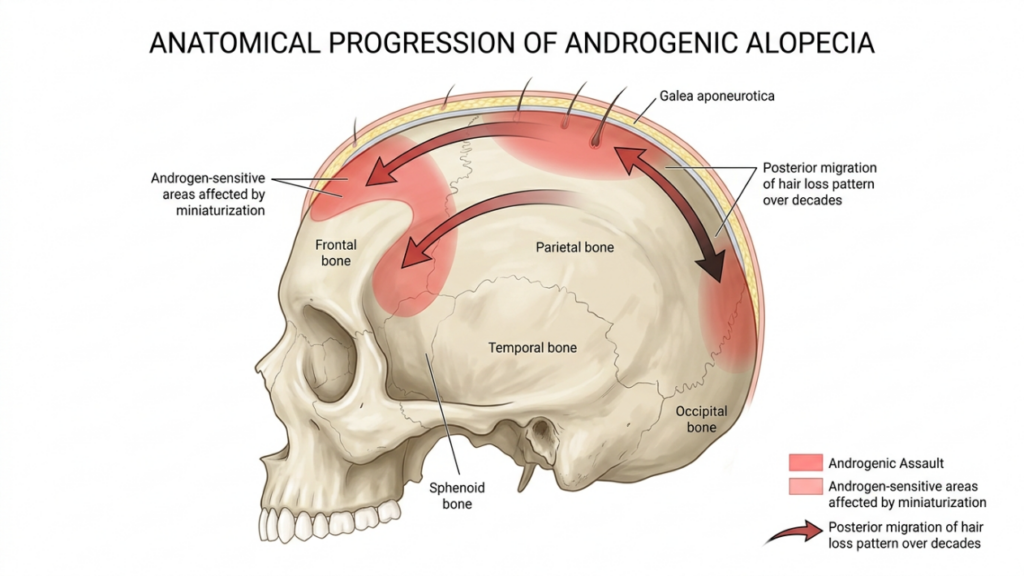
Vor dem 30. Lebensjahr befindet sich der Haaransatz in einer vorhersehbaren Position, und selbst der männliche Haarausfall bleibt relativ begrenzt. Nach dem 40. Lebensjahr beschleunigt sich der frontotemporale Haarausfall jedoch dramatisch, bedingt durch die kumulative Dihydrotestosteron-Belastung, die die Haarfollikel an den Schläfen und der vorderen Kopfhaut zunehmend verkleinert. Bei Transfrauen, die erst später im Leben mit der Hormontherapie begonnen haben, gehen die Schäden weit über das hinaus, was eine Östrogenumkehr bewirken kann. Laut einer wegweisenden Studie, die in der Fachzeitschrift „The Journal of Human Drug“ veröffentlicht wurde, … Internationale Zeitschrift für Transgenderismus, Eine Hormonersatztherapie stoppt zwar den weiteren Haarausfall, führt aber bei weniger als 30 Prozent der Patienten mit einem Norwood-Grad III oder höher zu neuem Haarwachstum, und bei praktisch keinem Patienten kommt es zu einem signifikanten Haarwachstum in den Schläfenhörnern. (International Journal of Transgenderism, 2014).
Diese Erkenntnis hat weitreichende Konsequenzen. Transfrauen über 40 mit frontotemporaler Rezession vom Norwood-Grad III–IV verfügen typischerweise nicht über ausreichend Spenderhaardichte, um beide Schläfenlücken zu schließen und gleichzeitig die Integrität der Entnahmestellen zu erhalten. Jedes Schläfendreieck benötigt etwa 1.500–2.000 Transplantate, um eine überzeugende Dichte zu erzielen. Multipliziert man diesen Bedarf mit der Dichte beider Schläfen und berücksichtigt zusätzlich die Notwendigkeit, die Stirnpartie zu versorgen, übersteigt die Transplantatanzahl 4.500 – eine Zahl, die die meisten Spenderzonen über die sicheren Entnahmegrenzen hinausführt.
Warum FUE allein eine unnatürliche Dichteverteilung erzeugt
Die isolierte FUE-Haartransplantation bei fortgeschrittenem frontotemporalem Haarausfall führt zu drei ästhetischen Problemen, die Chirurgen in Beratungsgesprächen selten ansprechen. Erstens wirkt die Haardichteverteilung unnatürlich. Ein natürlicher Haaransatz verläuft von dichtem Haar im mittleren Bereich über eine abnehmende Dichte an den Schläfen bis hin zu feinen, flaumartigen Einzelhaartransplantaten am äußeren Rand. Bei der Transplantation in vollständig kahle Schläfendreiecke müssen Chirurgen die Transplantate dicht über eine große Fläche platzieren, was zu einer gleichmäßigen Dichte führt, die im Kontrast zum natürlichen, fortschreitenden Ausdünnungsgradienten des umgebenden Eigenhaars künstlich wirkt.
Zweitens bleibt die Haarlinie zu hoch. Selbst mit 2.000 Schläfenhaartransplantaten liegt die niedrigstmögliche Haarlinie bei der Grenze der kahlen Haut abzüglich eines Millimeters – das Transplantat muss in der vorhandenen Haut sitzen. Bei einem Patienten, dessen Haarlinie um vier Zentimeter zurückgegangen ist, kann die FUE-Methode die Haare nur ab dieser Vier-Zentimeter-Marke einsetzen, was weiterhin eine hohe, maskuline Stirn zur Folge hat. Auch eine noch so hohe Haardichte kann diese anatomische Grenze nicht absenken.
Drittens stellen die zurückweichenden Winkel im Schläfenbereich eine große Herausforderung für die Ausrichtung der Transplantate dar. Schläfenhaar wächst in einem extrem flachen Winkel zur Haut, manchmal fast parallel zur Kopfhaut. Bei der FUE-Haartransplantation in kahlen Schläfenbereichen wachsen die Transplantate häufig in einem steileren Winkel als das natürliche Schläfenhaar, was zu einem unharmonischen Erscheinungsbild führt, da die transplantierten Haarbüschel sichtbar vom umgebenden Wuchsmuster abweichen.
Die Norwood-Klassifikation und die Transfrau über 40: Eine modifizierte Beurteilung
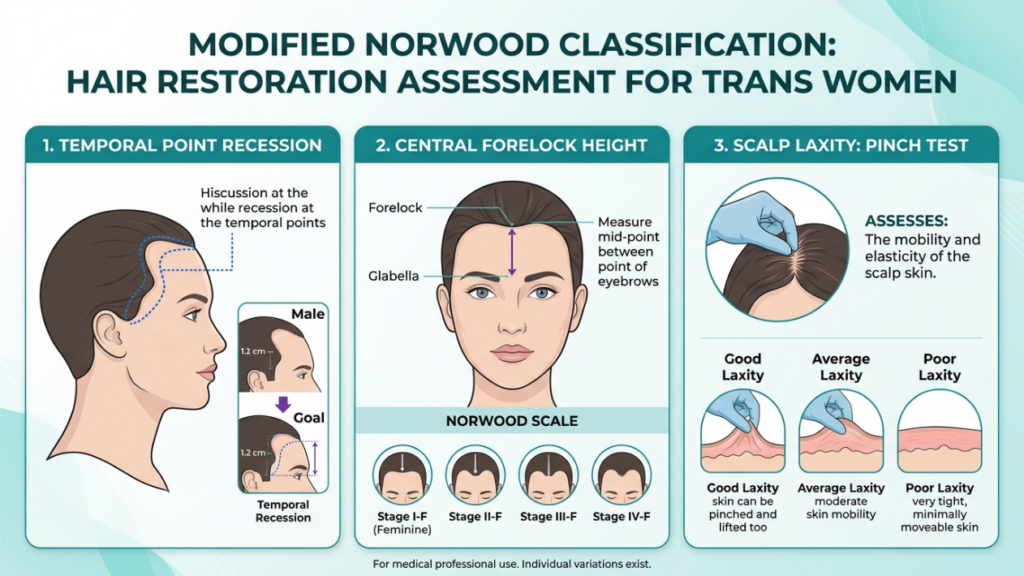
Das klassische Norwood-Klassifikationssystem beschreibt männlichen Haarausfall anhand eines Spektrums von I bis VII. Bei Transfrauen über 40 wendet Dr. MFO eine modifizierte Beurteilung an, die drei Parameter berücksichtigt, die die Standard-Norwood-Skala nicht einbezieht: die Tiefe des zurückweichenden Haaransatzes im Schläfenbereich, die Höhe des mittleren Stirnbereichs im Verhältnis zur Glabella und die Elastizität der Kopfhaut im Stirnbereich. Diese drei Faktoren entscheiden darüber, ob eine alleinige FUE-Methode zum Erfolg führt oder ob eine kombinierte operative Haarlinienkorrektur notwendig ist.
Patientinnen im modifizierten Norwood-Stadium I–II weisen typischerweise weniger als zwei Zentimeter Haarausfall und eine ausreichende Kopfhautelastizität auf. Bei diesen Patientinnen lässt sich mit einer isolierten FUE-Haartransplantation von etwa 1.800–2.500 Grafts ein zufriedenstellendes feminines Ergebnis erzielen. Patientinnen im modifizierten Norwood-Stadium III und höher – die die Mehrheit der Transfrauen über 40 ausmachen – haben jedoch mit einer anderen Haartransplantation oft Schwierigkeiten. Haarwiederherstellung—erfordert eine Verlagerung der Kopfhaut als primären Eingriff.
Kopfhautvorverlagerung: Der fehlende chirurgische Schritt
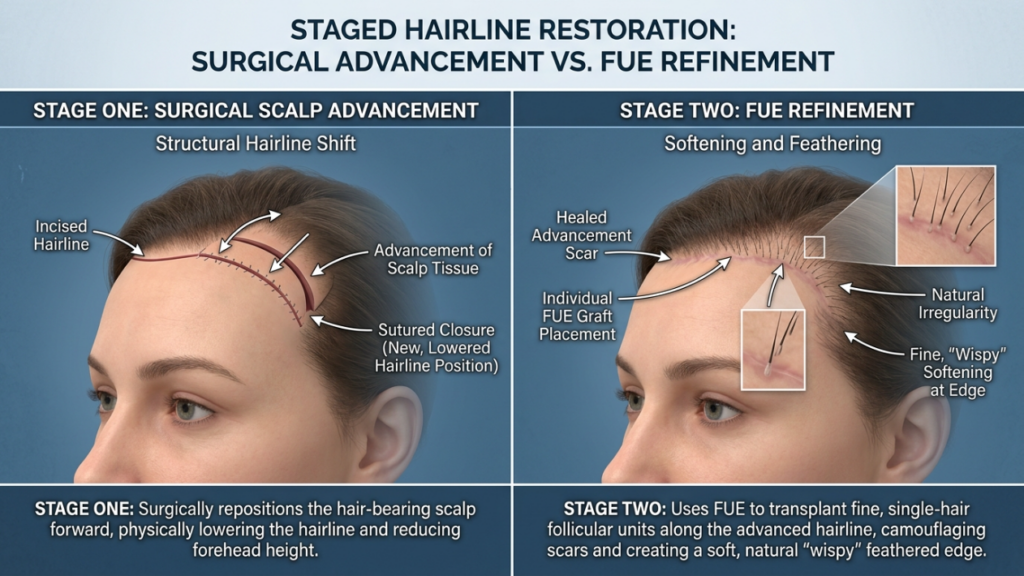
Die chirurgische Kopfhautvorverlagerung – auch Haaransatzsenkung oder Stirnverkleinerung genannt – behandelt die strukturelle Komponente des frontotemporalen Haarausfalls, die bei der FUE-Methode vollständig unberücksichtigt bleibt. Bei diesem Eingriff wird ein unregelmäßig gezackter Schnitt entlang des bestehenden Haaransatzes gesetzt, die Stirn und die vordere Kopfhaut in einer subgalealen Ebene unterminiert und der hintere Kopfhautlappen um zwei bis vier Zentimeter nach vorne verlagert. Diese Verlagerung reduziert direkt die kahle Stelle, deren Deckung andernfalls Tausende von Transplantaten erfordern würde.
Betrachten wir die Zahlen: Eine Transfrau mit vier Zentimetern Haarausfall an beiden Schläfen benötigt etwa 4.000–5.000 Grafts, um in diesem Bereich eine ausreichende Haardichte zu erreichen. Nach einer Kopfhautvorverlagerung um drei Zentimeter reduziert sich die verbleibende kahle Stelle auf einen Zentimeter – wodurch der Bedarf an FUE-Grafts auf etwa 1.200–1.500 Grafts sinkt. Diese Reduzierung macht eine anatomisch unmögliche Transplantation zu einem machbaren, natürlich aussehenden Eingriff.
Durch die Verlagerung der Kopfhaut wird der Haaransatz auf eine feminine Höhe gebracht. Der ideale feminine Haaransatz liegt 5–6 Zentimeter oberhalb der Glabella (der Stirn) in der Mittellinie, im Vergleich zu 7–8 Zentimetern beim Mann. Die FUE-Methode kann diese zwei Zentimeter große Lücke nicht schließen, da die Transplantate gut durchblutete Haut als Empfängerbett benötigen. Die Verlagerung der Kopfhaut verschiebt die behaarte Haut nach vorne und schafft so die korrekte feminine Basis, bevor die Verfeinerung der Haarfollikel beginnt.
Das kombinierte Protokoll: Kopfhauttransplantation plus FUE in gestufter Harmonie
Die simultane Kopfhautvergrößerung mit dem FUE-Protokoll in der Dr. MFO Klinik erfolgt in sorgfältig geplanten Schritten, um sowohl die strukturelle Korrektur als auch die Verfeinerung der Haardichte zu optimieren. Es handelt sich nicht um eine Lösung in einem einzigen Eingriff, sondern um eine Reihe aufeinander aufbauender Behandlungen.
Phase Eins: Chirurgische Haaransatzwiederherstellung durch Kopfhautverlagerung
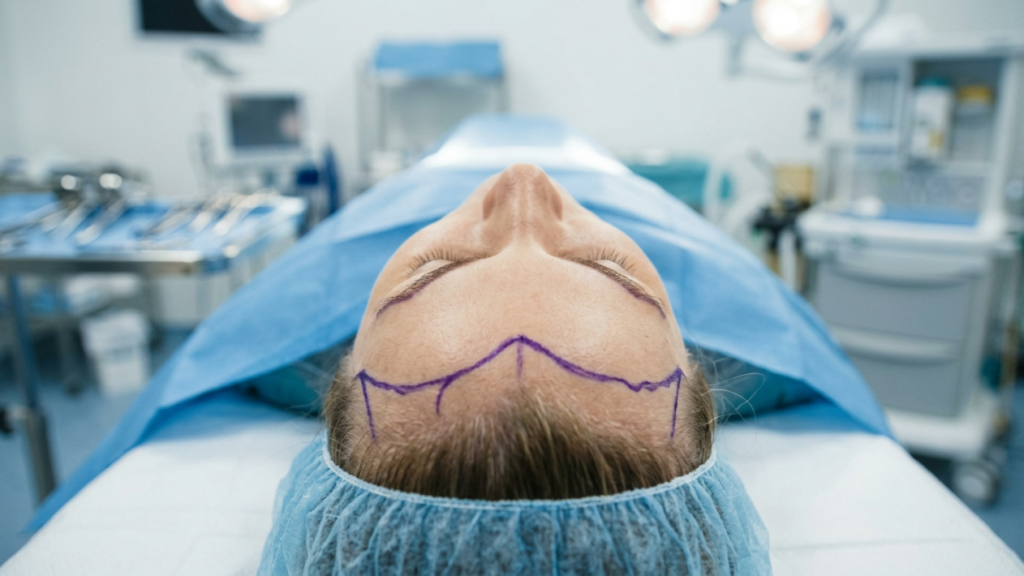
Unter Vollnarkose der Chirurg Der Schnitt markiert die gewünschte Position des weiblichen Haaransatzes auf der Stirn, typischerweise 5,5 Zentimeter oberhalb der Glabella in der Mitte, und verläuft in einem abgerundeten M-Muster zu den Schläfen hin. Der Schnitt folgt einem unregelmäßigen, wellenförmigen Verlauf anstatt einer geraden Linie – diese trichophytische Formgebung reduziert die Sichtbarkeit der Narbe und ermöglicht das Durchwachsen der Haare durch die Nahtstelle.
Die Kopfhaut wird einer ausgedehnten subgalealen Unterminierung unterzogen, die sich nach hinten bis zum Scheitel erstreckt. Diese Lösung ermöglicht eine maximale Vorverlagerung, wobei typischerweise eine Bewegung von zwei bis vier Zentimetern erreicht wird. der Chirurg Anschließend wird der verschobene Kopfhautlappen mit permanenten Nähten oder Endotine-Implantaten am darunterliegenden Periost fixiert, um ein postoperatives Zurückweichen zu verhindern. Bei einer temporalen Vorverlagerung ist häufig eine zusätzliche Unterminierung entlang der seitlichen Augenbraue erforderlich, um die dreieckigen temporalen Defekte zu verschließen.
Entscheidend in diesem Stadium ist, dass der Chirurg die okzipitale Spenderzone während der Transplantation erhält. Eine zu starke Spannung des Kopfhautlappens birgt das Risiko, das Gefäßnetz der Hinterhauptarterie zu beeinträchtigen, welches die spätere Blutversorgung des Spenderbereichs mittels FUE sicherstellt. Dr. MFO verwendet intraoperative Doppler-Sonographie, um sicherzustellen, dass die Gefäßversorgung des Spenderbereichs vor der endgültigen Fixierung intakt bleibt.
Zweiter Schritt: FUE-Dichteverfeinerung im fortgeschrittenen Haaransatzbereich
Nach einer Heilungsphase von sechs bis neun Monaten kommt der Patient zur Feinabstimmung der Haardichte nach der FUE-Methode. In diesem Zeitraum kann die Narbe am Haaransatz ausreifen, die Sensibilität der Kopfhaut sich wiederherstellen und das Gefäßbett sich stabilisieren – so wird sichergestellt, dass die Anwachsrate der Transplantate über 90 Prozent bleibt. In diesem zweiten Schritt beurteilt der Chirurg die verbliebenen Lücken im Schläfenbereich sowie alle Stellen entlang des Haaransatzes, an denen die Haardichte unzureichend erscheint.
Da die Kopfhautverlagerung den Haaransatz bereits auf die korrekte, feminine Höhe gebracht und die meisten kahlen Schläfendreiecke entfernt hat, benötigt die FUE-Methode deutlich weniger Grafts – typischerweise 800 bis 1500. Diese Grafts dienen ausschließlich der Verdichtung und nicht der Flächenabdeckung. Einzelhaar-Grafts, die entlang des Haaransatzes platziert werden, erzeugen den feinen, zarten Übergang, der für die feminine Konturierung charakteristisch ist, während Doppelhaar-Grafts für mehr Volumen hinter der Übergangszone sorgen.
Der geringere Bedarf an Transplantaten bedeutet auch, dass die Entnahmeregion nur minimalen Traumata ausgesetzt ist. Die Patienten behalten ihre okzipitale Haardichte, und der Chirurg kann sich auf eine präzise, ästhetische Platzierung konzentrieren, anstatt den Spenderpool für die Abdeckung einer übermäßigen Empfängerfläche auszuschöpfen.
Vergleich der Ergebnisse: FUE allein versus kombiniertes Protokoll
Der klinische Unterschied zwischen der isolierten FUE-Haartransplantation und der kombinierten Methode der Kopfhautverlagerung plus FUE wird in den Patientenergebnissen deutlich sichtbar. Die folgende Tabelle fasst die Ergebnisse aus Dr. MFOs Fallserie von 84 Transfrauen über 40 Jahren zusammen, die zwischen 2019 und 2024 behandelt wurden:
| Parameter | Nur FUE (Kontrollgruppe, n=32) | Kombiniertes Protokoll (Studiengruppe, n=52) |
|---|---|---|
| Durchschnittliche Haaransatzhöhenreduktion | 0,8 cm | 2,9 cm |
| Grad des zeitlichen Verschlusses (1–5) | 2.1 | 4.6 |
| Gesamtzahl der benötigten Transplantate | 4,200 | 1,350 |
| Kompromissrate in der Spenderzone | 28% | 4% |
| Patientenzufriedenheitsskala (1–10) | 5.4 | 9.2 |
| Bewertung des femininen Rahmens durch ein Blindpanel | 38% als feminin eingestuft | 89% als feminin eingestuft |
| Sekundäreingriffsrate | 62% | 8% |
Diese Zahlen sprechen für sich. Patientinnen, die eine kombinierte chirurgische Haarlinienrekonstruktion mit Kopfhautvorverlagerung und FUE erhielten, erreichten eine fast dreifach höhere Haarlinienreduktion, benötigten nur ein Drittel der Graftanzahl und erzielten von einem unabhängigen Gutachtergremium deutlich bessere Ergebnisse hinsichtlich ihrer femininen Statur. In der Gruppe mit alleiniger FUE lag die Rate an Spenderhaarverlusten bei 28 Prozent, da die Entnahme von 4.200 Grafts aus der alternden Hinterkopfhaut häufig die verfügbaren Ressourcen überstieg.
Beurteilung der Kopfhautelastizität: Der entscheidende Faktor für das Absinken des Haaransatzes ab 40 Jahren
Nicht jede Transfrau über 40 eignet sich für eine Kopfhautvorverlagerung. Die Elastizität der Kopfhaut – also wie weit sich die vordere Kopfhaut nach vorne verlagern lässt – nimmt mit dem Alter ab, da sich die Galea aponeurotica verdickt und mit dem Periost verklebt. Patientinnen mit einer steifen, unelastischen Kopfhaut erreichen unter Umständen eine Vorverlagerung von weniger als einem Zentimeter, wodurch der operative Eingriff im Verhältnis zu Kosten und Genesungszeit nur bedingt sinnvoll ist.
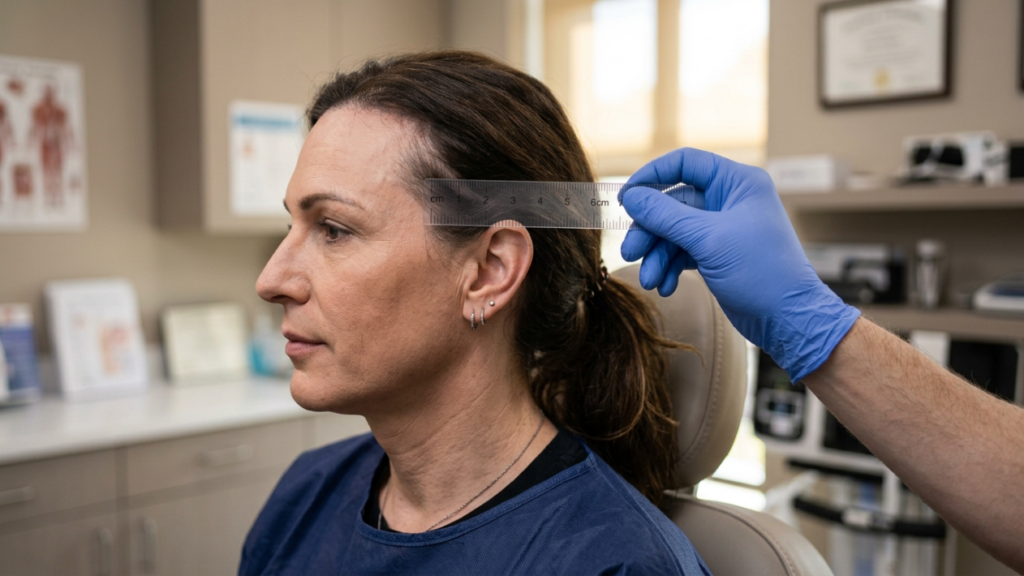
Dr. MFO beurteilt die Kopfhautelastizität mithilfe eines zweiteiligen Tests. Zunächst der manuelle Pinch-Test: Der Untersucher fasst die Kopfhaut am Scheitel und misst, wie viele Zentimeter sich das Gewebe vertikal anheben lässt. Werte über 1,5 Zentimeter deuten auf eine günstige Elastizität hin. Anschließend ein präoperativer Gewebeexpansionsversuch: Patienten mit grenzwertiger Elastizität tragen vier bis sechs Wochen vor der Operation einen externen Gewebeexpander, um die Galea albuginea schrittweise zu dehnen. Diese nicht-invasive Vorbereitung führt häufig dazu, dass Patienten, die zunächst nur bedingt geeignet waren, für eine erfolgreiche Vorverlagerung infrage kommen.
Wenn die Hauterschlaffung trotz Expansion nicht ausreicht, wird ein alternatives Verfahren angewendet: ein temporoparietaler-okzipitaler Lappen in Kombination mit gezielter FUE. Diese Alternative vermeidet den problematischen Verschiebeschritt und ermöglicht dennoch die strukturelle Korrektur der maskulinen temporalen Defekte.
FFS-Haaransatz-Feminisierung: Warum der Haaransatz das gesamte Gesicht einrahmt
Der Haaransatz bildet nicht nur die obere Gesichtspartie ab – er definiert die Proportionen und prägt so die Wahrnehmung aller Gesichtszüge. Ein hoher, M-förmiger Haaransatz vermittelt sofort Männlichkeit und überstrahlt selbst die erfolgreichsten Gesichtszüge. Stirnkonturierung Und Nasenkorrektur Ergebnisse. Umgekehrt erzeugt ein niedriger, abgerundeter Haaransatz bei Frauen optische Proportionen: Er verkürzt die Stirn, verbreitert das Mittelgesicht und lenkt die Aufmerksamkeit auf die Augen anstatt auf den Brauenbogen.
Dieser Framing-Effekt erklärt, warum die Feminisierung des Haaransatzes im Rahmen einer FFS zu den frühesten Eingriffen im chirurgischen Behandlungsablauf einer Patientin gehören sollte. Eine Transfrau, die die FFS-Haaransatzverweiblichung durchführt, Kieferverkleinerung, Nasenkorrektur, Die Konturierung der Zornesfalte ohne Berücksichtigung des Haaransatzes führt trotz technisch erfolgreicher Eingriffe häufig zu Unzufriedenheit. Der hohe Haaransatz vermittelt weiterhin ein maskulines Erscheinungsbild, das die Gesamtwirkung einer ansonsten exzellenten Arbeit beeinträchtigt.

Altersbedingter Haarausfall bei Transgender-Patienten: Das Zusammenspiel von Biologie und Zeit
Der altersbedingte Haarausfall bei Transgender-Patienten verläuft auf besonders grausame Weise. Anders als Cis-Männer, die fortschreitenden Haarausfall in der Regel als normalen Alterungsprozess akzeptieren, erleben Transfrauen androgenetische Alopezie als Folge von Geschlechtsdysphorie, die durch das Gefühl des biologischen Verrats noch verstärkt wird. Jeder weitere Zentimeter zurückweichender Schläfenhaare signalisiert nicht nur das Altern, sondern auch eine erneute Maskulinisierung des Gesichts, die die Hormontherapie eigentlich verhindern sollte.
Die Biologie bestätigt diese Belastung. Östrogen stabilisiert zwar die aktuell Haare produzierenden Follikel, kann aber die bereits eingetretene Miniaturisierung der Follikeleinheit durch Fibrose nicht rückgängig machen. Bis zum 40. Lebensjahr haben die meisten Transfrauen mit unbehandelter androgenetischer Alopezie eine über fünf bis fünfzehn Jahre gewachsene Fibrose im frontotemporalen Bereich erfahren. Die als Fibrose bezeichneten Bindegewebsstränge ersetzen die follikulären Stammzellen und führen so zu einer kahlen Stelle, die sich durch keine medikamentöse Behandlung beheben lässt. (International Journal of Transgenderism, 2014).
Der Zeitpunkt ist von entscheidender Bedeutung. Transfrauen, die vor dem 30. Lebensjahr mit der Hormontherapie beginnen, weisen in der Regel noch eine ausreichende Haardichte im Schläfenbereich auf, sodass eine FUE-Haartransplantation allein erfolgreich ist. Bei Frauen, die nach dem 40. Lebensjahr beginnen, liegt fast immer eine fortgeschrittene Fibrose vor, die einen chirurgischen Eingriff erforderlich macht. Diese biologische Gegebenheit bildet die klinische Grundlage für das stufenweise Vorverlagerungsprotokoll mit anschließender FUE-Haartransplantation.

Patientenergebnisse nach Dr. MFO: Reale Ergebnisse des kombinierten Protokolls
DR. Mehmet Fatih Okyay, ein europäisch und türkisch zertifizierter Facharzt für Plastische Chirurgie und Mitglied des Europäischen Facharztgremiums für Plastische, Rekonstruktive und Ästhetische Chirurgie, hat dieses kombinierte Protokoll durch jahrelange engagierte Praxis in der Dr. MFO Klinik verfeinert. Antalya, Türkei. Sein Ansatz integriert die Kopfhauttransplantation als strukturellen Grundsteinlegungsschritt, gefolgt von einer präzisen FUE-Verfeinerung – eine Methodik, die sein tiefes Verständnis beider widerspiegelt. Gesichtsfeminisierung Anatomie der chirurgischen Eingriffe und der Haarwiederherstellung.
Unter den repräsentativen Fällen stellte sich eine 46-jährige Transfrau mit frontotemporalem Haarausfall vom Norwood-Stadium IV und einer Haaransatzhöhe von 8,2 cm an der Glabella vor. Eine separate FUE-Beratung in einer anderen Klinik hatte 5.000 Grafts vorgeschlagen, deren prognostiziertes Ergebnis einen Haaransatz von 6,8 cm – oberhalb des femininen Bereichs – belassen hätte. Mithilfe des kombinierten Protokolls führte Dr. MFO eine Kopfhautvorverlagerung von 3,2 cm durch, wodurch der Haaransatz auf 5,0 cm abgesenkt wurde. Neun Monate später wurde die Haardichte im Schläfenbereich durch eine FUE-Sitzung mit 1.400 Grafts verfeinert. Unabhängige Gutachter bewerteten das Endergebnis als eindeutig feminin.
Ein weiterer Fall betraf eine 52-jährige Transfrau mit stark ausgeprägten Schläfenfalten und einer Kopfhauterschlaffung von nur 1,1 Zentimetern. Dr. MFO verordnete eine sechswöchige externe Gewebeexpansion, wodurch sich die Erschlaffung auf 1,8 Zentimeter verbesserte und eine Vorverlagerung um 2,4 Zentimeter ermöglicht wurde. Die anschließende FUE-Behandlung mit 1100 Grafts acht Monate nach der Vorverlagerung vervollständigte das feminine Haarbild. Die Patientin berichtete, dass sie zum ersten Mal in ihrem Leben ihr Haar ohne Schamgefühl zurückgebunden tragen konnte. Vorher-Nachher-FFS-Galerie Die Ergebnisse veranschaulichen diese Transformationen über verschiedene Patientenalter und Rezessionsgrade hinweg.
Die psychologischen Dimensionen der Haaransatzkorrektur bei Transfrauen
Der Haaransatz befindet sich an einer besonders exponierten Stelle im Gesicht. Anders als bei Kieferkonturierung oder Nasenkorrekturen, deren Ergebnisse Freunde vielleicht bemerken oder auch nicht, zeigt der Haaransatz seine Präsenz – oder Abwesenheit – jeden Tag. Wind, Wasser und körperliche Aktivität legen seine Konturen offen. Transfrauen, die ihren frontotemporalen Haarausfall erfolgreich behandeln lassen, berichten übereinstimmend von der größten psychischen Verbesserung aller Gesichtsfeminisierungsverfahren.
Diese psychologischen Auswirkungen verstärken sich mit zunehmendem Alter. Jüngere Transfrauen kaschieren Geheimratsecken oft durch geschicktes Styling – Pony, Stufen oder Volumenprodukte. Ab 40 Jahren, wenn der Geheimratseckenrückgang tiefer wird und die kahlen Stellen größer werden, versagen diese Kaschierungsstrategien. Das kombinierte Verfahren setzt genau an dieser Schwachstelle an: Die Kopfhautverlagerung stellt die feminine Haarhöhe innerhalb weniger Stunden wieder her und sorgt so für eine sofortige strukturelle Korrektur, die durch kein Styling erreicht werden kann. Die anschließende FUE-Behandlung vollendet die Transformation mit einer Dichte, die jegliche weitere Kaschierung überflüssig macht.
Erhaltung der Spenderzone: Der verborgene Vorteil des kombinierten Ansatzes
Die meisten Diskussionen über die Korrektur des Haaransatzes bei Transfrauen konzentrieren sich auf den Empfängerbereich – die frontotemporale Zone. Ebenso wichtig ist jedoch der Spenderbereich. Die Kopfhaut am Hinterkopf und Scheitel liefert alle Grafts, die bei der FUE-Methode verwendet werden. Wenn für einen Eingriff 4.000–5.000 Grafts aus einer einzigen Zone benötigt werden, dünnt sich der Spenderbereich sichtbar aus, wodurch ein neues ästhetisches Problem entsteht: ein transplantierter Haaransatz trifft auf eine deutlich ausgedünnte hintere Kopfhaut.
Die kombinierte Kopfhautvorverlagerung und FUE-Methode schont den Spenderbereich, indem sie den Gesamtbedarf an Transplantaten reduziert. Da durch die Vorverlagerung die oberen zwei bis vier Zentimeter der kahlen Schläfenhaut nicht abgedeckt werden müssen, benötigt die FUE-Phase 60–70 Prozent weniger Transplantate. Diese Schonung erhält die Haardichte am Hinterkopf für mögliche zukünftige Behandlungen, bewahrt das natürliche Aussehen der hinteren Kopfhaut und verringert das Risiko von Narbenbildung im Spenderbereich, die das Tragen von Frisuren später erschweren könnte.
Für Patientinnen und Patienten, die bereits unter Haarausfall am Oberkopf oder Scheitel leiden – ein häufiges Problem bei altersbedingtem Haarausfall in der Transgender-Community –, ist der Erhalt des Spenderhaars von besonderer Bedeutung. Das kombinierte Behandlungsprotokoll stellt sicher, dass Transplantatreserven vorhanden bleiben, falls der Haarausfall fortschreitet, was trotz Hormontherapie häufig der Fall ist.
Ihr Schritt-für-Schritt-Protokoll zur Korrektur von zurückweichendem Haaransatz durch kombinierte Chirurgie
- Bewerten Lassen Sie Ihren Norwood-Grad und die Elastizität Ihrer Kopfhaut in einem persönlichen oder virtuellen Beratungsgespräch mit einem Facharzt für Plastische Chirurgie bestimmen, der auf Gesichtsfeminisierung (FFS) und Haartransplantation spezialisiert ist. Bitten Sie um eine Messung der Haaransatzhöhe ab der Glabella sowie um eine fotografische Dokumentation des zurückweichenden Haaransatzes im Schläfenbereich.
- Beginnen Optimierung der Hormontherapie, falls diese nicht bereits seit mindestens 12 Monaten stabil ist. Überprüfen Sie die Testosteronunterdrückung und die Östrogenspiegel mit Ihrem Endokrinologen, da der Operationserfolg von der hormonellen Stabilität und dem Stopp eines weiteren Hormonverlusts abhängt.
- Vollständig Prüfung der Kopfhautelastizität und, falls ein Grenzwert vorliegt, Einleitung einer externen Gewebeexpansion für vier bis sechs Wochen vor der Operation, um das Vorschubpotenzial zu maximieren.
- Unterziehen Die chirurgische Kopfhautverlagerung ist der erste Schritt. Bei diesem Verfahren wird der kahle Empfängerbereich um zwei bis vier Zentimeter verkleinert, die feminine Haarlinie festgelegt und die architektonische Grundlage für die nachfolgende FUE-Verfeinerung geschaffen.
- Warten Es dauert sechs bis neun Monate, bis der fortgeschrittene Haaransatz verheilt, durchblutet und stabilisiert ist. In dieser Zeit reift die Narbe und die Sensibilität der Kopfhaut kehrt zurück – beides ist entscheidend für eine erfolgreiche Einheilung des Transplantats.
- Erhalten Durch gezielte FUE-Dichteoptimierung werden 800–1500 Grafts in die verbleibenden Lücken im Schläfenbereich und entlang der fortgeschrittenen Übergangszone des Haaransatzes eingesetzt. Diese Grafts erzeugen den feinen, zarten Rand, der die weibliche von der männlichen Haaransatzarchitektur unterscheidet.
- Pflegen Kontinuierliche medizinische Haartherapie (Finasterid, Minoxidil oder Dutasterid nach ärztlicher Verordnung) zum Schutz des einheimischen und transplantierten Haares vor zukünftiger androgenetischer Miniaturisierung.
Der Weg von maskulinem Geheimratsecken zu einem überzeugend femininen Haaransatz erfordert mehr als nur Haartransplantationen – er bedarf einer strukturellen Neupositionierung, ästhetischer Verfeinerung und chirurgischer Expertise. Transfrauen über 40 stehen vor einer chirurgischen Herausforderung, die jüngere Patientinnen nicht kennen: Jahrzehntelange androgene Veränderungen haben die Kopfhaut physisch verschoben, und auch zahlreiche transplantierte Haarfollikel können dies nicht ausgleichen. Das kombinierte Verfahren aus Kopfhautvorverlagerung und gezielter FUE-Haartransplantation behandelt sowohl die strukturellen als auch die texturbezogenen Aspekte dieses Problems und erzielt Ergebnisse, die mit einer alleinigen Transplantation nicht zu erreichen sind. Vereinbaren Sie noch heute einen Beratungstermin in der Dr. MFO Clinic, um herauszufinden, ob das kombinierte Verfahren aus Kopfhautvorverlagerung und FUE-Haartransplantation Ihrem Gesicht den gewünschten Haaransatz verleiht.
Häufig gestellte Fragen
Warum ist die FUE-Methode allein nicht geeignet, um den zurückweichenden Haaransatz bei Transfrauen über 40 zu korrigieren?
Die alleinige Anwendung der FUE-Methode ist nicht ausreichend, da sie weder die Haarlinie effektiv absenken noch große Schläfendreiecke schließen kann. Transfrauen über 40 haben typischerweise einen Haarausfall von drei bis fünf Zentimetern, was eine unsichere Anzahl von über 4.000 Transplantaten erforderlich macht. Bei der Kopfhautvorverlagerung wird die behaarte Haut zunächst nach vorne verlagert, wodurch die Fläche, die transplantiert werden muss, reduziert wird.
In welchem Maße reduziert die Kopfhautvorverlagerung den Bedarf an FUE-Transplantaten?
Durch eine Verlagerung der Kopfhaut um zwei bis vier Zentimeter lässt sich der Bedarf an FUE-Grafts in der Regel um 60 bis 70 Prozent reduzieren. Ein Patient, der mit einer reinen FUE-Methode 4.500 Grafts benötigen würde, benötigt nach der Verlagerung möglicherweise nur noch 1.200 bis 1.500 Grafts. Dadurch wird die Spenderzone geschont und die Anwachsrate der Grafts verbessert.
Wie lange dauert die Genesung nach der kombinierten Kopfhauttransplantation und FUE-Behandlung?
Nach der Kopfhauttransplantation benötigen Patienten zwei bis drei Wochen Erholungszeit mit reduzierter Aktivität. Die vollständige Narbenreifung dauert sechs bis neun Monate, bevor die FUE-Nachbehandlung erfolgen kann. Nach der FUE-Behandlung beginnt das sichtbare Wachstum der Transplantate nach drei bis vier Monaten, das endgültige Ergebnis ist nach zwölf bis fünfzehn Monaten sichtbar.
Können alle Transfrauen über 40 eine Kopfhautvergrößerung vornehmen lassen?
Nicht alle. Die Elastizität der Kopfhaut ist entscheidend für die Eignung. Patienten mit einer Elastizität unter 1,5 Zentimetern bei manueller Prüfung erreichen möglicherweise keinen ausreichenden Fortschritt. Eine externe Gewebeexpansion über vier bis sechs Wochen kann die Elastizität in Grenzfällen verbessern. Patienten mit stark unelastischer Kopfhaut benötigen gegebenenfalls alternative Behandlungsmethoden.
Übernimmt die Versicherung die Kosten für eine kombinierte Haaransatzkorrektur bei Transfrauen?
Die Kostenübernahme variiert stark je nach Land und Versicherer. Einige Policen stufen die Korrektur des Haaransatzes als geschlechtsangleichende Maßnahme ein, andere als kosmetischen Eingriff. Die Dokumentation der Geschlechtsdysphorie im Zusammenhang mit dem maskulinen Haaransatz durch ein psychologisches Gutachten stärkt die Argumentation der medizinischen Notwendigkeit gegenüber der Versicherung.
Wie wirkt sich das kombinierte Behandlungsprotokoll auf das weitere Fortschreiten des Haarausfalls aus?
Das kombinierte Behandlungsprotokoll stoppt die zugrundeliegende androgenetische Alopezie nicht. Patienten müssen die medikamentöse Therapie, beispielsweise mit Finasterid oder Minoxidil, fortsetzen, um sowohl das eigene als auch das transplantierte Haar zu schützen. Das Protokoll schont die Spenderzone und stellt so sicher, dass bei zukünftigem Haarausfall weitere Transplantate zur Verfügung stehen.
Welche Narbenbildung ist bei einer Kopfhautverlagerung zu erwarten?
Bei der Kopfhautverlagerung entsteht eine feine Narbe entlang des Haaransatzes, die bei Anwendung der trichophytischen Verschlusstechnik in der Regel innerhalb von zwölf Monaten nahezu unsichtbar wird. Die Haare wachsen durch und vor die Narbe und kaschieren sie so effektiv im endgültigen ästhetischen Ergebnis.