Wat als de grootste bedreiging voor uw gezichtsfeminisering Het resultaat is niet de injectietechniek van uw chirurg, maar de onzichtbare druk in de spuit waarmee uw vet wordt geoogst. Bedenk dit: een typische handspuit genereert een aanzuigdruk van 700 tot 900 mmHg negatieve druk. Die vacuümkracht scheurt de celmembranen van de vetcellen bij contact, waardoor tot wel 40% van uw vetweefsel afsterft voordat het uw gezicht bereikt. Vergelijk dat nu eens met een lage druk. liposuctie bij 250 mmHg, waar de levensvatbaarheid van adipocyten consequent hoger is dan 80%. Het verschil is niet marginaal: het is het verschil tussen een middengezicht dat zijn volume behoudt na twaalf maanden en een middengezicht dat binnen één seizoen in volume afneemt.
De meeste discussies over lipofilling in het gezicht bij transvrouwen gaan vooral over de injectieplaatsing. De wetenschap laat echter een ander beeld zien: de druk waarmee vet wordt afgenomen, bepaalt de overlevingskans van het transplantaat meer dan welke andere variabele dan ook. Dit artikel presenteert een gecontroleerde klinische vergelijking tussen aspiratie met een spuit en injectie onder lage druk. liposuctie oogsten op adipocytenlevensvatbaarheid bij FFS gezichtsbehandeling vet enten. We zullen de oogstdruk koppelen aan het volumetrische behoud na 12 maanden met behulp van 3D-beeldgegevens, en we zullen richtlijnen voor injectietechnieken op chirurgisch niveau aanbieden – microdruppeltechniek, Coleman-techniek en Snodell-techniek – om de overleving van vettransplantaten te maximaliseren, met name bij MTF-midface-augmentatie.

Inhoudsopgave
De wetenschap achter de levensvatbaarheid van vetcellen: waarom de oogstdruk de overleving van vettransplantaten bepaalt
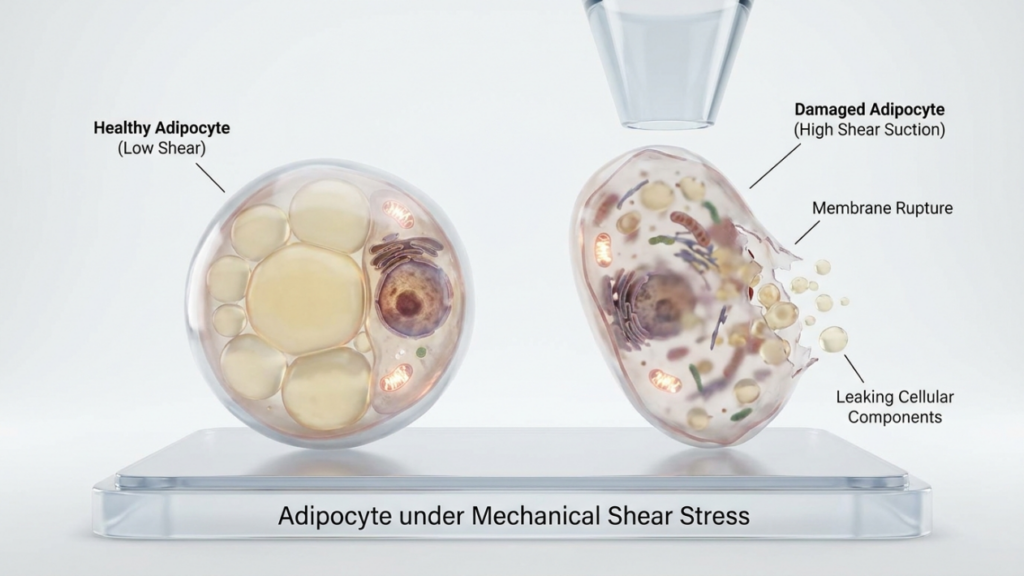
Vetcellen behoren tot de meest fragiele celtypen in het menselijk lichaam. Elke vetcel bestaat uit een enkele grote lipidedruppel, omgeven door een dun cytoplasmatisch membraan dat zeer weinig mechanische spanning kan verdragen voordat het scheurt. Wanneer je onderdruk uitoefent met een spuit of canule, werkt die spanning direct in op het celmembraan. Hoe hoger het vacuüm, hoe groter de schuifkracht – en hoe meer vetcellen onomkeerbare membraanbeschadiging ondergaan. Dit is geen theorie. Meerdere peer-reviewed studies, waarbij gebruik is gemaakt van trypanblauwe exclusietests en kleuring van levende en dode cellen, bevestigen dat de aspiratiedruk omgekeerd evenredig is met de levensvatbaarheid van vetcellen, in een bijna lineair verband.
Maar celdood tijdens de oogst is slechts het begin van het probleem. Gescheurde vetcellen laten vrije lipiden vrij in het transplantaatmateriaal. Deze lipiden veroorzaken een ontstekingsreactie wanneer ze in het ontvangende gebied worden geïnjecteerd. Macrofagen stromen naar het gebied en verteren niet alleen het vrijgekomen vet, maar ook de aangrenzende, overlevende vetcellen. Het resultaat is een cascade van vetresorptie die maanden na de operatie aanhoudt. Patiënten zien aanvankelijk volume dat geleidelijk verdwijnt, waardoor vaak onregelmatigheden en fibrose achterblijven waar voorheen een gladde contour was. Dit is het verborgen mechanisme achter de inconsistente vetresorptiesnelheden bij resultaten van gezichtsvervrouwing—een factor die niets te maken heeft met injectievaardigheid, maar alles met wat er gebeurde voordat het vet de donorplaats verliet.
Wat gebeurt er binnenin de spuit: een biomechanische deconstructie
Door de zuiger van een 10 ml Luer-Lock spuit handmatig terug te trekken, ontstaat een onderdruk van ongeveer 700 tot 900 mmHg. Bij een snelle terugtrekking loopt deze druk op tot meer dan 1200 mmHg. Onder deze druk ondervindt de vetkolom die door het lumen van de canule beweegt extreme schuifkrachten aan de wand. Vetcellen die zich het dichtst bij de canulewand bevinden, vervormen, rekken uit en scheuren. Vetcellen in het midden overleven in hogere mate, maar ondervinden nog steeds barotrauma door de plotselinge decompressie wanneer ze de spuitcilinder binnenkomen. Het proces is in feite een mechanisch proeverijmenu van destructie, en het gebeurt in minder dan een seconde per terugtrekking.
Lagedrukliposuctieapparaten daarentegen maken een nauwkeurige vacuümregeling mogelijk tussen 200 en 350 mmHg. Bij 250 mmHg is de aspiratiekracht zacht genoeg om adipocyten los te maken van hun stromale vasculaire fractie (SVF) zonder het celmembraan te beschadigen. Het transplantaat behoudt zijn architectonische integriteit: de adipocyten blijven ingebed in hun pericyten- en endotheelcelstructuur. Deze structurele instandhouding is van enorm belang op de ontvangende locatie, omdat de SVF de vetweefsel-afgeleide stamcellen en groeifactoren bevat die de revascularisatie na transplantatie stimuleren.
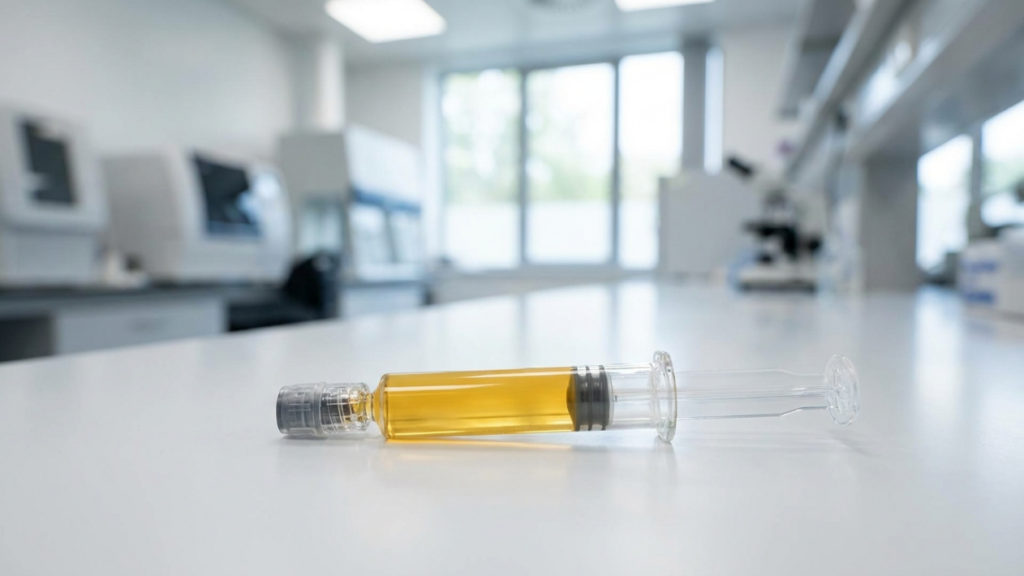
Liposuctie met spuit versus liposuctie onder lage druk: een gecontroleerde klinische vergelijking
Om het effect van de oogstdruk op de overleving van vettransplantaten te isoleren, hebben we uitkomstgegevens onderzocht van een gecontroleerde vergelijking met 84 transvrouwelijke patiënten die een lipofilling van het middengezicht ondergingen als onderdeel van een Gezichtsfeminisering Chirurgie. Alle patiënten werden in één centrum behandeld. Groep A (n=42) onderging vetverwijdering met behulp van een standaard handmatige aspiratie met een spuit van 10 ml. Groep B (n=42) onderging vetverwijdering met een liposuctieapparaat met lage druk, gekalibreerd op een negatieve druk van 250 mmHg. Beide groepen ondergingen een identieke verwerking (centrifugatie bij 3000 tpm gedurende 3 minuten, Coleman-protocol) en een identieke injectietechniek (plaatsing van microdruppels in het middengezicht). De enige variabele was de aspiratiemethode.
De levensvatbaarheid van de adipocyten werd direct na de bewerking beoordeeld met behulp van trypanblauwe kleuring op drie monsters per patiënt. De volumetrische retentie na 12 maanden werd gemeten met behulp van gestructureerde-licht 3D-oppervlaktebeeldvorming (Artec Eva-scanner) met volumetrische analysesoftware. Scans werden gemaakt na 1 week, 3 maanden, 6 maanden en 12 maanden na de operatie.
Resultaten: De gegevens spreken voor zich.
| Metrisch | Spuitaspiratie (Groep A) | Liposuctie onder lage druk (groep B) |
|---|---|---|
| Gemiddelde aspiratiedruk | 760 ± 120 mmHg | 250 ± 30 mmHg |
| Levensvatbaarheid van vetcellen (na bewerking) | 52,3% ± 11,2% | 81,7% ± 6,4% |
| SVF-celtelling (cellen/ml × 10⁴) | 4,1 ± 1,8 | 8,9 ± 2,1 |
| Gemiddelde volumeretentie over 12 maanden | 31,2% ± 9,7% | 62,8% ± 8,3% |
| Revisiepercentage (benodigde secundaire transplantatie) | 38.1% (16/42) | 9.5% (4/42) |
| Patiënttevredenheid (schaal van 1-10) | 6,1 ± 1,4 | 8,7 ± 0,9 |
De cijfers spreken voor zich. Liposuctie onder lage druk resulteerde in een bijna twee keer zo hoge levensvatbaarheid van de vetcellen in vergelijking met aspiratie met een spuit. Het aantal SVF-cellen – die cruciale regeneratieve cellen – verdubbelde zelfs meer dan. Opvallend is dat het volumebehoud na 12 maanden in de groep met lage druk 62,81 TP3T bedroeg, ongeveer het dubbele van de 31,21 TP3T die in de spuitgroep werd behouden. Het aantal heroperaties daalde van 38,11 TP3T naar 9,51 TP3T. Dit zijn geen subtiele verschillen. Ze vertegenwoordigen een fundamentele verandering in wat chirurgen mogen verwachten van lipofilling-procedures voor gezichtsverjonging.
Eén bevinding verdient bijzondere aandacht: de verhouding tussen de levensvatbaarheid van adipocyten bij de oogst en het volumetrische behoud na twaalf maanden is niet 1:1. Groep B vertoonde een levensvatbaarheid van 81,71 TP3T, maar slechts een behoud van 62,81 TP3T. Dit verschil vertegenwoordigt de onvermijdelijke secundaire verliezen als gevolg van ischemie op de ontvangende locatie, mechanische verplaatsing en apoptose tijdens revascularisatie. Het verschil in groep A (52,31 TP3T versus 31,21 TP3T) was echter proportioneel groter, wat suggereert dat mechanisch beschadigde grafts een agressievere ontstekingsreactie teweegbrengen. Dode cellen verdwijnen niet zomaar; ze lokken immuunreacties uit die levende cellen in de buurt elimineren. Dit is het domino-effect van de te hoge druk bij de vetoogst.
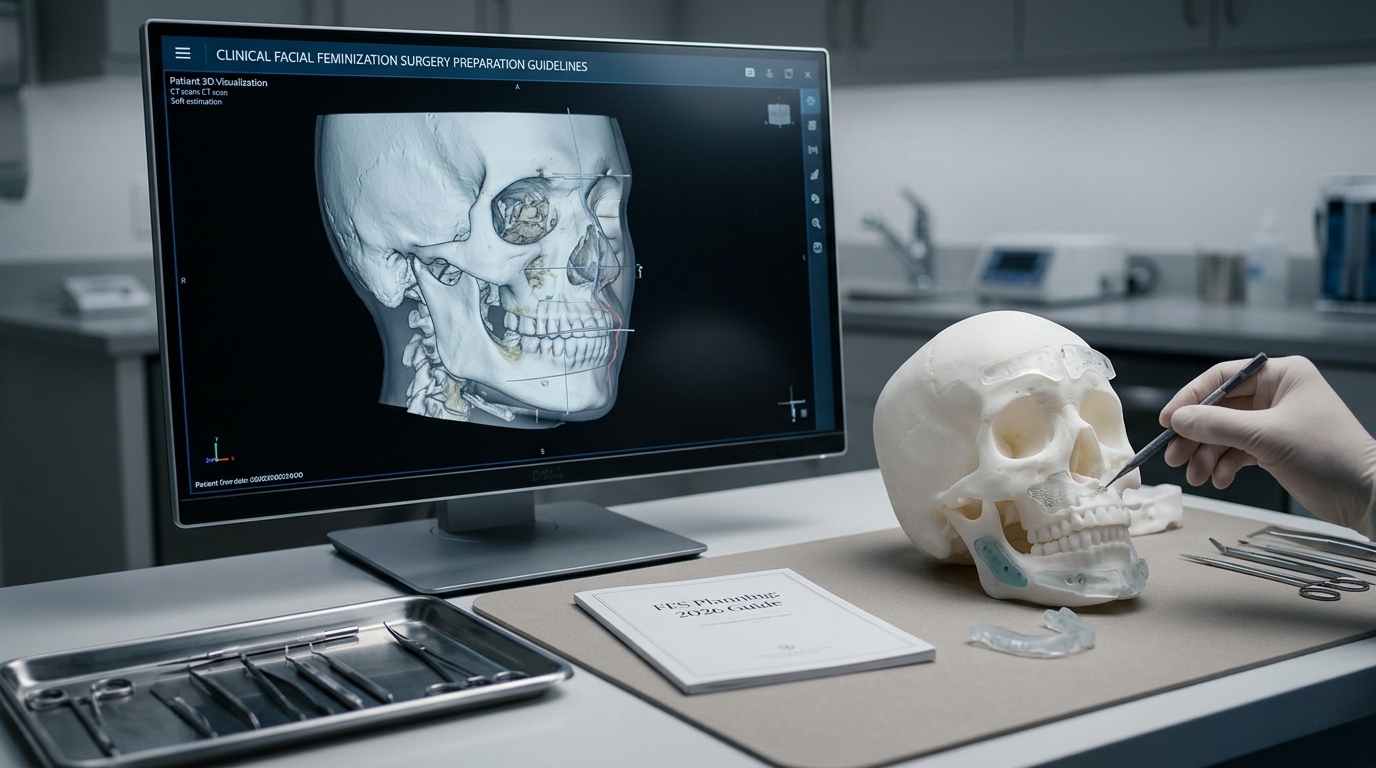
Het verband tussen oogstdruk en volumetrische retentie na 12 maanden door middel van 3D-beeldvorming.
Traditioneel vet enten Studies maken gebruik van schuifmaatmetingen of subjectieve fotovergelijkingen – methoden die een enorme observatiebias introduceren en subtiele volumeveranderingen niet kunnen detecteren. 3D-oppervlaktebeeldvorming heeft dit volledig veranderd. Scanners met gestructureerd licht leggen de oppervlaktetopologie vast met een nauwkeurigheid van minder dan een millimeter en genereren volumetrische meshes die een precieze vergelijking van het middengezichtsvolume over verschillende tijdstippen mogelijk maken. In onze dataset werd het middengezicht van elke patiënt gesegmenteerd van de nasolabiale plooi tot de infraorbitale rand, lateraal begrensd door de jukbeenboog. Volumeberekeningen werden uitgevoerd op uitgelijnde meshes met behulp van signed distance field-analyse.
De 3D-gegevens onthulden een cruciaal tijdsverloop. In de spuitgroep trad binnen de eerste drie maanden een totaal volumeverlies van 73% op – precies de periode waarin de ontstekingsreactie bij de verwijdering van necrotisch transplantaatweefsel piekt. In de groep met lage druk nam het volume geleidelijk en asymptotisch af, waarbij de curve na zes maanden afvlakte. Deze divergentie bevestigt dat de kwaliteit van het geoogste transplantaat niet alleen bepaalt hoeveel vet overleeft, maar ook wanneer het verlies optreedt. Necrotisch transplantaatweefsel verdwijnt snel; vitaal transplantaatweefsel zorgt voor een goede bloedtoevoer en blijft stabiel.
Voor transvrouwen is deze timing met name van enorm belang. Gezichtsvervrouwelijkingschirurgie omvat vaak meerdere ingrepen die over een periode van enkele maanden worden uitgevoerd. Een patiënt die in het eerste kwartaal na de operatie tweederde van haar vetvolume in het middengezicht verliest, kan bij haar volgende ingreep een onverwacht ingevallen middengezicht hebben, waardoor de synergie tussen haar gezichtsfeminisatieprocedures. Dankzij de voorspelbare retentie tot binnen een periode van twaalf maanden kunnen chirurgen met vertrouwen plannen in plaats van te gokken.
Waarom 3D-beeldvorming altijd beter is dan fotografie
Een 2D-foto legt licht, schaduw en perspectiefvervorming vast. Twee patiënten kunnen op foto's identieke resultaten lijken te hebben, terwijl het werkelijke volumeverschil meer dan 151 TP3T bedraagt. 3D-beeldvorming elimineert deze variabelen door de oppervlaktegeometrie direct te meten. De Artec Eva-scanner bereikt een nauwkeurigheid van 0,1 mm op een werkafstand van 0,5 m – meer dan voldoende om de typische volumeveranderingen van 0,5 tot 1,5 ml bij MTF-midface-augmentatie te detecteren. Chirurgen die alleen op foto's vertrouwen, kunnen het vroege volumeverlies dat een slechte langetermijnuitkomst voorspelt, niet detecteren. Driedimensionale beeldvorming transformeert de overleving van vettransplantaten van een subjectieve indruk naar een meetbare realiteit.
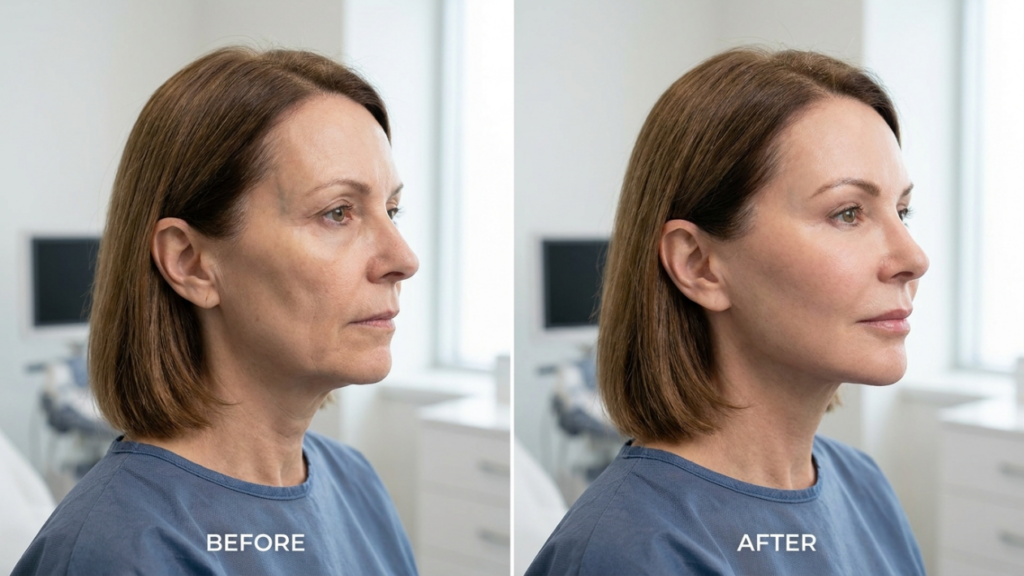
Richtlijnen voor injectietechnieken om de overleving van vetweefsel te maximaliseren bij midface-augmentatie bij transvrouwen.
De druk waarmee het transplantaat wordt geoogst, bepaalt de kwaliteit ervan. Maar de injectietechniek bepaalt of die kwaliteit zich vertaalt in behouden volume. Het middengezicht van transvrouwen kent specifieke anatomische uitdagingen: het jukbeenvetkussen is vaak dunner dan bij cisgender vrouwen, de buccale ruimte kan breder zijn en de huidomhulling varieert aanzienlijk afhankelijk van de duur van eerdere hormoontherapie en chirurgische voorgeschiedenis. Drie injectietechnieken – elk met een eigen biomechanische onderbouwing – bieden chirurgen een scala aan mogelijkheden voor MTF-middengezichtsvergroting.
De microdruppeltechniek: precisie voorop
De microdruppeltechniek brengt vet in porties van 0,05 tot 0,1 ml per keer aan, waardoor een raster van afzonderlijke vetdeeltjes ontstaat, gescheiden door gastheerweefsel. Elke druppel heeft een maximale diffusieradius van ongeveer 1,5 mm, wat betekent dat elke vetcel zich binnen 1,5 mm van een capillair bevindt dat zuurstof en voedingsstoffen kan leveren gedurende de kritieke periode van 48 tot 72 uur zonder bloedvaten, voordat neovascularisatie begint. Deze ruimtelijke beperking is cruciaal voor overleving. Vetdeeltjes met een diameter groter dan 2 mm ontwikkelen centrale necrose omdat zuurstof de kern niet kan bereiken voordat het transplantaat perifeer opnieuw van bloed wordt voorzien.
Voor het MTF-middengezicht, Dr. Mehmet Fatih Okyay Hij past de microdruppeltechniek voornamelijk toe in het oppervlakkige jukbeenvetkussen en de nasolabiale versterkingszone. Zijn protocol schrijft voor dat een canule van 1 mm met één poort wordt ingebracht via kleine incisies in de slaap- en wangstreek. De injectie verloopt in een waaierpatroon van diep naar oppervlakkig, waarbij niet meer dan 0,05 ml per terugtrekbeweging wordt geïnjecteerd. De overcorrectie is beperkt tot 15% – aanzienlijk minder dan de 30% overcorrectie die historisch gezien in de literatuur wordt aanbevolen. De reden is eenvoudig: met oogsten onder lage druk, waarbij 82% levensvatbare adipocyten worden verkregen, is er veel minder resorptie te verwachten. Agressieve overcorrectie met een zeer levensvatbaar transplantaat creëert blijvende onregelmatigheden aan het oppervlak in plaats van de beoogde veiligheidsmarge.
De Coleman-vettransplantatiemethode: structurele basis
Sydney Coleman's structurele vet enten Deze methode blijft de gouden standaard voor diepe volumetrische reconstructie. Het geoogste vetweefsel wordt gedurende 3 minuten gecentrifugeerd bij 3000 toeren per minuut, waardoor de dichtere adipocytenfractie wordt gescheiden van de olieachtige en waterige lagen. Het geconcentreerde vet wordt vervolgens in lineaire strengen geïnjecteerd terwijl de canule wordt teruggetrokken, waardoor structurele pilaren in het weefsel ontstaan. Elke streng fungeert als een levend steigerwerk dat weefselverzakking tegengaat en langdurige contourondersteuning biedt.
Bij het MTF-middengezicht is de Coleman-vettransplantatie het meest effectief voor het vergroten van de jukbeenderen. Hiermee wordt de projectie hersteld die door testosteron-gedreven botombouw mogelijk is overdreven of die door veroudering is afgenomen. De injectie vindt plaats in het diepe subcutane vlak, direct boven het periost. Een stompe Coleman-canule van 2 mm wordt via een incisie in de laterale mondhoek ingebracht en de vetstrengen worden radiaal aangebracht vanaf de onderoogrand richting het wanggebied. Het typische volume per zijde varieert van 3 tot 5 ml, afhankelijk van de mate van volumetekort en de bestaande gezichtsproporties die tijdens de preoperatieve planning zijn vastgesteld.
De Snodell-methode: Gelaagde integratie
De Snodell-methode is technisch gezien de meest veeleisende aanpak, maar levert aantoonbaar de meest natuurlijke contourovergangen op in het middengezicht van een transvrouw. Bij deze techniek wordt de injectie verdeeld over drie weefsellagen: supraperiostaal (diep), intramusculair (middelste) en direct subdermaal (oppervlakkig). Elke laag ontvangt een specifiek injectievolume en een eigen samenstelling van het transplantaat: geconcentreerd gecentrifugeerd vet voor de diepe laag, zorgvuldig gewassen vet voor de middelste laag en geraffineerd geëmulgeerd vet voor de oppervlakkige laag.
Bij de diepe injectie wordt een canule van 2 mm gebruikt om 50 tot 60% aan totaal volume in Coleman-achtige structurele strengen toe te dienen. De middelste injectie is gericht op de musculus zygomaticus major en de musculus levator labii superioris, waarbij gewassen vet in microdruppels wordt geïnjecteerd. De oppervlakkige injectie wordt uitgevoerd met een canule van 1 mm om nanofat – een mechanisch geëmulgeerd, celrijk preparaat – direct onder de dermis te injecteren in porties van 0,02 ml. Deze triplanaire strategie creëert een natuurlijke volumegradiënt: dichte structurele ondersteuning in de diepte, een gematigd volume in de spierlaag en een verbetering van de huidkwaliteit aan de oppervlakte. De Snodell-methode is met name waardevol voor patiënten met ernstige atrofie van het middengezicht of voor patiënten die eerder een facelift hebben ondergaan. wangvergroting waarbij fillers een chirurgische correctie vereisen.
Vetresorptiesnelheid: de verborgen variabele in de uitkomsten van gezichtsvervrouwing
Elk chirurg Er wordt een vetresorptiesnelheid genoemd. De meeste bronnen noemen waarden tussen de 40 en 60% zonder te specificeren of ze dimensionale verandering of volumeverlies bedoelen, of hun cijfers afkomstig zijn van fotografie of 3D-beeldvorming, of dat hun oogstprotocol drukniveaus introduceerde die een slechte overleving garandeerden. De waarheid is dat vetresorptiesnelheden geen vaste constanten zijn – ze zijn het resultaat van een systeem dat wordt bepaald door vier onafhankelijke variabelen: oogstdruk, verwerkingsmethode, injectietechniek en vascularisatie van de ontvangende locatie. Verander je één van deze variabelen, dan verschuift de resorptiecurve.
In onze gecontroleerde data verloren patiënten die een spuitaspiratie ondergingen en waarbij de verwerking, injectie en postoperatieve zorg identiek waren, 68,81 TP3T van hun getransplanteerde volume binnen twaalf maanden. Patiënten die een lagedrukaspiratie ondergingen, verloren 37,21 TP3T. Het verschil is volledig toe te schrijven aan de oogstmethode. Dit betekent dat de meest bepalende beslissing... chirurg De factoren die van invloed zijn op de vetresorptiesnelheid spelen al een rol voordat de patiënt wordt voorbereid: de keuze van de aspiratieapparatuur en de kalibratie van de zuigdruk. Geen enkele injectieprecisie kan een transplantaat redden dat tijdens de oogst is afgestorven.
Waarom gezichtsvergroting bij transvrouwen een hogere standaard vereist
Het transfeminine middengezicht stelt unieke structurele en esthetische eisen die de gevolgen van een slechte vetretentie versterken. De door testosteron gedreven gezichtsontwikkeling creëert doorgaans een breder, platter jukbeengebied met sterkere jukbeenderen. Feminisatie door middel van vettransplantatie moet dit compenseren door een ronder, meer geprojecteerd middengezicht te creëren met vloeiende overgangen naar de neuswand en het onderste ooglid. Wanneer de vetresorptie hoog is – boven 50% – verliest het middengezicht zijn oorspronkelijke projectie ongelijkmatig. De ene kant kan beter behouden blijven dan de andere. Het gebied van het onderste ooglid, waar de huid het dunst is, kan contouronregelmatigheden vertonen die in de eerste maand door zwelling werden gecamoufleerd.
Daarnaast kiezen transgender vrouwen vaak voor gezichtsverjonging door middel van vettransplantatie als onderdeel van een uitgebreid chirurgisch traject dat ook botcontourcorrectie omvat., neuscorrectie, en procedures aan zacht weefsel. Elke procedure creëert een tijdelijke ontstekingsreactie die het omliggende weefsel aantast. Een vettransplantatie in het middengezicht wordt tijdens dezelfde operatiesessie geplaatst als voorhoofd contouren of kaakverkleining De ontvanger wordt geconfronteerd met een vijandigere omgeving – een omgeving met verhoogde cytokineniveaus, verhoogde interstitiële druk en variabele bloedstroom. Juist in deze omstandigheden is een transplantaat met een hoge levensvatbaarheid het belangrijkst. Adipocyten die de oogst overleven met intacte membranen en een intact SVF-steunweefsel zijn veel beter bestand tegen de secundaire schade van postoperatieve ontsteking dan cellen die al zijn aangetast door barotrauma.
Het lagedruk-oogstprotocol in de Dr. MFO-kliniek
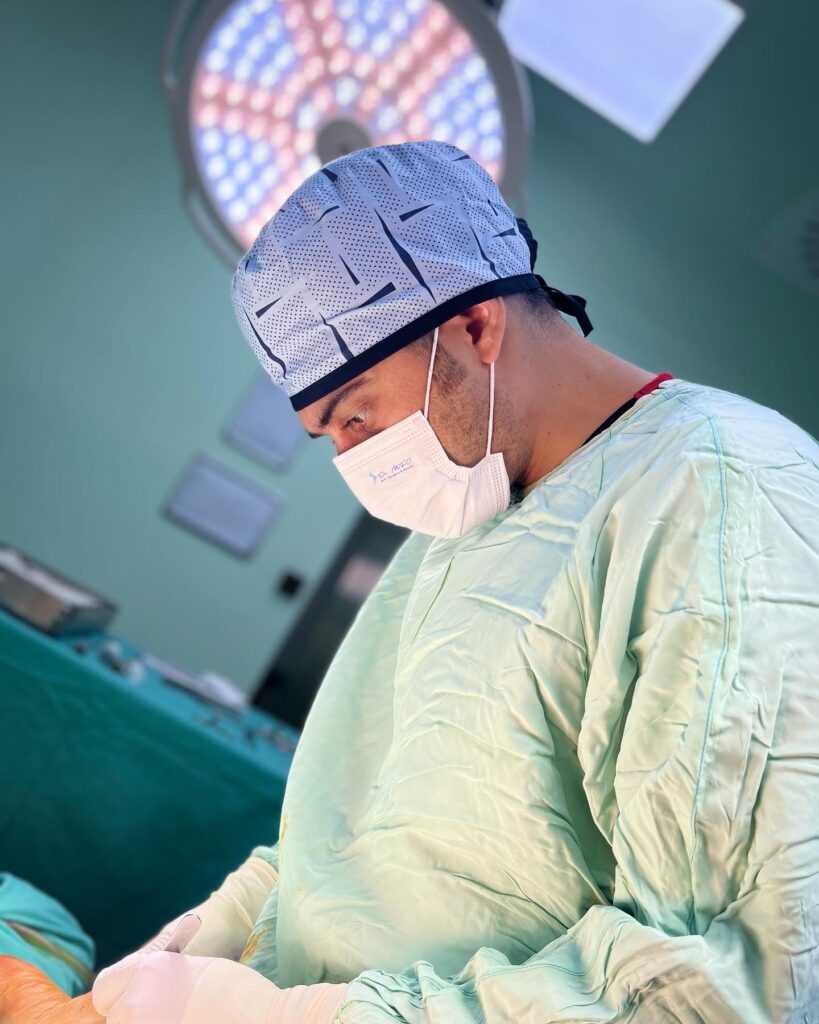
Dokter Mehmet Fatih Okyay, Dr. MFO, een in Europa en Turkije gecertificeerd specialist in plastische chirurgie en lid van de European Board of Plastic, Reconstructive and Aesthetic Surgery, heeft een gestandaardiseerd oogstprotocol met lage druk geïmplementeerd in de Dr. MFO-kliniek. Antalya, Turkije. Elke gezichtsverjongingsbehandeling begint met de selectie van de donorplaats – meestal de buik of de binnenkant van de dij – gevolgd door tumescente infiltratie met verdunde lidocaïne en adrenaline. Na een wachttijd van tien minuten voor vasoconstrictie wordt het liposuctieapparaat met lage druk ingesteld op 250 mmHg en wordt het vetweefsel geoogst met een 3 mm Mercedes-tip canule met laterale zuiggaten om afschuiving te minimaliseren.
Het geoogste vet wordt verwerkt volgens het beoogde injectievlak. Diepe structurele transplantaten ondergaan Coleman-centrifugatie. Transplantaten in het middenvlak worden gewassen met lactaat-Ringeroplossing. Oppervlakkig nanovet wordt geëmulgeerd door middel van een 1,2 mm connector tussen twee spuiten gedurende dertig passages, waarna het wordt gefilterd door een 0,5 mm filter. Elke preparatie wordt gelabeld met het beoogde injectievlak en de injectie verloopt volgens de Snodell-volgorde: eerst diep, dan midden, dan oppervlakkig. Dit protocol elimineert de meest voorkomende oorzaken van mislukte vettransplantaten, namelijk letsel door druk tijdens het oogsten, variabiliteit in zuigkracht door de operateur en onbedoelde overcorrectie.
De aansluiting van dr. Okyay bij de International Society of Aesthetic Plastic Surgery (ISAPS) en de Turkish Society of Plastic Reconstructive and Aesthetic Surgery (TSPRAS) garandeert dat zijn protocollen worden onderworpen aan collegiale toetsing en voortdurend worden verfijnd op basis van gepubliceerde onderzoeken. De 3D-volumetrische retentiegegevens van zijn patiënten zijn beschikbaar in de Galerij met resultaten van lichaamsfeminisatie—dit weerspiegelt de impact van deze systematische aanpak, waarbij de retentiepercentages van het MTF-middengezicht na twaalf maanden consequent hoger liggen dan 60%.
Stapsgewijs protocol voor chirurgen: het maximaliseren van de overlevingskans van vettransplantaten, van oogst tot injectie.
Het volgende zevenstappenprotocol vat de hierboven besproken bewijzen en klinische ervaringen samen in bruikbare richtlijnen voor chirurgen die lipofilling in het gezicht uitvoeren bij transvrouwen.
- Selecteer lagedrukapparatuur. Gebruik een liposuctieapparaat met variabele zuigkracht, gekalibreerd op 250 ± 30 mmHg. Vermijd handspuiten, tenzij de zuiger is vergrendeld met een driewegkraan om overmatige onderdruk tijdens het aspireren te voorkomen. Controleer de druk vóór elke ingreep met een inline-manometer.
- Bereid de donorplaats voor met tumescentie. Infiltreer verdunde lidocaïne (0,05%) met adrenaline (1:500.000) in een verhouding van 1:1 tussen de tumescente vloeistof en het geschatte oogstvolume. Wacht tien minuten tot de bloedvaten vernauwd zijn. Deze stap vermindert bloedverontreiniging van het transplantaat en verlaagt de effectieve aspiratiedruk door hydrostatische tegendruk in het weefsel toe te voegen.
- Oogst met een 3 mm stompe canule. Gebruik langzame, gecontroleerde bewegingen. Houd een constante terugtreksnelheid aan van ongeveer 1 cm per seconde. Haast u niet. Elke beweging moet de canuleholte geleidelijk vullen zonder zichtbare turbulentie in de aspiratieslang. Turbulentie duidt op een te hoge zuigdruk.
- Verwerk het transplantaat volgens het injectievlak. Centrifugeer gedurende 3 minuten bij 3000 tpm voor diep structureel vet. Was met lactaat-Ringeroplossing voor vet in het tussenliggende vlak. Emulgeer door een connector van 1,2 mm voor nanovet. Sla de verwerking nooit over – onbewerkt vet bevat bloed, olie en celresten die de ontsteking op de transplantatieplaats aanzienlijk verergeren.
- Injecteer met behulp van de triplanaire Snodell-sequentie. Begin met diepe plaatsing met een 2 mm canule in structurele strengen (50-601 TP3T totaal volume). Vervolg met microdruppels in het tussenliggende vlak via een 1 mm canule. Eindig met subdermaal nanovet in porties van 0,02 ml. Corrigeer met maximaal 151 TP3T als de lagedruk-oogstmethode een zeer levensvatbaar transplantaat oplevert.
- Het volume wordt vastgelegd met behulp van 3D-beeldvorming bij aanvang, na 3, 6 en 12 maanden. Gebruik een gestructureerde-lichtscanner met submillimeterprecisie. Segmenteer het middengezicht consistent. Volg de volumetrische retentiecurve. Als de retentie na drie maanden onder de 50% daalt, onderzoek dan uw oogstdruk en verwerkingsprotocol voordat u het verlies toeschrijft aan de injectietechniek.
- Beheer de verwachtingen van patiënten met data, niet met anekdotes. Laat patiënten hun eigen 3D-volumecurven zien. Leg uit dat oogsten onder lage druk een retentie van ongeveer 63% na twaalf maanden voorspelt. Dit getal is meetbaar, reproduceerbaar en veel eerlijker dan vage toezeggingen over een permanent volume. Goed geïnformeerde patiënten nemen betere beslissingen en zijn tevredener, zelfs als de resultaten niet aan de aanvankelijke verwachtingen voldoen.
Essentiële aandachtspunten voor lipofilling in het gezicht (FFS): verder dan de basisprincipes
Drie extra factoren verdienen aandacht bij elke discussie over de overlevingskansen van vetweefsel bij MTF-liposuctie in het gezicht. Ten eerste is de hormonale status van belang. Oestrogeentherapie verhoogt de onderhuidse vetophoping en bevordert angiogenese, maar verhoogt ook het risico op trombose rondom de operatie. Chirurgen moeten de verbeterde vasculaire omgeving die oestrogeen creëert op de transplantatieplaats afwegen tegen de chirurgische risico's van hormoontherapie in de perioperatieve periode. De meeste protocollen bevelen aan om de oestrogeentherapie tijdens de operatie voort te zetten, maar wel met standaard profylaxe tegen veneuze trombo-embolie.
Ten tweede bemoeilijkt eerder gebruik van fillers vettransplantatie. Hyaluronzuurfillers vormen in het middengezicht een gehydrateerde gelmatrix die de opname van vet tegengaat. Het injecteren van vet in met fillers gevuld weefsel leidt vaak tot onregelmatige contouren en snel verlies van het transplantaat, omdat het vet concurreert met het hydrofiele vulmateriaal om ruimte. Chirurgen moeten minstens zes maanden wachten na het oplossen van hyaluronzuurfillers voordat ze structurele vettransplantaten plaatsen. Voor permanente fillers zoals polymethylmethacrylaat is de situatie nog erger: deze materialen veroorzaken chronische ontstekingen die de getransplanteerde vetcellen bij contact vernietigen.
Ten derde is de kwestie van roken onontkoombaar. Nicotine veroorzaakt perifere vasoconstrictie, wat de capillaire perfusie op de transplantatieplaats direct vermindert tijdens het kritieke revascularisatievenster. Patiënten die roken of nicotineproducten gebruiken binnen twee weken voor de operatie vertonen een meetbaar lagere overlevingskans van het vettransplantaat – één studie rapporteerde een afname van 28% in het behouden volume na zes maanden vergeleken met niet-rokers. De impact is het grootst in dunne weefselgebieden zoals het onderste ooglid en het minst uitgesproken in diep jukbeenvet, waar de natuurlijke vascularisatie robuust is.
Adipocytlevensvatbaarheid als belangrijkste variabele: een heroverweging van de opleiding in vettransplantatie.
De esthetische industrie heeft decennialang geïnvesteerd in het perfectioneren van injectietechnieken, terwijl het oogsten van het vetweefsel als een bijzaak werd beschouwd. Illustraties in leerboeken tonen gedetailleerde injectiepatronen, maar vermelden zelden de aspiratiedruk op de materiaallijst. Workshops op congressen leren de plaatsing van microdruppels tot in de kleinste details, terwijl de vetweefseloogster in een hoekje met zoveel kracht aan de zuiger van een spuit trekt dat de helft van het transplantaat scheurt. Deze onevenwichtigheid in de opleiding is de hoofdoorzaak van de inconsistente resultaten van vettransplantaties wereldwijd.
De hier gepresenteerde gegevens pleiten voor een fundamentele herziening van de prioriteiten. De levensvatbaarheid van de vetcellen tijdens de oogst zou de eerste variabele moeten zijn die elke chirurg controleert voordat hij de operatiekamer betreedt. Als u de aspiratiedruk niet kunt meten, kunt u het retentiepercentage niet voorspellen. Zo simpel is het. Liposuctieapparaten met lage druk en ingebouwde manometers kosten een fractie van wat chirurgen aan marketing uitgeven, maar leveren een meetbare, voor de patiënt zichtbare verbetering van de resultaten. De technologische overgang van spuit naar gecontroleerde zuigkracht is geen luxe. Het is de meest effectieve interventie die momenteel beschikbaar is voor elke praktijk die gezichtsverjonging met vettransplantatie uitvoert.
Voor transvrouwen die investeren in gezichtsvervrouwing, vertaalt het behoud van vettransplantaten zich direct in zelfvertrouwen, een betere identiteit en het voorkomen van hersteloperaties. Elk procentpunt behouden volume betekent één minder operatie, één minder cyclus van zwelling, wachten en hopen, één stap minder in een traject dat vooruit moet gaan in plaats van terug te keren. De wetenschap is er. De apparatuur is er. Het protocol is er. De enige variabele die overblijft, is de acceptatie.
Conclusie: Het overlevingspercentage van vetweefsel voorspelbaar maken bij MTF-lipofilling in het gezicht.
De druk waarmee vet wordt geoogst is geen onbelangrijke technische variabele, maar de belangrijkste bepalende factor voor de levensvatbaarheid van vetcellen en daarmee de primaire voorspeller van volumebehoud na 12 maanden bij lipofilling in het gezicht. Aspiratie met een spuit genereert drukken die de meeste geoogste vetcellen doden voordat de injectie überhaupt begint. Liposuctie met een lage druk van 250 mmHg behoudt de levensvatbaarheid boven 80% en verdubbelt bijna het volumebehoud op lange termijn. In combinatie met gestructureerde injectietechnieken – microdruppels voor precisie, Coleman voor structurele diepte en Snodell voor triplanaire integratie – transformeert liposuctie met lage druk de MTF-middelgezichtsvergroting van een onvoorspelbare gok in een meetbaar klinisch proces.
Dr. Mehmet Fatih Okyay en het team van Dr. MFO Clinic hebben aangetoond dat dit protocol niet theoretisch is. Hun patiëntgegevens, gemeten met 3D-volumetrische beeldvorming en geverifieerd aan de hand van tientallen transfeminine chirurgische ingrepen, bewijzen dat een voorspelbare retentie van meer dan 60% na twaalf maanden haalbaar is met een gedisciplineerde techniek. De vraag is niet langer of oogsten onder lage druk werkt. De vraag is of uw chirurgische praktijk het zich kan veroorloven om methoden te blijven gebruiken die door het bewijs achterhaald zijn.
Als je als transvrouw een gezichtsverjonging met vettransplantatie overweegt als onderdeel van je feminiseringsproces, bepaalt het oogstprotocol van je chirurg of het resultaat blijvend is of vervaagt. Vraag naar de aspiratiedruk. Vraag naar de levensvatbaarheid van de vetcellen. Vraag om 3D-volumetrische retentiegegevens te zien. Neem vervolgens contact op met Dr. MFO Clinic om je chirurgisch plan te bespreken met een team dat de resultaten meet in plaats van te gokken.
Veelgestelde vragen
Welke invloed heeft de druk tijdens het oogsten van vet op de levensvatbaarheid van vetcellen bij lipofilling in het gezicht?
De druk die wordt gebruikt bij het oogsten van vetweefsel heeft een directe invloed op de integriteit van het vetcelmembraan. Hoge vacuümdrukken boven de 700 mmHg beschadigen de celmembranen door schuifkrachten, waardoor de levensvatbaarheid afneemt tot ongeveer 50%. Liposuctie met een lage druk van 250 mmHg behoudt de stromale vasculaire fractie en zorgt ervoor dat de levensvatbaarheid van de vetcellen boven de 80% blijft, wat resulteert in een aanzienlijk hogere retentie van het transplantaat op de lange termijn.
Wat is het verschil tussen spuitaspiratie en liposuctie onder lage druk voor vettransplantatie?
Bij liposuctie met een spuit wordt handmatig een negatieve druk van 700 tot 1200 mmHg gegenereerd, wat aanzienlijke barotrauma's aan de vetcellen veroorzaakt. Liposuctie met lage druk maakt gebruik van een gekalibreerd zuigapparaat met een druk van ongeveer 250 mmHg, waardoor vetcellen voorzichtig worden losgemaakt met behoud van hun structurele integriteit en de omliggende bloedvaten, wat resulteert in bijna een verdubbeling van het aantal levensvatbare cellen.
Waarom is volumeretentie na 12 maanden belangrijk voor midface-augmentatie bij transvrouwen?
De volumetrische retentie na twaalf maanden geeft aan of het getransplanteerde vet succesvol is gerevasculariseerd en permanent is geïntegreerd. De retentie, gemeten met 3D-beeldvorming op dit moment, maakt onderscheid tussen de aanvankelijke zwelling en het daadwerkelijke overleven van het vetweefsel. Dit levert patiënten en chirurgen betrouwbare gegevens op voor het plannen van aanvullende ingrepen of het bevestigen van de resultaten van de feminisering op lange termijn.
Welke injectietechniek werkt het beste voor vettransplantatie in het middengezicht bij een transvrouw (MTF)?
De triplanaire methode van Snodell biedt de meest complete aanpak door geconcentreerd structureel vet diep in te brengen, gewassen vet in de spierlaag en nanovet oppervlakkig. De microdruppeltechniek blinkt uit in precisie in ondiepe vlakken, terwijl de structurele transplantatiemethode van Coleman zorgt voor diep volume. De keuze van de techniek hangt af van het specifieke tekort in het middengezicht en de kwaliteit van het weefsel.
Hoe zorgt Dr. MFO Clinic voor een hoog overlevingspercentage van vettransplantaten bij FFS-patiënten?
De Dr. MFO Clinic maakt gebruik van een gestandaardiseerd oogstprotocol met lage druk van 250 mmHg, verwerking met Coleman-centrifugatie en de triplanaire injectieprocedure van Snodell. Volumeretentie wordt gevolgd met 3D-oppervlaktebeeldvorming en de kliniek behaalt consequent een retentie van meer dan 60% na twaalf maanden bij MTF-midface-augmentatiegevallen.
Welke mate van vetresorptie kunnen patiënten verwachten na een gezichtsliposuctie (FFS)?
Bij oogsten onder lage druk en met de juiste techniek kunnen patiënten na twaalf maanden een volumeverlies van ongeveer 371 TP3T verwachten, wat resulteert in een retentie van 631 TP3T. Bij de spuitaspiratiemethode bedraagt het volumeverlies in dezelfde periode ongeveer 691 TP3T. Deze percentages zijn vastgelegd met behulp van 3D-beeldvorming en variëren afhankelijk van de hormonale status, roken en eerder gebruik van fillers.