
Als het omhoog draaien van de neuspunt het enige geheim was voor een vrouwelijke neus, zou elke patiënt die een rotatie van 105 graden onderging, met een harmonieus en overtuigend resultaat de kliniek verlaten. Dat is echter niet het geval. Sterker nog, een te ver doorgedraaide neuspunt zonder bijbehorende correctie van de neusrug en neusvleugels leidt tot wat collega's en patiënten herkennen als de "varkensneus"-deformiteit: een uitstekende, onnatuurlijke neus die van verre al verraadt dat er een operatie heeft plaatsgevonden. Na honderden van deze ingrepen te hebben uitgevoerd... neuscorrectie procedures binnen gezichtsfeminisering In de chirurgie zie ik deze fout, die zich op één variabele richt, steeds weer terugkomen op verschillende continenten, in diverse chirurgische filosofieën en bij verschillende patiëntengroepen.
De neus is geen enkele hendel die je omhoog trekt om een genderschakelaar om te zetten. Het is een topografische kaart van negen esthetische subeenheden – elk bepaald door een eigen huiddikte, kraakbeenstructuur en weke-delenomhulsel – waarbij een verandering in één regio geometrisch doorwerkt in elke aangrenzende zone. Een alomvattend feminiserende neuscorrectie Dit vereist een strategie die de neusstructuur per onderdeel analyseert, nauwgezet afgestemd op de etnische anatomie van elke patiënt. Ik heb u het bewijs voor die bewering beloofd, en ik zal het u per onderdeel presenteren.
Inhoudsopgave
Waarom overmatige focus op de rotatie van de neuspunt tot onnatuurlijke resultaten leidt
De gangbare opvatting in gezichtsfeminisering Volgens de theorie van Circles lijkt de mannelijke neus mannelijk omdat de neuspunt zich in een hoek van ongeveer 90 tot 95 graden bevindt, terwijl de vrouwelijke neus gemiddeld 100 tot 108 graden draait. De logica hierachter is dan ook dat het draaien van de neuspunt naar 105 graden de neus vrouwelijker maakt. Deze lineaire redenering houdt echter geen stand bij een anatomische analyse. chirurg Als een neus met een dikke huid, brede vleugels en een prominente rugzijde 105 graden wordt gedraaid zonder de andere onderdelen aan te pakken, ontvouwen zich gelijktijdig drie structurele rampen.
Ten eerste zorgt de naar boven gedraaide neuspunt ervoor dat de neusgaten van voren zichtbaar zijn – de zogenaamde "overrotatie"-afwijking. De esthetische waarnemer ervaart een overmatige zichtbaarheid van de neusgaten als disproportioneel ten opzichte van de neuslengte, waardoor de verhouding van 2,1:1 tussen neuslengte en neuspuntprojectie, die het visuele evenwicht definieert, wordt geschonden. (Daniel & Calista, Plastische en Reconstructieve Chirurgie, 2013). Ten tweede vergroot het draaien van de neuspunt zonder de dorsale bult te verkleinen paradoxaal genoeg de bult, omdat de verkorte neuslengte de resterende dorsale prominentie proportioneel groter doet lijken. Ten derde vergroot het opwaarts draaien van de neuspunt de afstand tussen de neusvleugels en de neuscolumella, waardoor een wijd uitlopende, hoekige vorm ontstaat aan de neusbasis.

Het raamwerk van de neussubeenheid: een paradigma voor neusfeminisatie
Het principe van de neussubeenheden, oorspronkelijk beschreven door Burget en Menick voor neusreconstructie, verdeelt de neus in negen esthetische zones: de neusrug, de neuspunt (inclusief de columella), de gepaarde neuswanden, de gepaarde neusvleugels, de gepaarde zachte driehoeken en de neusbasis. Elke subeenheid heeft een eigen huiddikte, skeletale ondersteuning en weke-delencontour. Wanneer we dit raamwerk toepassen op neus feminisering, Wij erkennen dat vrouwelijkheid geen eendimensionale benadering is, maar een gestalt die ontstaat door de harmonische wisselwerking van alle subeenheden die in harmonie samenwerken. Een op subeenheden gebaseerde benadering vervrouwelijkend neuscorrectie Evalueert en past elke zone aan ten opzichte van de andere zones en de etnische achtergrond van de patiënt.
Neem bijvoorbeeld de architectuur van een muziekinstrument. Het aanspannen van één snaar op een viool verbetert de symfonie niet. Op dezelfde manier garandeert het draaien van één anatomische variabele op een neus zonder het instrument opnieuw in balans te brengen disharmonie. chirurg moet fungeren als een anatomische dirigent, die aandacht besteedt aan de toonhoogte en resonantie van elke subeenheid binnen de gezichtscompositie.
Vergelijkende resultaten: Rotatie van de tip met één variabele versus een op subeenheden gebaseerde aanpak
De onderstaande tabel vat de uitkomstpatronen samen die ik heb waargenomen bij mijn neuscorrecties. FFS-galerij In dit onderzoek worden casussen vergeleken met een chirurgische filosofie gebaseerd op rotatie van de tip met één variabele en een op subeenheden gebaseerde aanpak. De gegevens zijn afkomstig van door patiënten gerapporteerde tevredenheidsscores en revisiepercentages, gedocumenteerd over een periode van vijf jaar.
| Parameter | Alleen puntrotatie | Op subeenheden gebaseerde feminiserende neuscorrectie |
|---|---|---|
| Patiënttevredenheid (1–10) | 5,8 ± 1,7 | 9,1 ± 0,6 |
| Revisiepercentage binnen 2 jaar | 32% | 6% |
| incidentie van overrotatiedeformiteit | 28% | 2% |
| Waargenomen vrouwelijkheidsscore (onafhankelijke beoordelaar) | 5.4/10 | 8.9/10 |
| Percentage complicaties aan de neusluchtwegen | 18% | 4% |
| Beoordeling van het natuurlijke uiterlijk | 4.2/10 | 9.0/10 |
Merk op dat het revisiepercentage daalt van 32% naar 6% wanneer een subunitbenadering de enkelvoudige variabelebenadering vervangt. De overmatige rotatieafwijking verdwijnt vrijwel volledig. Deze cijfers spreken voor zich: opereren aan de neus als een onderling verbonden systeem in plaats van als een rotatiehefboom levert aanzienlijk betere en duurzamere resultaten op. Patiënten en onafhankelijke beoordelaars bevestigen consequent dat de subunitbenadering resulteert in een neus die authentiek vrouwelijk oogt in plaats van chirurgisch veranderd.
Eenheid 1: De neusrug – Vormgeving van de skeletstructuur
De neusrug De neusrug vormt de centrale as van de neus en dient als de architectonische ruggengraat waarop alle andere onderdelen rusten. Bij een mannelijke neus heeft de neusrug doorgaans een convex profiel – wat patiënten een bult noemen – veroorzaakt door een combinatie van overtollig botweefsel bij het neusbeen en overtollig kraakbeen bij de bot-kraakbeenovergang. De mannelijke neusrug is ook vaak breder en rechter in de laterale contour, wat een gevoel van hoekigheid uitstraalt dat mannelijkheid aangeeft.
Tijdens vermindering van de rugbult Bij een feminiserende neuscorrectie moet de chirurg zowel bot als kraakbeen op een evenwichtige, stapsgewijze manier behandelen. Componentmatige reductie van de neusbult – het scheiden van de bovenste laterale kraakbeenderen van het neusschot, vervolgens stapsgewijs de rand van het neusschot verkleinen, gevolgd door het afschaven van het bot of een osteotomie – behoudt de cruciale interne neusklep en zorgt tegelijkertijd voor een concave tot rechte, vrouwelijke neuslijn. Deze techniek voorkomt de "omgekeerde V"-deformiteit en behoudt de functie van de neusademweg.
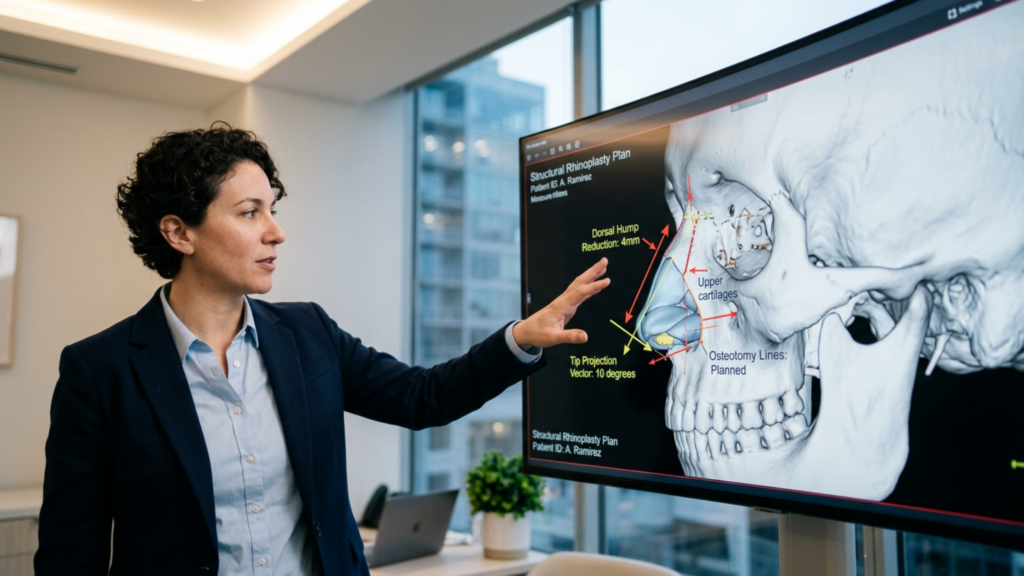
Hier is een inzicht dat de meeste chirurgen over het hoofd zien: de mate van dorsale reductie moet worden afgestemd op de geplande rotatie van de neuspunt. Als je de dorsale zijde met 4 millimeter reduceert, maar de neuspunt slechts met 5 graden roteert, ontstaat er een zichtbare oneffenheid bij de breuk boven de neuspunt. Als je de neuspunt met 15 graden roteert, maar de dorsale zijde nauwelijks aanraakt, wordt de bult een berg op een proportioneel verkorte neus. Dorsale reductie en neuspuntrotatie zijn geometrische partners. Elke millimeter dorsale reductie ontsluit een specifiek bereik van toelaatbare neuspuntrotatie voordat het visuele evenwicht verstoord raakt.
Etniciteit compliceert deze kwestie verder. Bij patiënten van Midden-Oosterse afkomst is de neusrug doorgaans groter, de huid dikker en de ondersteuning van de neuspunt zwakker. Overmatige reductie van de neusrug bij patiënten met een dikke huid uit het Midden-Oosten resulteert vaak in een amorfe, brede neusbrug, omdat het dikke weefsel niet strak over het gereduceerde skelet valt. Bij deze patiënten reduceer ik de neusrug op een meer conservatieve manier en combineer dit met puntvormende hechtingen en dorsale onlay-transplantaten om een verfijnde vrouwelijke lijn te creëren zonder het etnische karakter op te offeren.
Daarentegen hebben patiënten van Oost-Aziatische afkomst doorgaans een lage, platte neusrug in plaats van een bolle bult. Voor deze patiënten is neusrugvergroting – met behulp van kraakbeentransplantaten of zorgvuldig geplaatst structureel materiaal – de aangewezen ingreep. Het vergroten van de neusrug bij Oost-Aziatische patiënten bereikt twee feminiseringsdoelen tegelijk: het creëert het concave neusprofiel dat geassocieerd wordt met vrouwelijke esthetiek, en het versmalt optisch de brede neusbasis door de 'tentpaal' van de neuspiramide omhoog te brengen.
Subeenheid twee: De neuspunt – een herdefiniëring van vrouwelijkheid voorbij de rotatiehoek
De neuspunt is het meest in het oog springende onderdeel van de neus en trekt de meeste aandacht. feminiserende neuscorrectie discussies. Het gesprek blijft echter beperkt tot één dimensie: de rotatiehoek. Ja, de vrouwelijke punt heeft doorgaans een rotatiehoek van 100 tot 108 graden. Maar rotatie is slechts één van de vier kenmerken van de punt die informatie over het geslacht bevatten.
De andere drie zijn vorm, definitie en volume. De mannelijke punt presenteert zich als breed, bolvormig en slecht gedefinieerd – een afgeronde massa die zwaar oogt. De vrouwelijke punt presenteert zich als een smalle, driehoekige, fijn gedefinieerde structuur met duidelijke lichtreflecties langs de koepelvormige hoeken. Het bereiken van deze transformatie vereist rotatie van de neuspunt gecombineerd met tipdefiniërende hechtingen (transdomaal en interdomaal), cephalische trim van de laterale crura en, indien nodig, tiptransplantatie.
Neem een analogie: een vierkante doos roteren maakt er nog geen bol van. Je moet ook de geometrie ervan veranderen. Tip-definiërende hechtingen verkleinen de koepelhoek, waardoor de dubbele lichtreflexen ontstaan die een verfijnde, vrouwelijke neuspunt kenmerken. Cephalische trim vermindert het volume van de laterale crura, waardoor de neuspunt minder volumineus wordt. Bij patiënten met een dikke neushuid – een kenmerk dat veel voorkomt bij diverse etnische groepen – plaats ik een tip-onlay-transplantaat van septumkraakbeen om de neuspunt door de dikke laag heen te laten steken, waardoor een zichtbare definitie ontstaat die met hechtingen alleen niet te bereiken is onder dicht zacht weefsel.
Vermijd de veelgemaakte fout om een dikke neuspunt te veel te roteren om een gebrekkige vorm te compenseren. Overmatige rotatie bij een dikke huid resulteert in een korte, stompe, opstaande neus die er 'kunstmatig' uitziet in plaats van vrouwelijk. Verbeter in plaats daarvan eerst de projectie en definitie van de neuspunt. Zodra de vorm van de neuspunt is vastgesteld, volgt de rotatie vanzelf als een secundaire aanpassing, waarbij meestal slechts 5 tot 10 graden verandering nodig is in plaats van de 15 tot 20 graden die sommige chirurgen proberen.
Subeenheid drie: Chirurgie aan de vleugelbasis – Controle van de basisbreedte
De basis van de neusvleugels vormt het fundament van de neuspiramide en geeft sterke geslachtskenmerken weer. Mannenneuzen hebben doorgaans bredere, dikkere en meer uitlopende neusvleugels met een grotere afstand tussen de neusvleugels. Vrouwenneuzen hebben meestal smallere, dunnere neusvleugels en een kleinere afstand tussen de neusvleugels, waardoor van onderaf gezien een verfijnde, driehoekige basis ontstaat.
Wanneer chirurgen de tip draaien zonder de neusvleugelbasischirurgie Door deze ingreep raakt de voorheen acceptabele breedte van de neusvleugels visueel disproportioneel. De kortere neuslengte na tiprotatie zorgt ervoor dat de basis van de neusvleugels breder lijkt ten opzichte van de nieuwe, kortere neusas. Dit is de reden waarom patiënten die alleen een tiprotatie ondergaan vaak vragen: "Waarom ziet mijn neus er na de operatie breder uit?" Het antwoord is geometrisch: de basis is niet breder geworden, maar het dak erboven is korter geworden.
De reductie van de neusvleugelbasis moet worden afgestemd op de etniciteit van de patiënt. Bij patiënten van Afrikaanse afkomst zijn de neusvleugels doorgaans dikker en de afstand tussen de neusvleugels daadwerkelijk groter. Een agressieve wigresectie van de neusvleugels bij deze patiënten brengt het risico met zich mee van zichtbare littekens en een onnatuurlijke, te smalle basis die niet past bij de andere gelaatstrekken. Ik geef de voorkeur aan een conservatieve, stapsgewijze excisie – vaak een wig van 2 tot 3 millimeter – in combinatie met een excisie van de neusvleugelrand indien nodig, precies in de groef tussen de neusvleugel en het gezicht, om littekens te verbergen.
Patiënten van Latijns-Amerikaanse of Zuidoost-Aziatische afkomst hebben een gemiddelde breedte van de neusvleugels en een variabele dikte van de neusvleugelwand. Bij deze patiënten combineer ik een wigexcisie van de neusvleugel met een implantaat van de neusvleugelrand om inkepingen in de neusvleugel te voorkomen – een misvorming waarbij de neusvleugelrand zich terugtrekt na volumevermindering, waardoor de rand van het neusgat vanaf de zijkant zichtbaar wordt. Bij Noord-Europese en blanke patiënten is de basis van de neusvleugel doorgaans al smal, waardoor een aanpassing mogelijk niet nodig is of slechts een subtiele excisie van de neusvleugelrand vereist.
Een cruciaal technisch punt: een operatie aan de basis van de neusvleugels moet worden uitgevoerd. na De repositionering van de neuspunt en de reductie van de neusrug zijn voltooid. De breedte van de neusvleugelbasis is een afhankelijke variabele: deze verandert wanneer de neushoogte, de projectie van de neuspunt en de neusrugcontour veranderen. Door eerst aan de basis te opereren en vervolgens de neuspunt en neusrug aan te passen, bestaat het risico dat de neusvleugels te veel worden verwijderd zodra de neusproporties tijdens de operatie veranderen.
Subeenheid Vier: Esthetiek van de columella – De centrale pijler van vrouwelijk evenwicht
De columella is de smalle strook weefsel tussen de neusgaten, en de lengte, positie en vorm ervan hebben een grote invloed op de waarneming van de neuspunt en -basis. Esthetiek van de columella Deze elementen worden zelden besproken bij feminiserende rhinoplastiek, terwijl ze een essentieel onderdeel vormen dat de relatie tussen tiprotatie, zichtbaarheid van de neusgaten en alar-columellaire harmonie regelt.
De ideale vrouwelijke columella hangt 2 tot 4 millimeter onder de neusvleugelrand, waardoor een zacht gebogen lobulus onder de neuspunt ontstaat. Een hangende columella (te veel columella zichtbaar) oogt mannelijk omdat het de neusas verlengt en de neuspunt zwaarder doet lijken. Een teruggetrokken columella (te weinig zichtbaar) geeft een korte, opwaartse neus die wijst op overreductie – precies de misvorming die overrotatie veroorzaakt.

Wanneer de rotatie van de neuspunt de koepelvormige kraakbeentjes naar boven trekt, verkort de columella in feite, tenzij de mediale crura tegelijkertijd worden gerepositioneerd en ondersteund. Ik gebruik columellaire steuntransplantaten – kleine rechthoekjes kraakbeen die tussen de mediale crura worden geplaatst – om de positie van de columella onafhankelijk van de rotatie van de neuspunt te controleren. Deze steun fungeert als een kiel, waardoor de columella niet terugtrekt, terwijl de neuspunt wel onafhankelijk kan roteren. Het resultaat is dat de vrouwelijke, 2-4 millimeter zichtbare columella behouden blijft, ongeacht de rotatiehoek.
Bij patiënten met een hangende columella – een veelvoorkomend kenmerk van mannelijke neuzen – voer ik een transfixie-excisie van het membraneuze septum uit, gecombineerd met het herpositioneren van de mediale crura. Deze retractie van de columella moet zorgvuldig worden afgemeten; overmatige retractie in combinatie met rotatie van de neuspunt geeft een "chirurgische" uitstraling die het vertrouwen in het resultaat ondermijnt. Precisie in dit onderdeel onderscheidt een verfijnde chirurg. neuscorrectie van grove pogingen tot gendersignalering.
Etnische neuscorrectie FFS: Eén maat past nooit op alle neuzen.
Als er één principe is dat ervaren plastisch chirurgen gespecialiseerd in feminiserende neuscorrecties onderscheidt van technici, dan is het dit: het ideaalbeeld van een vrouwelijke neus verschilt per etniciteit. Een vrouwelijke blanke neus, een vrouwelijke Oost-Aziatische neus en een vrouwelijke Afrikaanse neus delen conceptuele kenmerken – fijnheid, verfijning, proportionaliteit – maar verschillen aanzienlijk in hun specifieke anatomische parameters.
Etnische neuscorrectie FFS Dit vereist dat de chirurg rekening houdt met de skeletale afkomst van de patiënt, terwijl hij de neusvorm naar vrouwelijke proporties aanpast. Het proberen om één enkel blank sjabloon op elke patiënt toe te passen, leidt tot rampzalige resultaten: te smalle neusvleugels bij patiënten van Afrikaanse afkomst, een ingezakte neusrug bij patiënten uit het Midden-Oosten en onnatuurlijke, verwesterde neuzen bij patiënten uit Oost-Azië. Elk van deze uitkomsten schreeuwt "chirurgie" en versnippert de gelaatsidentiteit van de patiënt.
Mijn aanpak volgt een eenvoudige beslissingsmatrix. Bij patiënten met een prominente neusrug (typisch voor neuzen uit het Midden-Oosten, het Middellandse Zeegebied en sommige blanke neuzen) heeft het verkleinen van de neusrug prioriteit, gevolgd door het definiëren van de neuspunt en een conservatieve rotatie. Bij patiënten met een lage, platte neusrug (typisch voor neuzen uit Oost-Azië, Zuidoost-Azië en sommige Afrikaanse neuzen) heeft het vergroten van de neusrug prioriteit, gevolgd door het vergroten van de neuspuntprojectie en het afvlakken van de neusvleugels. Bij patiënten met brede, dikke neusvleugels (typisch voor neuzen uit Afrika, Afro-Caribisch gebied en sommige Latijns-Amerikaanse neuzen) heeft het aanpassen van de neusvleugels prioriteit, altijd met een conservatieve excisie om zichtbare littekens te voorkomen.
Wat alle etnische benaderingen gemeen hebben, is de filosofie van de neussubeenheden. Ongeacht de etniciteit moet de chirurg elke neussubeenheid beoordelen, de afwijking ervan ten opzichte van het vrouwelijke ideaal voor die etnische groep vaststellen en interventies plannen die elke subeenheid stapsgewijs dichter bij het etnisch-specifieke vrouwelijke doel brengen. De som van deze stapsgewijze aanpassingen resulteert in een neus die als vrouwelijk wordt beschouwd. En Etnisch congruent – twee eigenschappen die samen moeten komen voor een succesvol resultaat.
Vermindering van de rugbult: de onderschatte feminiseringshefboom
Terwijl de chirurgische gemeenschap zich obsessief concentreert op de rotatie van de neuspunt, vermindering van de rugbult Het verwijderen van de neusbult is wellicht de meest krachtige manier om de vrouwelijke vorm van de neus te veranderen bij transgenderpatiënten. De neusbult is het meest opvallende genderkenmerk op de neus – zichtbaar vanuit elke hoek, leesbaar van meters afstand en onmogelijk te camoufleren met make-up of belichting. Door de verwijdering verandert de neus van een horizontale, agressieve structuur in een verticale, elegante vorm.
Het verminderen van de neusbult is echter geen simpele kwestie van bot wegschaven. De bult is een samengestelde structuur: het bovenste derde deel bestaat uit bot (neusbeenderen en het frontale uitsteeksel van de bovenkaak), en de onderste twee derde uit kraakbeen (neusschot en bovenste laterale kraakbeenderen). Een volledige reductie van de neusbult vereist dat beide weefseltypen worden aangepakt. Ik gebruik een componenttechniek: ik scheid de bovenste laterale kraakbeenderen van het neusschot, verklein de neusrug stapsgewijs met een schaar en verklein vervolgens de benige neusrug met een rasp of osteotoom. Na de reductie hecht ik de bovenste laterale kraakbeenderen weer vast met hechtdraden of plaats ik spreidingsgrafts om de interne neusklep open te houden.
De vrouwelijke dorsale lijn verschilt van de mannelijke niet alleen in hoogte, maar ook in vorm. De mannelijke dorsale lijn loopt recht of licht convex. De vrouwelijke dorsale lijn loopt recht tot licht concaaf, met een subtiele knik boven de neuspunt – een lichte inkeping net boven de neuspunt die schaduw creëert en de neusrug visueel van de neuspunt scheidt. Om deze knik boven de neuspunt te bereiken, moet het neusschot 1 tot 2 millimeter lager liggen dan de neuspunt bij de voorste neushoek. Dit creëert een bewuste contourvariatie die er delicaat en vrouwelijk uitziet. (Daniel & Calista, Plastische en Reconstructieve Chirurgie, 2013). Dit detail is onzichtbaar bij gemiddelde resultaten, maar onmiskenbaar bij superieure resultaten.
Neuscorrectie bij transgenderpatiënten: functionele en esthetische integratie
Transgenderpatiënten die een gezichtsvervrouwelijking ondergaan, geven vaak de voorkeur aan hun uiterlijk, en dat is begrijpelijk – het gezicht is immers het belangrijkste middel om genderidentiteit uit te drukken. Echter, neuscorrectie transgender De procedures hebben functionele gevolgen die niet genegeerd kunnen worden. De neus moet net zo goed kunnen ademen als dat hij eruitziet. Overmatige rotatie vernauwt de interne neusklep. Overmatige reductie van de neusrug doet de middelste neusholte inzakken. Overmatige vernauwing van de neusvleugelbasis beperkt de externe neusklep. Elke ingreep aan een subeenheid, indien uitgevoerd zonder functioneel inzicht, verhoogt het risico.
In mijn praktijk bij Dr. MFO Kliniek, Elk plan voor feminiserende rhinoplastiek omvat een functionele beoordeling. Ik beoordeel de interne neusklephoek (normaal is 10 tot 15 graden), de uitlijning van het septum, de grootte van de neusschelpen en de competentie van de neusvleugels. Wanneer ik de neusrug verklein, plaats ik preventief spreidingsgrafts bij elke patiënt met een klephoek kleiner dan 15 graden. Wanneer ik de neuspunt roteer, beoordeel ik de ondersteuning van de columella om klepcollaps te voorkomen. Wanneer ik de basis van de neusvleugels versmal, behoud ik voldoende luchtwegdiameter om externe klepvernauwing te voorkomen.
Deze functionele waarborgen doen geen afbreuk aan het esthetische resultaat. Integendeel, ze verbeteren het juist. Een structureel gezonde neus behoudt zijn vorm tientallen jaren. Een structureel aangetaste neus gaat mis: de neuspunt zakt, de neusbrug wordt breder en de neusvleugels zakken in. Functionele integriteit en esthetische schoonheid zijn geen tegenstrijdige krachten, maar versterken elkaar. Het vermogen van de patiënt om vrij te ademen door een neus die er ook vrouwelijk uitziet, is de ultieme maatstaf voor het succes van de operatie.
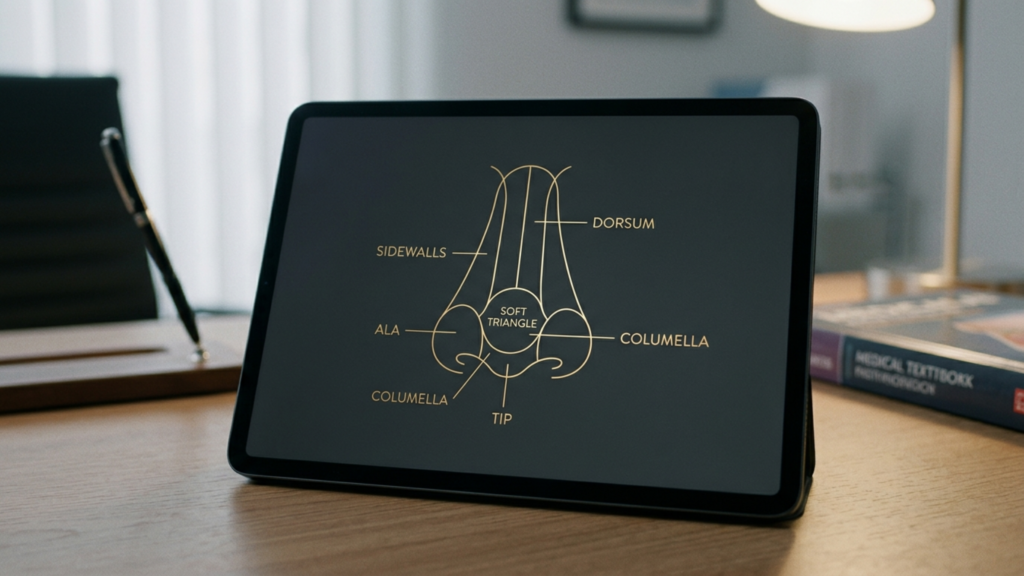
Neusonderdelen en het sequentiële chirurgische plan
Het uitvoeren van een op subeenheden gebaseerde feminiserende neuscorrectie vereist een gedisciplineerde chirurgische procedure. De volgorde van de ingrepen is van belang, omdat elke aanpassing de verhoudingen tussen aangrenzende subeenheden opnieuw kalibreert. Ik volg een specifieke, reproduceerbare procedure die in de loop der jaren is verfijnd. gespecialiseerde neuscorrectiepraktijk.
- Stap 1—Eerst dorsale reductie: Bepaal de nieuwe ruglijn. Deze lijn bepaalt de verticale as van de neus en hoeveel rotatie van de neuspunt de verhoudingen kunnen verdragen.
- Stap 2—Plaatsing van de spreidingsgraft: Reconstrueer de interne neusklep na dorsale reductie. Plaats bilateraal kraakbeenspreidtransplantaten om de klephoek van 10-15 graden te behouden.
- Stap 3—Definitie van de kolomvormige steunbalk en het uiteinde: Plaats een columellaire steun om de positie van de columella te controleren, en breng vervolgens transdomale en interdomale hechtingen aan om de punt te definiëren en te versmallen.
- Stap 4—Trotatie van de punt: Nadat de punt is bepaald en de columella is ondersteund, draai je de punt naar de voor de betreffende etnische groep geschikte vrouwelijke hoek – doorgaans 100-105 graden voor blanke vrouwen, 95-100 graden voor Oost-Aziatische vrouwen en 95-100 graden voor vrouwen van Afrikaanse afkomst.
- Stap 5—Osteotomieën: Voer laterale en mediale osteotomieën uit om de benige piramide te versmallen, waarbij de nieuwe dorsale breedte wordt aangepast aan de verfijnde breedte van de neuspunt.
- Stap 6—Aanpassing van de alarbasis: Nadat de neuspunt en de neusrug zijn afgewerkt, moet de basis van de neusvleugels worden beoordeeld. Als de afstand tussen de neusvleugels groter is dan de afstand tussen de binnenste ooghoeken, moet een geleidelijke wigexcisie van de neusvleugels of een excisie van de neusvleugelbasis worden uitgevoerd.
- Stap 7 - Definitieve contourafwerking en sluiting: Verfijn de supratipbreuk, verwijder overtollig opperhuidweefsel, sluit de incisies zorgvuldig en breng de spalk aan.
Deze procedure respecteert de geometrische afhankelijkheden tussen de verschillende onderdelen. Elke stap bouwt voort op de vorige en elke aanpassing wordt gevalideerd ten opzichte van het aangrenzende onderdeel voordat de chirurg verdergaat. Het resultaat is een neus waarbij de neusrug, neuspunt, neusvleugel en neusbasis harmonieus en vrouwelijk samenwerken in een evenwichtige compositie, in plaats van elkaar te belemmeren.
Pas deze aanpak toe: uw stapsgewijze handleiding voor de evaluatie van subeenheden
Overweegt u een feminiserende neuscorrectie? Gebruik dan de volgende stappen voor zelfevaluatie om te bepalen of een benadering met één variabele of een uitgebreidere benadering met meerdere subeenheden het meest geschikt is voor uw anatomie. Bij elke stap wordt u gevraagd om één subeenheid eerlijk te onderzoeken en uw bevindingen te noteren.
- Bekijk je rugprofiel. Ga zijdelings voor een spiegel staan. Is uw profiel bol (bult), recht of hol? Een bol profiel duidt op een mannelijke rugstructuur en vereist een reductie. Een vlak of hol profiel vereist mogelijk een augmentatie, afhankelijk van uw etniciteit.
- Meet de rotatie van je tip. Fotografeer je gezicht vanaf de zijkant en trek een lijn van de neuswortel naar het subnasale punt, en vervolgens van het subnasale punt naar het punt dat de neuspunt definieert. Schat de nasolabiale hoek. Als deze lager is dan 95 graden, kan het draaien van de neuspunt helpen, maar alleen als de neusrug dit toelaat.
- Evalueer uw definitie van de fooi. Van voren gezien, lijkt uw tip één enkele ronde reflectie te hebben of twee afzonderlijke lichtreflecties? Een enkele reflectie duidt op een bolle vorm die bijgeschaafd moet worden, niet alleen gedraaid.
- Evalueer de breedte van de vleugelbasis. Vergelijk de afstand tussen uw neusvleugels met de afstand tussen uw binnenste ooghoeken. Als de basis van de neusvleugels breder is dan uw ogen, dient een correctie van de neusvleugels samen te vallen met een ingreep aan de neuspunt of de bovenzijde van uw ogen.
- Controleer de weergave van de kolommen. Hoeveel van de columella hangt er vanaf de zijkant onder de neusvleugelrand? Als dit meer dan 4 millimeter is, moet een columellareductie in combinatie met een repositionering van de neuspunt worden overwogen.
- Houd rekening met je etnische achtergrond. Vergelijk uw neusvorm niet met een algemeen ideaal, maar met vrouwelijke neuzen van uw eigen etnische groep. Dit voorkomt onrealistische verwachtingen en overbehandeling door middel van chirurgie.
- Plan een consult in waarin alle onderdelen aan bod komen. Vraag tijdens een gesprek met een chirurg specifiek hoe hij of zij van plan is uw neusrug, neuspunt, columella en neusvleugelbasis aan te passen – niet alleen de rotatiehoek. Een chirurg die alleen de rotatie bespreekt, plant een ingreep met slechts één variabele.
Klaar voor de volgende stap naar een natuurlijk vrouwelijke neus? Dien uw aanvraag in naar Dokter MFO Kom vandaag nog naar de kliniek en ontvang een persoonlijke, subunit-voor-subunit chirurgische beoordeling die is afgestemd op uw unieke anatomie.
Veelgestelde vragen
Waarom zorgt alleen een rotatie van de neuspunt niet voor een vrouwelijke neus?
Tiprotatie pakt slechts één van de vier variabelen van de neuspunt aan: de hoek. Zonder tegelijkertijd de definitie, het volume en de contour van de neuspunt te veranderen, en zonder de neusrug, de columella en de basis van de neusvleugel aan te passen, creëert rotatie een overmatig gedraaid, onnatuurlijk uiterlijk dat eerder doet denken aan een chirurgische ingreep dan aan authentieke vrouwelijkheid.
Wat is een neussubunitbenadering bij feminiserende neuscorrectie?
Bij een neussubunitbenadering worden alle anatomische zones van de neus – de neusrug, neuspunt, neusvleugelbasis en neusplooi – als onderling afhankelijke structuren geëvalueerd en aangepast. Elke subunit wordt afgestemd op de andere en op de etnische anatomie van de patiënt, wat resulteert in een evenwichtig, natuurlijk vrouwelijk uiterlijk in plaats van een aanpassing op één enkele variabele.
Welke invloed heeft etniciteit op de planning van een feminiserende neuscorrectie?
Etniciteit bepaalt de aanvankelijke neusarchitectuur van de patiënt: huiddikte, hoogte van de neusrug, breedte van de neusvleugels en ondersteuning van de neuspunt. Een blanke vrouwelijke neus verschilt van een Oost-Aziatische of Afrikaanse vrouwelijke neus. De subunit-benadering past elke zone aan een etnisch-specifiek vrouwelijk ideaal aan, in plaats van een universeel sjabloon op te leggen.
Wat is het verminderen van de neusrugbult en waarom is dit belangrijk voor de feminisering van de neus?
Bij het verwijderen van de neusrugbult wordt de bolle, benige en kraakbeenachtige uitstulping langs de neusrug weggehaald. Hierdoor verandert de neus van een horizontaal, mannelijk profiel in een verticaal, elegant profiel. Het is wellicht de krachtigste manier om de neus te feminiseren, omdat de neusrugbult het meest zichtbare genderkenmerk op de neus is.
Hoe vult chirurgie aan de basis van de neusvleugels de rotatie van de neuspunt aan?
Door de rotatie van de neuspunt wordt de zichtbare lengte van de neus verkort, waardoor de bestaande breedte van de neusvleugels in verhouding groter lijkt. Een operatie aan de basis van de neusvleugels versmalt deze basis om de nieuwe verhoudingen te corrigeren. Zonder aanpassing van de neusvleugels rust een geroteerde neuspunt op een onevenredig brede basis, wat een onnatuurlijk en onevenwichtig uiterlijk creëert.
Kan een feminiserende neuscorrectie de neusademhalingsfunctie behouden?
Ja. Een op subeenheden gebaseerde aanpak omvat functionele waarborgen zoals spreidingsgrafts na dorsale reductie, columellaire steunbalkjes tijdens tiprotatie en alarrandgrafts tijdens basisvernauwing. Deze behouden of verbeteren de interne en externe neuskleppen, waardoor de neus net zo goed ademt als dat hij eruitziet.
Wat is de supratipbreuk en waarom is deze belangrijk bij een feminiserende neuscorrectie?
De supratip break is een subtiele verdieping net boven de neuspunt die een schaduwlijn creëert tussen de neusrug en de neuspunt. Dit contourdetail is een kenmerk van de vrouwelijke neusesthetiek. Het vereist een precieze reductie van de neusrug, waarbij de voorste septumhoek iets lager ligt dan de neuspunt, waardoor een opzettelijke, delicate schaduw ontstaat.
Hoe weet ik of ik een op subeenheden gebaseerde aanpak nodig heb voor mijn neuscorrectie?
Als uw neusanatomie afwijkingen vertoont in meer dan één onderdeel – zoals een bult op de neusrug, brede neusvleugels en een bolvormige neuspunt – zal een aanpak die zich op één variabele richt, niet werken. Bekijk uw neus vanuit alle hoeken en identificeer welke onderdelen afwijken van uw etnische vrouwelijke ideaal. Meerdere afwijkingen vereisen een alomvattende aanpak die rekening houdt met alle onderdelen.