

The trichophytic incision is a surgical technique designed to minimize visible scarring in forehead lift and facial feminization surgery (FFS) by allowing hair to grow through the incision line. This method is particularly valuable for patients undergoing hairline lowering, forehead reduction, or brow lift procedures, where aesthetic outcomes and scar concealment are critical. Unlike traditional coronal or pretrichial incisions, the trichophytic approach strategically bevels the incision to transect hair follicles, enabling hair regrowth directly through the scar. This innovation has revolutionized upper facial rejuvenation and gender-affirming surgeries, offering a near-invisible scar while achieving precise anatomical adjustments.
This article explores the mechanism, applications, and advantages of the trichophytic incision in forehead lift and FFS, with a focus on postoperative care strategies to prevent scar formation. The discussion is grounded in peer-reviewed studies, clinical guidelines, and expert consensus to ensure evidence-based insights.
What Is a Trichophytic Incision?
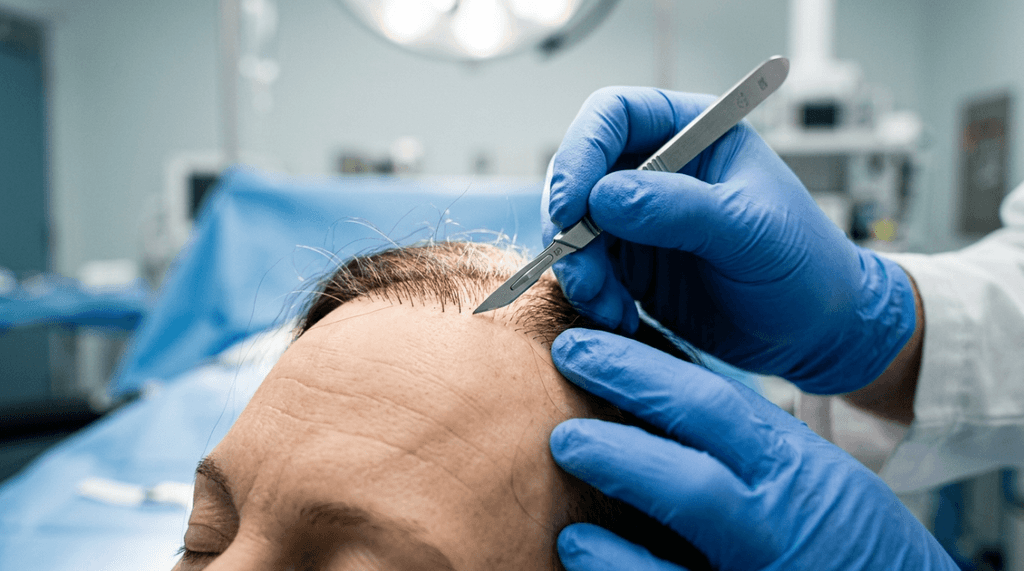
The trichophytic incision is a surgically beveled cut made along the hairline, typically 2–3 millimeters posterior to the anterior hairline (Kim & Hong, 2020). The incision is angled to transect hair follicles, allowing hair to regrow through the scar tissue. This technique was first introduced by Marzola in 2005 and has since become a gold standard for procedures requiring hairline adjustment or scar camouflage (Kim & Hong, 2020).
Mechanism of Scar Camouflage
- Beveled Incision: The surgeon creates an incision at a 45-degree angle, cutting through the dermis and hair follicles while preserving the subcutaneous layer.
- Hair Follicle Transection: By intentionally severing hair follicles, the incision stimulates new hair growth through the healing scar.
- Wound Closure: The scalp and forehead flaps are approximated with minimal tension, ensuring optimal alignment for hair regrowth.
- Postoperative Hair Growth: Within 3–6 weeks, hair begins to grow through the incision line, concealing the scar and blending it with the natural hairline (Mayer, 2020).
This method is particularly effective in forehead lift, hairline lowering, and FFS, where minimal scarring is a priority.
Applications in Forehead Lift and Facial Feminization Surgery (FFS)
1. Forehead Lift (Brow Lift)
The trichophytic incision is widely used in forehead lift (brow lift) surgeries to:
- Lower a high hairline (common in patients with genetic or age-related forehead elongation).
- Elevate the eyebrows to a more youthful position.
- Reduce forehead rhytids (deep wrinkles) by tightening the forehead skin.
- Maintain or adjust hairline position without visible scarring (Dunn & Hohman, 2024).
Clinical Outcomes in Forehead Lift
A retrospective study by Holcomb and McCollough (2001) evaluated 99 patients who underwent trichophytic incisions for upper facial rejuvenation:
- 72% of patients (42/58) achieved optimal results with frontal trichophytic incisions.
- The technique was especially effective in revision surgeries, where previous procedures had elevated the hairline beyond an acceptable position.
- No significant hairline elevation occurred, preserving the natural hairline contour.
2. Facial Feminization Surgery (FFS)
In FFS, the trichophytic incision is a cornerstone technique for:
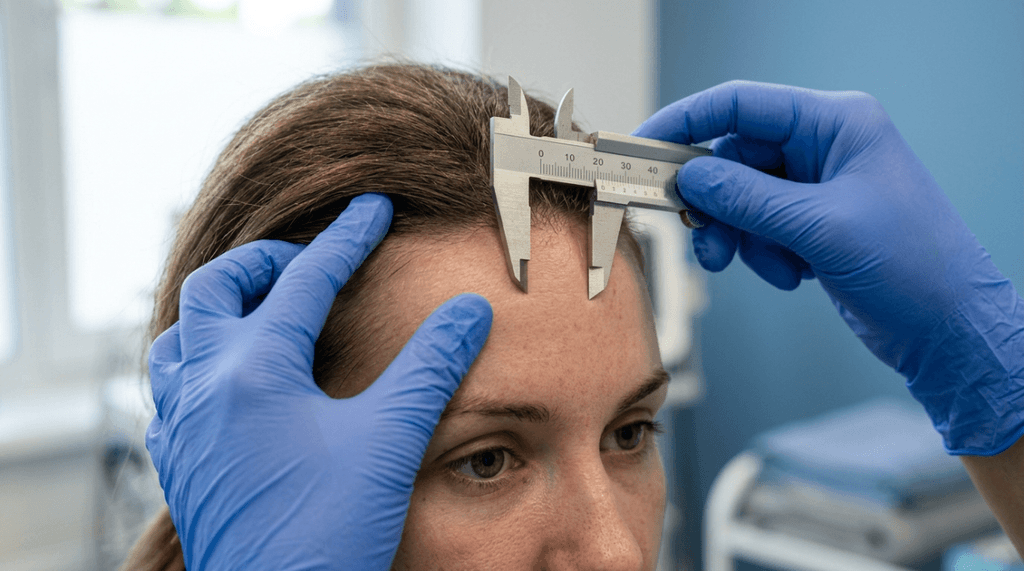
- Hairline lowering (reducing forehead height for a more feminine appearance).
- Forehead contouring (reshaping the frontal bone and soft tissue).
- Brow lift (elevating the eyebrows to a more feminine position).
Objective Outcomes in FFS
A 2022 PubMed study (PMID: 36580551) quantified the results of trichophytic brow lift with hairline advancement in FFS:
- Average brow lift: 4–5 mm
- Average hairline lowering: 6–7 mm
- Average forehead reduction: 10–11 mm
- Result: A more feminine upper facial third, with minimal visible scarring due to hair regrowth through the incision (AYZUbXMU, 2022).
Trichophytic Incision vs. Traditional Techniques
| Feature | Trichophytic Incision | Coronal Incision | Pretrichial Incision |
|---|---|---|---|
| Scar Visibility | Minimal (hair grows through scar) | Moderate (hidden in scalp) | Moderate (anterior to hairline) |
| Hairline Adjustment | Yes (can lower or raise hairline) | Elevates hairline | Can lower hairline |
| Surgical Exposure | Excellent (full access to forehead) | Excellent | Good |
| Recovery Time | 2–3 weeks (hair regrowth begins) | 3–4 weeks | 2–3 weeks |
| Best For | Hairline lowering, FFS, scar camouflage | High hairline patients | Patients with stable hairlines |
Postoperative Care: Preventing Scar Formation
While the trichophytic incision minimizes scarring, proper postoperative care is essential to ensure optimal healing and scar camouflage. The following strategies are evidence-based and recommended by plastic surgery experts:
1. Immediate Postoperative Care (0–7 Days)
- Dressing and Compression:
- Apply a light compressive dressing (e.g., Barton-type dressing) to reduce swelling and hematoma risk (Dunn & Hohman, 2024).
- Avoid excessive pressure on the brows to prevent flap necrosis.
- Antibiotic Ointment:
- Use topical antibiotic ointment (e.g., bacitracin) on sutures to prevent infection.
- Pain Management:
- Prescribe oral analgesics (e.g., acetaminophen, ibuprofen) for mild to moderate pain.
- Avoid aspirin (increases bleeding risk).
2. Early Recovery (1–4 Weeks)
- Suture/Staple Removal:
- Remove sutures or staples at 7–10 days post-op (Dunn & Hohman, 2024).
- Hair and Scar Care:
- Avoid hair dyes, heat styling, or chemical treatments for at least 4 weeks.
- Gently cleanse the incision with mild shampoo (e.g., baby shampoo) to prevent folliculitis.
- Avoid picking at scabs to prevent scar widening.
- Swelling and Bruising:
- Cold compresses (first 48 hours) to reduce swelling.
- Arnica montana (topical or oral) may accelerate bruise resolution (though evidence is mixed).
3. Long-Term Scar Management (4+ Weeks)
- Hair Regrowth Monitoring:
- New hair growth typically begins at 3–6 weeks.
- Full camouflage may take 3–6 months (Mayer, 2020).
- Scar Massage:
- Gentle scar massage (after suture removal) with silicone gel or vitamin E oil to soften the scar.
- Sunscreen Protection:
- SPF 30+ sunscreen to prevent hyperpigmentation of the scar.
- Avoid Smoking and Alcohol:
- Smoking impairs wound healing and increases scar risk (Dunn & Hohman, 2024).
4. Complications and Mitigation Strategies
| Complication | Prevention Strategy | Management |
|---|---|---|
| Hematoma/Seroma | Compressive dressing, avoid trauma | Drainage, antibiotics if infected |
| Infection | Antibiotic ointment, sterile technique | Oral antibiotics (e.g., cephalexin) |
| Scar Widening | Minimal tension closure, layered suturing | Scar revision, laser therapy |
| Alopecia (Hair Loss) | Gentle hair care, avoid traction | Hair growth stimulants (e.g., minoxidil) |
| Nerve Injury | Careful dissection (avoid temporal nerve) | Physical therapy, time (usually resolves) |

Case Studies: Trichophytic Incision in Practice
Case 1: Hairline Lowering in a Cisgender Female
- Patient: 45-year-old female with a high hairline and forehead elongation.
- Procedure: Endoscope-assisted trichophytic anterior hairline brow lift (Kim & Hong, 2020).
- Outcome:
- Hairline lowered by 8 mm.
- Scar completely concealed by hair regrowth at 6 months.
- Patient satisfaction: 9/10 (minimal visibility, natural appearance).
Case 2: Facial Feminization Surgery (FFS)
- Patient: 28-year-old transgender female seeking forehead reduction and brow lift.
- Procedure: Trichophytic brow lift + hairline advancement + frontal sinus reshaping (AYZUbXMU, 2022).
- Outcome:
- Forehead reduced by 11 mm.
- Brow lift of 5 mm.
- Hairline lowered by 7 mm.
- Scar undetectable at 12 months due to hair regrowth.
Why Choose Trichophytic Incision for FFS and Forehead Lift?
- Scarless or Near-Invisible Results:
- Hair grows directly through the scar, making it virtually undetectable (Mayer, 2020).
- Precision in Hairline Adjustment:
- Allows millimeter-perfect lowering or raising of the hairline.
- Versatility:
- Suitable for cisgender patients (forehead lift) and transgender patients (FFS).
- Faster Recovery:
- Less downtime compared to traditional coronal lifts.
- High Patient Satisfaction:
- >90% of patients report excellent or good outcomes (Holcomb & McCollough, 2001).
Limitations and Considerations
While the trichophytic incision is highly effective, it may not be suitable for all patients:
- Receding Hairlines: Patients with male-pattern baldness may not achieve full scar camouflage.
- History of Poor Scarring: Those with keloid or hypertrophic scarring may require alternative techniques (e.g., endoscopic lift).
- Low Hair Density: Patients with thin hair may have less effective scar concealment.
- Surgeon Expertise: The technique has a learning curve and requires precise beveling to avoid follicle damage (Kim & Hong, 2020).

Conclusion
The trichophytic incision represents a paradigm shift in forehead lift and FFS, offering scarless or near-invisible results through hair regrowth integration. Its ability to lower the hairline, elevate the brows, and reshape the forehead—while minimizing visible scarring—makes it a preferred choice for both aesthetic and gender-affirming surgeries.
For optimal outcomes, meticulous surgical technique, proper postoperative care, and patient-specific considerations are essential. By adhering to evidence-based practices, surgeons can maximize aesthetic results and minimize complications, ensuring high patient satisfaction.
Sources
- Dunn, T., & Hohman, M. H. (2024). Pretrichial Brow Lift. StatPearls Publishing. https://www.ncbi.nlm.nih.gov/books/NBK570632/
- Holcomb, J. D., & McCollough, E. G. (2001). Trichophytic Incisional Approaches to Upper Facial Rejuvenation. Archives of Facial Plastic Surgery. https://journals.sagepub.com/doi/abs/10.1001/archfacial.qst00014.48
- Kim, J. M., & Hong, J. G. (2020). Endoscope-Assisted Trichophytic Anterior Hairline Brow Lift. Archives of Aesthetic Plastic Surgery, 26(2), 59-65. https://e-aaps.org/journal/view.php?number=59&viewtype=pubreader
- Mayer, T. (2020). Forehead Reduction and Hairline Lowering. Dr. Toby Mayer. https://www.drtobymayer.com/forehead-reduction-hairline-lowerin
- National Center for Biotechnology Information. (2022). Objective Outcomes of Trichophytic Brow Lift and Hairline Advancement in Facial Feminization Surgery. PubMed. https://pubmed.ncbi.nlm.nih.gov/36580551/