

Introduction
Facial Feminization Surgery (FFS) is a transformative set of procedures designed to align the facial features of transgender women with a more traditionally feminine appearance. Among the most impactful interventions is the feminization of the hairline, a critical element in softening the upper facial third and eliminating masculine traits. The M-shaped male hairline, characterized by deep temporal recessions, contrasts sharply with the rounded, lower, and more uniform female hairline, which sits closer to the eyebrows and frames the face with a softer, more youthful contour (Knott et al., 2024; 8VRR4U10).
Two primary surgical approaches exist for creating a feminine hairline: scalp advancement (hairline lowering surgery) and hair transplantation (FUE/FUT). Each method offers distinct advantages, limitations, and outcomes, and the optimal choice depends on individual anatomy, hair loss patterns, and aesthetic goals. This article explores the differences between male and female hairlines, compares scalp advancement and hair transplantation, and discusses hybrid approaches for achieving the most natural, feminine forehead contour.

Male vs. Female Hairline: Key Anatomical Differences
The male hairline typically exhibits an M-shaped pattern, with pronounced recessions at the temples and a higher, more angular forehead. This configuration is influenced by androgenetic alopecia, which causes progressive thinning and recession, particularly at the frontal and temporal regions (lb5drR8a, 2018; 8VRR4U10). In contrast, the female hairline is rounded, lower, and more uniform, with minimal temporal recession. It sits 4–6 cm above the glabella (the area between the eyebrows) and maintains a softer, more gradual transition into the forehead (PLe8rEt5, 2013; 7sHm9GlV, n.d.).
| Feature | Male Hairline | Female Hairline |
|---|---|---|
| Shape | M-shaped, angular | Rounded, uniform |
| Position | Higher on the forehead | Lower, closer to the eyebrows |
| Temporal Recession | Pronounced | Minimal or absent |
| Density | Thinner at temples | Even density |
| Stability | Prone to recession (androgenetic alopecia) | Stable, less prone to dramatic changes |
These differences are not merely aesthetic; they play a critical role in facial gender perception. Studies confirm that the upper facial third—comprising the forehead, brow, and hairline—is the most influential region in determining gender recognition (Knott et al., 2024; 8VRR4U10).

Scalp Advancement (Hairline Lowering Surgery)
What Is Scalp Advancement?
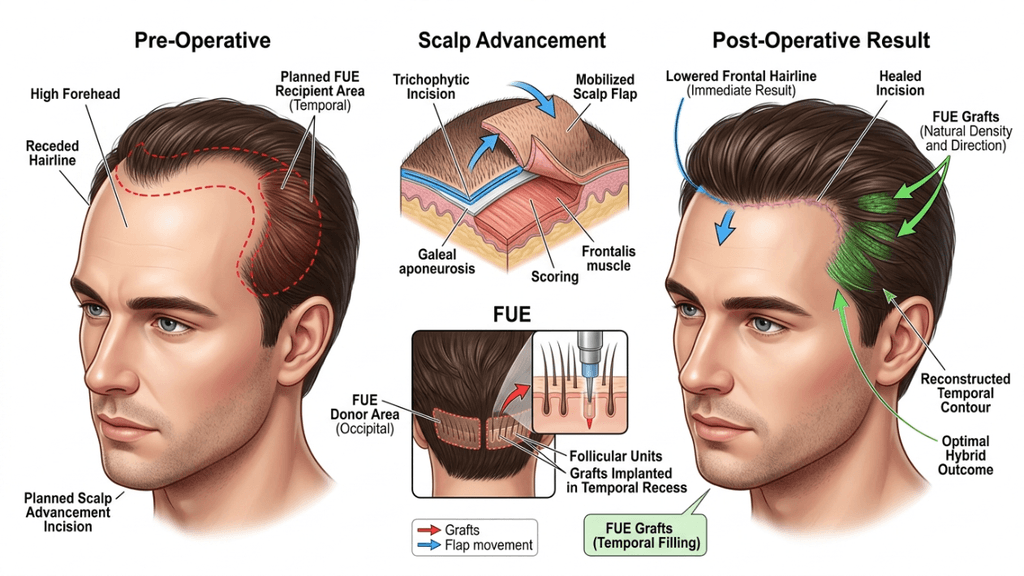
Scalp advancement, also known as hairline lowering surgery or forehead reduction, is a surgical procedure that physically moves the hairline forward by excising a strip of forehead skin and pulling the scalp downward. This method instantly reduces forehead height and creates a lower, more feminine hairline (Epstein & Epstein, 2020; GNbVynKD, 2023).
Technique and Process
- Preoperative Assessment: The surgeon evaluates scalp laxity (how much the scalp can stretch) to determine the feasible amount of advancement. Typically, 5–10 mm of lowering is achievable, though balloon tissue expansion can extend this to 15–20 mm in select cases (GNbVynKD, 2023).
- Incision and Advancement: A trichophytic incision (hidden within the hairline) is made, and the scalp is advanced forward. Excess forehead skin is removed, and the scalp is sutured into its new position.
- Scar Management: The resulting scar is fine and linear, often concealed within the hairline. In some cases, additional hair transplants may be used to further camouflage the scar (GNbVynKD, 2023).
Advantages of Scalp Advancement
✅ Immediate Results: The hairline is lowered instantly, with visible changes from the first postoperative day. ✅ High Density: Provides unsurpassed hair density along the new hairline, as the existing hair is preserved and repositioned. ✅ Natural Contour: Creates a smooth, rounded hairline that mimics the female aesthetic. ✅ Long-Term Stability: Results are permanent, with no risk of hair loss in the advanced area (unless underlying alopecia is present).
Limitations and Considerations
⚠ Scalp Laxity Dependency: Not all patients are candidates. Those with tight scalps may achieve only minimal advancement (2–4 mm). ⚠ Scar Visibility: While often well-hidden, the scar may be visible in some lighting conditions or with certain hairstyles (e.g., pulled-back hair). ⚠ Sensory Changes: Temporary numbness in the forehead due to nerve disruption (typically resolves within 8–12 months). ⚠ Not Suitable for Receding Hairlines: Patients with active hair loss (e.g., androgenetic alopecia) are poor candidates, as the advanced hairline may recede over time (GNbVynKD, 2023; pA9cCwch, 2023).
Ideal Candidates for Scalp Advancement
- Individuals with a stable, non-receding hairline.
- Those with high foreheads (congenital or post-trauma).
- Patients seeking immediate, dramatic lowering of the hairline.
- Transgender women undergoing FFS with sufficient scalp laxity.
Hair Transplantation (FUE) for Hairline Feminization
What Is FUE Hair Transplantation?
Follicular Unit Extraction (FUE) is a minimally invasive hair restoration technique where individual hair follicles are extracted from a donor area (typically the back of the scalp) and implanted along the hairline. This method allows for precise control over hairline shape, density, and angle, making it ideal for feminizing an M-shaped hairline (4pr4aH28, 2024; xj70LWOM, 2008).
Technique and Process
- Donor Hair Extraction: Follicles are harvested using a micro-punch tool, leaving minimal scarring.
- Recipient Site Creation: Tiny incisions are made along the desired hairline, following a feminine template (rounded, lower, with soft transitions).
- Graft Placement: Follicles are implanted at natural angles to replicate the female hairline’s soft, feathery edge.
Advantages of FUE Hair Transplantation
✅ Customizable Shape: Allows for precise sculpting of the hairline, including filling temporal recessions (the “M” to “U” transition). ✅ No Linear Scar: Unlike scalp advancement, FUE leaves no visible linear scar (only tiny, dot-like scars in the donor area). ✅ Suitable for Hair Loss: Ideal for patients with thinning or receding hairlines due to androgenetic alopecia. ✅ Gradual, Natural Results: Hair grows in naturally over 6–12 months, blending seamlessly with existing hair.
Limitations and Considerations
⚠ Gradual Results: Full results take 6–12 months, requiring patience. ⚠ Multiple Sessions May Be Needed: Achieving optimal density may require 1–2 sessions, spaced 6–12 months apart. ⚠ Donor Area Limitations: Patients with limited donor hair (e.g., extensive baldness) may not achieve sufficient density. ⚠ Higher Cost: Generally more expensive than scalp advancement, especially for large areas (SWgAUiqA, 2024).
Ideal Candidates for FUE Hair Transplantation
- Individuals with M-shaped or receding hairlines.
- Those with insufficient scalp laxity for advancement.
- Patients who prefer no linear scar or have had prior scalp surgeries.
- Transgender women with androgenetic alopecia or temporal thinning.
Scalp Advancement vs. Hair Transplant: A Comparative Analysis
| Factor | Scalp Advancement | FUE Hair Transplant |
|---|---|---|
| Results Timeline | Immediate (visible post-op) | Gradual (6–12 months) |
| Density | Full density (existing hair repositioned) | Depends on graft count (may require multiple sessions) |
| Scarring | Linear scar (hidden in hairline) | No linear scar (tiny dot scars in donor area) |
| Suitability for Hair Loss | Not ideal (requires stable hairline) | Ideal (works with receding/thinning hair) |
| Forehead Height Reduction | Yes (5–20 mm) | No (only adds hair, does not lower skin) |
| Cost | Lower (single procedure) | Higher (per graft, multiple sessions possible) |
| Recovery Time | 1–2 weeks (sutures removed in 7–10 days) | 5–7 days (minimal downtime) |
| Risk of Complications | Nerve damage (temporary numbness) | Infection, graft failure (rare) |
| Long-Term Stability | Permanent (unless alopecia progresses) | Permanent (transplanted hair is DHT-resistant) |
Which Procedure Is Better for Feminizing the Hairline?
The choice depends on individual anatomy and goals:
| Scenario | Recommended Approach | Why? |
|---|---|---|
| High forehead, stable hairline | Scalp Advancement | Immediate, dense lowering of the hairline. |
| M-shaped hairline, temporal recession | FUE Hair Transplant | Fills recessions and reshapes the hairline. |
| Thinning hair, androgenetic alopecia | FUE Hair Transplant | Restores density where scalp advancement cannot. |
| Prior scalp surgery (e.g., FUT) | FUE Hair Transplant | Avoids further scarring; adds hair where needed. |
| Severe forehead height + M-shape | Hybrid (Advancement + FUE) | Combines immediate lowering with temporal fill. |
Hybrid Approaches: Combining Scalp Advancement and Hair Transplantation
For patients with both a high forehead and an M-shaped hairline, a hybrid approach—combining scalp advancement and FUE hair transplantation—often yields the most natural, feminine result.
How It Works
- Scalp Advancement First: The hairline is lowered surgically, reducing forehead height.
- FUE for Temporal Recessions: 3–6 months post-advancement, FUE is used to:
- Fill the temporal recessions (softening the “M” into a “U”).
- Camouflage the advancement scar (if visible).
- Increase density at the new hairline.
Advantages of Hybrid Approaches
✅ Best of Both Worlds: Combines the immediate lowering of advancement with the precision of FUE. ✅ Natural Feminine Contour: Achieves a rounded, soft hairline with no visible gaps. ✅ Customizable: Tailored to the patient’s unique hairline shape and forehead height.
Case Example
A 28-year-old transgender woman presents with:
- A high forehead (7 cm from glabella to hairline).
- An M-shaped hairline with deep temporal recessions.
- Stable hair density in the donor area.
Treatment Plan:
- Scalp Advancement: Lowers hairline by 10 mm, reducing forehead height.
- FUE (2,000 grafts): Fills temporal recessions and softens the hairline edges. Result: A natural, rounded female hairline with immediate and long-term benefits.
Patient Selection and Preoperative Planning
Key Considerations for Choosing Between Scalp Advancement and Hair Transplant
| Factor | Scalp Advancement | FUE Hair Transplant |
|---|---|---|
| Forehead Height | ✅ Ideal for high foreheads | ❌ Does not reduce forehead height |
| Hairline Shape | ❌ Cannot fix M-shape alone | ✅ Ideal for reshaping M to U |
| Hair Density | ✅ Preserves existing density | ⚠ Requires sufficient donor hair |
| Scalp Laxity | ✅ Must have good laxity | ❌ Not dependent on laxity |
| Prior Hair Loss | ❌ Not suitable if receding | ✅ Works with thinning/receding hair |
| Scar Tolerance | ⚠ Linear scar (hidden) | ✅ No linear scar |
| Budget | ✅ Lower cost | ❌ Higher cost |
Preoperative Assessment
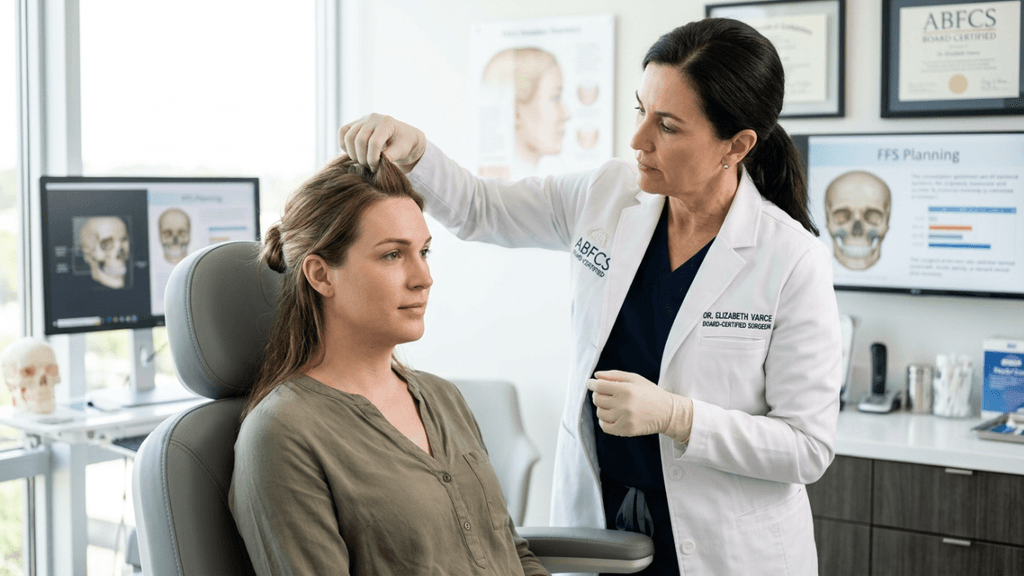
A thorough evaluation by a board-certified FFS or hair restoration surgeon should include:
- Scalp Laxity Test: Measures how far the scalp can advance.
- Hairline Analysis: Determines if the hairline is M-shaped, receding, or stable.
- Donor Hair Evaluation: Assesses density and availability for FUE.
- Forehead Height Measurement: Identifies if scalp advancement is feasible.
- Patient Goals: Discusses expectations, timeline, and budget.
Recovery, Risks, and Long-Term Outcomes
Recovery Timeline
| Procedure | First Week | 2–4 Weeks | 1–3 Months | 6–12 Months |
|---|---|---|---|---|
| Scalp Advancement | Swelling, bruising, sutures | Sutures removed, initial healing | Scar maturation, numbness improves | Full sensation returns |
| FUE Hair Transplant | Scabbing, mild swelling | Scabs fall off, redness fades | New hair begins to grow | Full results visible |
Potential Risks and Complications
| Procedure | Common Risks | Rare Risks |
|---|---|---|
| Scalp Advancement | Temporary numbness, scar visibility | Infection, hematoma, poor healing |
| FUE Hair Transplant | Swelling, itching, temporary shock loss | Infection, poor graft survival, unnatural density |
Long-Term Outcomes
- Scalp Advancement: Results are permanent, provided the hairline remains stable. Patients report high satisfaction due to the immediate, dramatic change (GNbVynKD, 2023).
- FUE Hair Transplant: Transplanted hair is DHT-resistant (if taken from the safe donor zone) and permanent. However, native hair may continue to thin if androgenetic alopecia is untreated (4pr4aH28, 2024).
- Hybrid Approach: Combines the immediate benefits of advancement with the long-term precision of FUE, offering the most natural and stable results.
Conclusion: Which Approach Is Right for You?
Creating a feminine hairline is a cornerstone of FFS, significantly impacting facial gender perception. The choice between scalp advancement and hair transplantation depends on:
- Forehead Height: If the forehead is too high, scalp advancement is the only method that physically lowers it.
- Hairline Shape: If the hairline is M-shaped, FUE transplantation is essential for reshaping.
- Hair Density: If thinning or receding is present, FUE is the better option.
- Scalp Laxity: If the scalp is tight, FUE may be the only viable choice.
- Budget and Timeline: Scalp advancement offers immediate results at a lower cost, while FUE provides gradual, customizable outcomes at a higher price.
Final Recommendations
- For High Foreheads with Stable Hairlines: Scalp Advancement (with optional FUE for refinement).
- For M-Shaped or Receding Hairlines: FUE Hair Transplant (with possible future advancement if forehead height is an issue).
- For Complex Cases (High Forehead + M-Shape): Hybrid Approach (Advancement + FUE).
Consulting with an experienced FFS or hair restoration surgeon is critical to determine the best personalized approach for achieving a natural, feminine hairline.
Sources
- Epstein, J., & Epstein, G. K. (2020). Hairline-lowering surgery. Facial Plastic Surgery Clinics of North America. https://www.facialplastic.theclinics.com/article/S1064-7406(20)30003-1/abstract
- GNbVynKD. (2023). Surgical hairline advancement: Patient candidacy and best techniques. Hair Transplant Forum International. https://www.ishrs-htforum.org/content/28/5/184
- Knott, P. D., David, A. P., House, A. E., Targ, S., Park, A. M., Seth, R., & Knott, P. D. (2024). Objective outcomes of trichophytic brow lift and hairline advancement in facial feminization surgery. Facial Plastic Surgery & Aesthetic Medicine, 26(6), e807–e812. https://pubmed.ncbi.nlm.nih.gov/38138173/
- lb5drR8a. (2018). Hairline restoration: Difference in men and women—length and shape. PubMed. https://pubmed.ncbi.nlm.nih.gov/29631285/
- PLe8rEt5. (2013). Phenotype of normal hairline maturation. ResearchGate. https://www.researchgate.net/publication/256479799_Phenotype_of_Normal_Hairline_Maturation
- 7sHm9GlV. (n.d.). Male vs female hairline: 5 major differences. Theradome. https://www.theradome.com/blogs/blog/male-vs-female-hairline
- 8VRR4U10. (2019). The upper third in facial gender confirmation surgery: Forehead and hairline. PubMed. https://pubmed.ncbi.nlm.nih.gov/31299729/
- 4pr4aH28. (2024). From scalp flaps to follicular units: A historical perspective on hair transplantation techniques. PubMed. https://pubmed.ncbi.nlm.nih.gov/40008796/
- xj70LWOM. (2008). A review of modern surgical hair restoration techniques. PMC. https://pmc.ncbi.nlm.nih.gov/articles/PMC2840892/
- SWgAUiqA. (2024). Forehead reduction vs. hair transplant: Which is the better option? Dr. Sidle. https://www.drsidle.com/blog/forehead-reduction-vs-hair-transplant-which-is-the-better-option/