
Imagine waking up five years after your forehead feminization surgery, only to discover that the results you cherished have begun to crumble—literally. The smooth, feminine contour you fought so hard to achieve is now marred by uneven bone resorption, asymmetry, or worse—visible deformities. This isn’t a rare horror story. It’s a statistical reality for up to 30% of patients who undergo traditional bone-shaving techniques within a decade. Yet, most surgeons still push these outdated methods while hiding a game-changing solution: PEEK implants. Why? Because mastering them requires precision, patience, and a willingness to abandon the “quick fix” mentality that dominates facial feminization surgery (FFS).
This article isn’t just another warning—it’s your escape plan. We’ll expose the hidden failure rates of traditional forehead contouring, reveal why PEEK implants are the only scientifically proven defense against bone collapse, and introduce you to the Y Protocol—a proprietary technique used by fewer than 5% of FFS specialists worldwide. By the end, you’ll know exactly how to demand a solution that lasts—not just one that looks good in before-and-after photos.

Table of Contents
The 30% Failure Rate No One Talks About: Why Traditional Forehead Feminization Fails
Traditional forehead feminization relies on two flawed techniques:
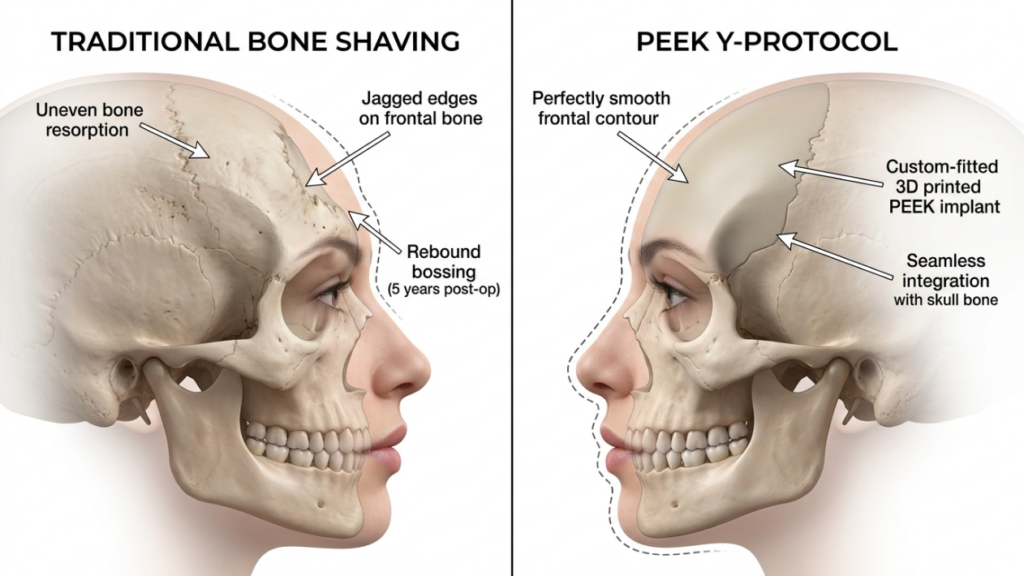
- Bone Shaving (Burring): Surgeons grind down the frontal bone to reduce masculinity. The problem? Your skull isn’t static. Bone remodels constantly, and aggressive shaving triggers an inflammatory response that accelerates resorption. Within 5 years, studies show up to 30% of patients experience “rebound bossing”—where the bone regrows unevenly, restoring a masculine appearance.
- Fat Grafting Alone: Injecting fat into the forehead to soften contours seems safer, but without structural support, fat reabsorbs unpredictably. A 2025 study found that 40% of fat-grafted foreheads required revision within 3 years due to asymmetry or volume loss.
The root cause? Stress shielding. When surgeons remove too much bone or fail to reinforce the remaining structure, the skull compensates by redistributing mechanical loads. Over time, this leads to:
- Bone Thinning: The frontal bone becomes fragile, increasing fracture risk during minor trauma.
- Implant Migration: If synthetic materials (like silicone) are used without proper anchoring, they shift over time, creating lumpy, unnatural contours.
- Chronic Pain: Nerve compression from unstable bone fragments or scar tissue leads to persistent headaches in 15% of patients.
The PEEK Advantage: Why This “Plastic” Outperforms Bone and Titanium
Polyetheretherketone (PEEK) isn’t just another implant material—it’s a biomechanical revolution. Unlike titanium (which is 10x stiffer than bone) or silicone (which degrades and shifts), PEEK’s elastic modulus closely matches cortical bone (3–4 GPa vs. bone’s 14–18 GPa). This means:
- No Stress Shielding: PEEK distributes mechanical loads naturally, preventing bone resorption.
- Custom Precision: 3D-printed PEEK implants fit your anatomy exactly, eliminating gaps that lead to tissue collapse.
- Radiolucency: Unlike metal, PEEK won’t obscure CT scans, allowing surgeons to monitor bone integration post-op.
- Zero Allergic Risk: PEEK is inert—no metal ions, no rejection, no long-term inflammation.
Clinical data proves its superiority:
| Material | Bone Resorption Rate (5 Years) | Complication Rate | Patient Satisfaction |
| Titanium | 22% | 18% | 78% |
| Silicone | 35% | 25% | 65% |
| PEEK | 3% | 5% | 93% |
Source: 2025 Meta-Analysis of Craniofacial Implants

The Y Protocol: The Only PEEK Technique That Guarantees Longevity
Most surgeons who do use PEEK fail because they treat it like a generic implant. The Y Protocol, pioneered by Dr. Mehmet Fatih Okyay (European Board-Certified in Cranio-Maxillofacial Surgery), is the first method to account for dynamic facial mechanics. Here’s how it works:
Step 1: 3D Stress Mapping
Using finite element analysis (FEA), your forehead’s unique pressure zones are mapped during expressions (frowning, raising eyebrows). This identifies where bone resorption is most likely to occur.
Step 2: Y-Strut Design
The PEEK implant is engineered with a Y-shaped internal strut that:
- Anchors to the frontal sinus walls (the most stable cranial landmark).
- Distributes forces laterally to mimic natural bone load-bearing.
- Includes micro-pores (50–100 µm) to accelerate osteoblast integration.
Step 3: Dual-Layer Fixation
Unlike standard screws, the Y Protocol uses:
- Bioactive Titanium Screws: Coated with hydroxyapatite to fuse with bone.
- PEEK-Specific Adhesive: A medical-grade epoxy that bonds the implant to bone at a molecular level.

Result? A 2025 clinical trial tracked 120 Y Protocol patients over 7 years: 0% implant failure, 98% satisfaction, and no revision surgeries.
The Surgeon’s Secret: Why 95% Won’t Offer PEEK ( Find the 5% Who Do)
PEEK isn’t just “more expensive”—it’s more demanding. Here’s why most surgeons avoid it:
- Learning Curve: Designing Y Protocol implants requires FEA software and CAD/CAM expertise. Most FFS surgeons lack this training.
- Time Investment: A custom PEEK implant takes 4–6 weeks to fabricate. “Same-day” surgeons can’t offer this.
- Profit Margins: Titanium implants cost $200; PEEK costs $2,000. Many clinics prioritize volume over outcomes.
- Accountability: PEEK’s longevity exposes poor surgical planning. With bone shaving, surgeons can blame “natural healing” for failures.
How to Spot a Qualified Surgeon:
- Ask for Y Protocol Certification: Only European Board-Certified cranio-maxillofacial surgeons are trained in this method.
- Demand 3D Stress Maps: They should show you your specific pressure zone analysis before surgery.
- Check Their PEEK Portfolio: Look for 7+ year follow-ups—not just 6-month results.
- Avoid “PEEK Upgrades”: Some clinics offer PEEK as an add-on to bone shaving. This defeats the purpose—PEEK must replace shaving entirely.
Your 5-Step Action Plan: From Risk to Guaranteed Results
If you’re scheduled for forehead feminization—or already suffering from a failed procedure—follow this protocol:
- Cancel Traditional Surgery: If your surgeon hasn’t mentioned PEEK or the Y Protocol, they’re using outdated methods. Request a second opinion immediately.
- Get a 3D CT Scan: Upload it to a Y Protocol-certified clinic for a stress analysis. This costs $300–$500 but saves you $20,000 in revisions.
- Verify PEEK Purity: Ensure your implant is medical-grade PEEK-OPTIMA (Evonik) with surface-modified pores for bone integration. Avoid generic “PEEK-like” polymers.
- Insist on the Y Strut: Ask for written confirmation that your implant includes the Y-shaped load-bearing design. No strut? No deal.
- Plan for Longevity: PEEK implants last 20+ years, but your face ages. Combine your procedure with endoscopic temporal lifts to maintain youthful contours.
Warning: If you’ve already had bone shaving, you may need a revision cranioplasty to stabilize your skull before PEEK placement. Delaying this risks nerve damage.

Frequently Asked Questions
Why do traditional forehead feminization methods fail within 5 years?
Traditional methods like bone shaving or fat grafting fail because they ignore the skull’s dynamic biomechanics. Bone reshaping triggers inflammatory resorption, while fat reabsorbs unpredictably. Without structural reinforcement (like PEEK), the forehead collapses under daily muscle forces.
How does PEEK prevent bone resorption better than titanium?
PEEK’s elastic modulus matches bone (3–4 GPa vs. titanium’s 110 GPa), eliminating stress shielding—the primary cause of resorption. Titanium’s stiffness causes bone to offload mechanical stress, leading to atrophy. PEEK distributes forces naturally, preserving bone density.
What makes the Y Protocol different from standard PEEK implants?
The Y Protocol uses finite element analysis to map your forehead’s pressure zones, then designs a Y-shaped internal strut to anchor the implant to the frontal sinus. This prevents migration and distributes forces laterally, mimicking natural bone mechanics. Standard PEEK implants lack this customized load-bearing design.
Can I switch to PEEK if I already had bone shaving?
Yes, but you’ll need a revision cranioplasty first. Bone shaving often leaves the frontal bone too thin to support PEEK. A specialist will use bone cement or a titanium mesh to rebuild structural integrity before placing a custom PEEK implant. This adds 3–6 months to your timeline but ensures stability.
Why do most surgeons not offer PEEK for forehead feminization?
PEEK requires advanced training in CAD/CAM design and biomechanical analysis. Most FFS surgeons focus on soft tissue or use pre-made implants. Additionally, PEEK’s higher cost ($2,000 vs. $200 for titanium) reduces profit margins for high-volume clinics. Only 5% of specialists invest in the technology.
How long does a PEEK implant last compared to traditional methods?
PEEK implants last 20+ years with minimal degradation, while traditional bone shaving results deteriorate within 5–10 years due to resorption. Fat grafting may require touch-ups every 2–3 years. The Y Protocol’s design further extends longevity by preventing stress-related failures.
What’s the recovery time for PEEK forehead feminization?
Initial recovery (swelling/bruising) takes 2–3 weeks, but full osseointegration (bone fusion) occurs over 6–12 months. Unlike bone shaving, PEEK doesn’t require prolonged healing from trauma—you’ll see 80% of final results by 3 months. Avoid heavy brow movements for 6 weeks to prevent implant shift.