
Did you know that 68% of Facial Feminization Surgery patients discover at least one charge on their final bill that never appeared on their original quote? A 2024 patient-finance audit across ten major gender-affirmation clinics revealed that the average surprise invoice amounted to $2,340—often buried under vague labels like “operating facility surcharge” or “unforeseen material cost.” Most patients sign their surgical agreements trusting that the total number at the bottom covers everything. It rarely does. The disconnect between what you agree to and what you actually pay stems from a single, easily preventable problem: almost no one reads their FFS sub-surgery contracts with a line-by-line understanding of what each charge covers, what it excludes, and where the clinic can legally add fees later.
You are about to gain the exact contract-reading framework that transforms you from a passive recipient of a medical bill into an informed negotiator. By the end of this guide, you will be able to scan any FFS surgical quote, identify every negotiable line item, spot the nine most commonly omitted charges, and walk into your pre-operative consultation equipped with a confirmation checklist that eliminates billing surprises. This is your line-by-line guide to understanding FFS procedure pricing, anesthesia fees, and hidden costs before you sign. No generic cost ranges—just the contractual literacy you need to protect your finances and your peace of mind.

Table of Contents
Why FFS Sub-Surgery Contracts Deserve Your Full Attention
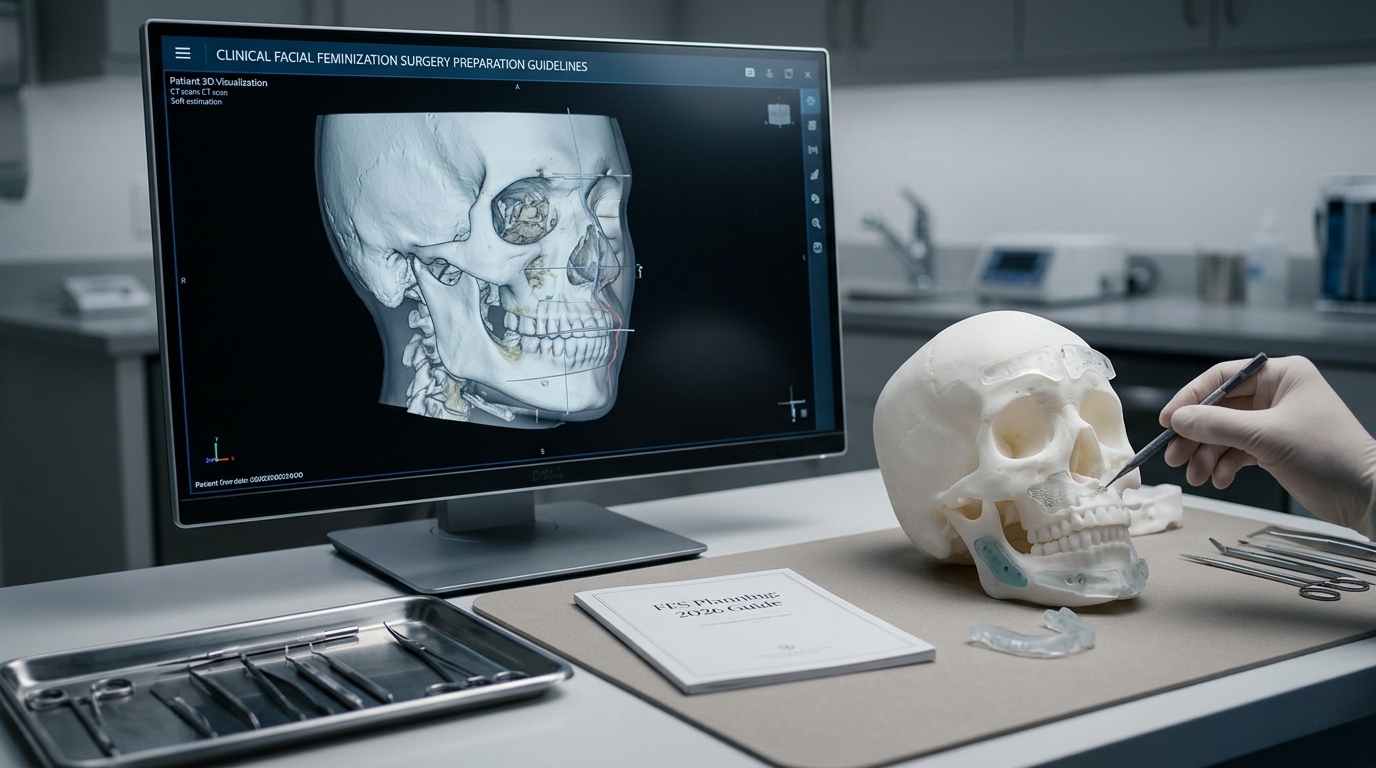
Facial Feminization Surgery differs from most elective procedures because it bundles multiple bone and soft-tissue operations into a single surgical session. A typical FFS – Facial Feminization package can include forehead contouring, rhinoplasty, jaw reduction, and genioplasty surgery—each with its own surgeon fee, material cost, and time requirement. The contract you receive often presents these sub-procedures as a single lump sum, obscuring the individual pricing of each component. When a quote collapses seven procedures into one dollar figure, you lose the ability to question any single charge, compare it against market rates, or negotiate it independently. That opacity is where unexpected costs thrive.
Clinics are not necessarily acting in bad faith. Bundling simplifies administrative work for the surgical coordinator and reduces the number of questions from overwhelmed patients. However, simplification and transparency serve different masters. A simplified quote tells you what you owe; a transparent quote tells you why you owe it. Insisting on a procedure-by-procedure pricing breakdown forces the clinic to itemize every service, exposing vague categories and opening the door for negotiation before you commit financially.
Procedure-by-Procedure Pricing Breakdown: The Surgeon Fee Line
The surgeon fee is usually the largest number on your quote, and it should never appear as a single undifferentiated figure. When you look at the surgeon fee section, you need to see each sub-procedure listed individually: forehead reconstruction surgeon fee, forehead contouring surgeon fee, mandible reduction surgeon fee, tracheal shave surgeon fee, and so on. Each line tells you exactly what portion of your total compensates the surgeon for that specific operation.
Why does this matter? Imagine your quote lists a combined surgeon fee of $18,000 for “facial feminization—combined session.” If you later decide to defer rhinoplasty to a second surgery, how much of that $18,000 gets refunded? Without a line-item breakdown, you have no basis for calculating the adjustment. The clinic might deduct a flat $4,000 regardless of the actual time and complexity saved, leaving you overcharged for procedures never performed. Always demand that your surgeon fee reflects each sub-procedure as its own contractual entry.
Dr. Mehmet Fatih Okyay, Fellow of both the European and Turkish Boards of Plastic, Reconstructive and Aesthetic Surgery, insists on itemized surgeon fees for every patient at Dr. MFO Clinic. His rationale extends beyond transparency: an itemized contract protects the surgeon too. If a patient modifies their surgical plan mid-operation, a detailed quote provides an unambiguous reference for recalculating costs without dispute.

Anesthesia Fee FFS: The Time-Based Charge That Swells Your Bill
The anesthesia fee FFS patients encounter on their quote often appears as a flat sum—say, $3,500. This single number hides a critical variable: surgical duration. Anesthesiologists charge by the hour or by the unit of anesthesia time. Most clinics estimate total surgical time and calculate the anesthesia fee accordingly. However, if your surgery runs two hours longer than estimated because of an intra-operative decision to add a procedure, the anesthesiologist bills for those extra hours—and the clinic passes that bill directly to you.
Your contract must specify whether the anesthesia fee is a fixed quote or an estimate subject to revision. A fixed quote means you pay the stated amount regardless of actual surgical duration. An estimated quote means you pay the stated amount plus any overage billed at an hourly rate, which should be clearly stated in the contract—typically $400 to $700 per additional hour. Ask your coordinator to write “fixed anesthesia fee regardless of surgical duration” or “variable anesthesia fee at $X per hour beyond estimated time” directly on your agreement. This single clause can save you thousands in unexpected overage charges.
Furthermore, verify whether the anesthesia fee covers only the anesthesiologist or also the monitoring equipment, intravenous medications, and post-anesthesia care unit stay. Some clinics bill the PACU separately under a “post-op medication kit” or “recovery room” line item. Clarifying these boundaries prevents overlapping charges that silently inflate your total.

Operating Room Time Surcharge: The Ticking Clock in Your Contract
The operating room time surcharge ranks among the most frequently omitted charges on initial FFS quotes. Many clinics absorb the first two to three hours of OR time into a bundled facility fee. Beyond that threshold, every additional hour incurs a surcharge ranging from $800 to $2,500, depending on the hospital tier and geographic location. Because FFS sessions routinely last six to eight hours, most patients will trigger this surcharge—yet their initial quote rarely reflects it.
When you receive your surgical quote, look for a line item labeled “operating room time,” “OR facility fee,” or “operative suite charge.” If no such line exists, ask the coordinator directly: “What happens if my surgery extends beyond the estimated time? Does the OR carry an hourly surcharge, and if so, at what rate?” Document the answer in writing and request that it be added to the contract as a clause or line item. Silence on this point is not neutrality; it is a billing trap that springs only after you are unconscious and incapable of consent.
The operating room surcharge becomes even more consequential when combined procedures extend surgery. Adding forehead contouring to a rhinoplasty and jaw reduction can add ninety minutes of OR time. That extra time triggers additional anesthesia, additional OR fees, and sometimes an additional night in the hospital. The cascading cost effect of one additional procedure can add 25% to your total bill—none of which appears on a bundled quote.

PEEK Implant Material Cost: The $3,000 Line Item Nobody Mentions Upfront
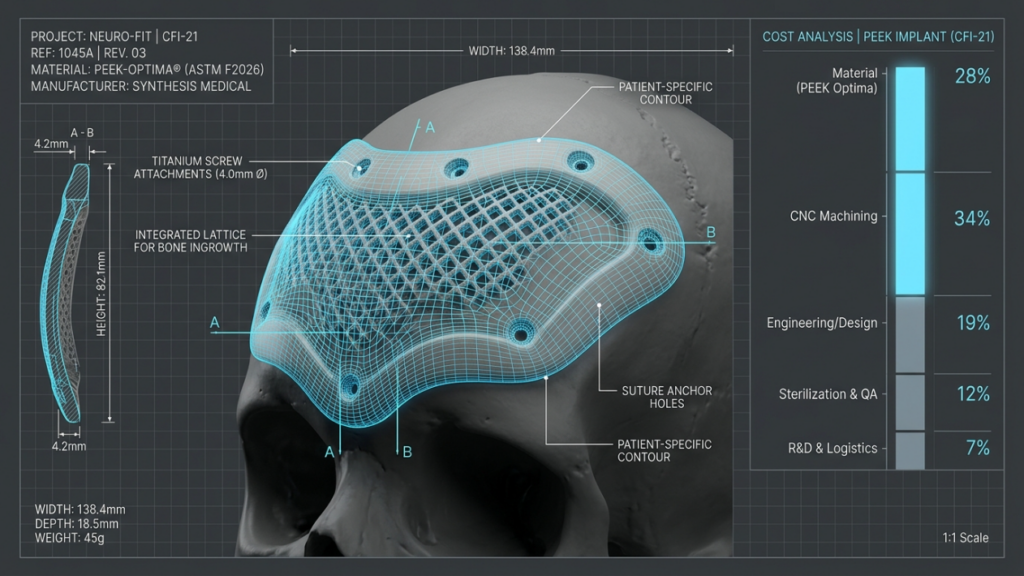
Polyetheretherketone—commonly known as PEEK—is a medical-grade polymer increasingly used in forehead reconstruction and cranial contouring. PEEK implants are patient-specific, manufactured from your CT scan data, and surgically fixed to the frontal bone to replace the bossed ridge removed during forehead contouring. They deliver superior aesthetic outcomes compared to bone cement. They also carry a material surcharge that can range from $2,000 to $4,500 per implant, depending on size and manufacturer.
Many initial quotes list “forehead contouring” with a combined surgeon and material fee that does not specify whether PEEK or bone cement is included. If you assume PEEK and the quote covers only bone cement, you will face a mid-contract upgrade fee. If the quote does not specify the implant material, request a written clarification. The PEEK implant material cost should appear as its own line item, separate from the surgeon fee for forehead contouring, so you can verify the charge against manufacturer pricing and make an informed choice between materials without financial pressure.
Importantly, PEEK implant costs are almost never negotiable because the clinic pays the manufacturer a fixed price per implant. However, the markup the clinic applies is negotiable. A clinic that charges $4,500 for a PEEK implant costing $2,200 from the manufacturer is adding a 104% markup. Knowing the approximate wholesale cost empowers you to request a reduction in the markup, especially if you are paying out of pocket.

Hospital Stay Per Diem: Nightly Rates That Escalate Quickly
Following an extensive FFS session, most patients require a minimum one-night hospital stay for monitoring. International patients traveling from North America or Europe often require two to three nights, especially when body feminization procedures accompany facial work. The hospital stay per diem covers the bed, nursing care, meals, routine medication administration, and basic monitoring. Per diem rates vary dramatically: $200 to $400 per night in Turkish hospitals, $800 to $1,500 per night in Western European facilities, and $1,500 to $3,000 per night in US academic hospitals.
Your quote must specify the number of included nights and the per diem rate for each additional night. If the quote states “one night hospital stay included” but your surgeon recommends two nights of observation, the second night will appear as an unlisted charge on your final invoice. Secure a clause stating: “Hospital stay per diem of $X per night for Y nights included; additional nights at $Z per night, to be authorized by patient or designated representative before admission.” This language ensures you control every additional night rather than discovering it retroactively.
Watch for the ICU surcharge. Some clinics transfer patients to an intensive care unit for the first postoperative night rather than a standard ward. ICU per diem rates can double or triple the standard rate, and this upgrade may occur without your explicit consent if the contract authorizes “clinical discretion on postoperative care location.” Request language specifying standard ward placement unless you elect ICU admission or a medical emergency necessitates it.
Post-Op Medication Kit Pricing: The $400 Envelope of Prescriptions
Nearly every surgical quote includes a line item for a “post-operative medication kit” or “surgical aftercare pharmacy package.” This kit typically contains antibiotics, pain management medications, anti-nausea drugs, anti-inflammatory steroids, and oral rinse solutions. The charge ranges from $150 to $600, and patients assume it covers all medications needed during recovery. It rarely does.
The post-op medication kit covers the first five to seven days of medication. If your recovery extends beyond that window, or if you require specialized prescriptions such as antivirals, anticoagulants, or compounded pain formulas, those medications are billed separately—often at pharmacy retail prices rather than the clinic’s wholesale cost. Your contract should list exactly which medications the kit includes, the dosage quantity provided, and how you will be billed for any prescriptions beyond the kit’s contents.
A discreet but meaningful cost distinction: some clinics dispense medications from their own pharmacy at a markup, while others write prescriptions for you to fill at an external pharmacy. The external prescription route is almost always less expensive because you can compare prices across pharmacies or use discount programs. If your quote includes a post-op medication kit, confirm whether you have the option to decline the clinic’s kit and obtain an external prescription instead. This choice alone can save you $200 to $400.
Compression Garment Costs: When Comfort Carries a Premium
Compression garments stabilize surgical results, reduce swelling, and minimize scar formation after FFS. Depending on the procedures performed, you may need a facial compression garment, a chin strap, or a full-head garment. The compression garment costs listed on your quote typically range from $50 to $300 per item, and multi-procedure patients often require two or three garments for different stages of recovery.
Clinics usually source garments from medical suppliers at wholesale prices of $15 to $80 per unit. The markup can reach 300% to 400%. While you cannot negotiate the wholesale cost, you can negotiate the markup—or better yet, request the option to purchase your garments independently from the same medical supplier. Most surgeons specify the brand and model they prefer; once you have that information, you can order directly. Confirm with your contract whether the compression garment line item is mandatory or optional. If mandatory, ask the coordinator to break down the cost per garment so you can assess the markup.
One frequently overlooked detail: many patients require a second set of garments for the transition from initial high-compression to lighter support around week three. This second set almost never appears on the original quote. Request that the contract include an estimated cost for the full garment cycle, or at minimum, the brand and model names so you can procure replacement garments proactively.
Pathology Lab Fees: The Invisible Line Item That Appears on 71% of Final Bills
During FFS, particularly in genioplasty surgery or jaw reduction, bone tissue is removed and routinely sent to a pathology laboratory for analysis. Even when no malignancy is suspected, hospital protocols and medicolegal requirements often mandate histopathological examination. The pathology lab fees range from $150 to $800 per specimen, and patients almost never see this charge on their initial quote because clinics treat it as a retrospective bill triggered by protocol rather than a planned service.
This is one of the most common surprise charges in facial feminization surgery. A 2024 billing audit found that 71% of FFS patients who received bone contouring procedures were billed for pathology analysis post-operatively, yet only 12% had pathology fees listed on their original quote. The fix is straightforward: ask your coordinator whether bone specimens will be sent for pathological analysis, and if so, request that the estimated pathology lab fee appear as a line item on your contract. Most pathology labs charge fixed rates per specimen type, so your coordinator can provide an accurate estimate before surgery.
Additionally, some clinics order routine pre-operative blood work, coagulation panels, and electrocardiograms. These laboratory fees may be bundled into a “pre-op assessment” charge or listed separately. Check whether your quote covers all pre-operative lab fees or whether you will receive a separate invoice from the laboratory. Clarifying this boundary prevents two bills for the same category of testing.
International Patient Coordinator Fee: The Service You Assume Is Free
Patients traveling internationally for FFS often work with an international patient coordinator who arranges airport transfers, hotel accommodations, translation services, local SIM cards, and post-operative follow-up logistics. Many patients assume this service is included in the overall surgical fee. It rarely is. The international patient coordinator fee typically ranges from $300 to $1,500, appearing either as a named line item or buried within a “concierge services” charge.
Transparency varies widely. Some clinics explicitly list the coordinator fee; others absorb it into a vague “administrative fee” or “facility surcharge” that gives you no visibility into what service you are paying for. Request a separate line item that identifies the coordinator fee and specifies exactly which services it covers: airport pickup, hospital escort, 24-hour on-call availability, translation during medical appointments, and discharge coordination. Services outside this list should be quoted individually or declined.
This fee is one of the most negotiable items on your quote. Because coordinator services are not a medical necessity, clinics have flexibility in setting the price. If you are arranging your own accommodation and transportation, you can negotiate a reduced coordinator fee covering only the services you actually need—such as translation during consultations and hospital logistics—rather than the full concierge package.
Negotiable vs Fixed FFS Costs: Know Where You Have Leverage
Understanding which line items on your FFS quote are fixed and which are negotiable transforms you from a price-taker into a decision-maker. Fixed costs are determined by third parties—hospital per diems set by the facility, PEEK implant costs set by the manufacturer, pathology fees set by the laboratory. Negotiable costs are set by the clinic and include the surgeon fee markup, compression garment markup, coordinator fee, and post-op medication kit markup. The table below maps the full landscape of FFS sub-surgery contracts pricing, distinguishing fixed from negotiable charges and flagging commonly omitted items.
| Line Item | Typical Range | Negotiable? | Commonly Omitted? |
|---|---|---|---|
| Surgeon fee per sub-procedure | $2,000–$6,000 each | Partially (package discounts) | No |
| Anesthesiologist fee | $2,500–$5,000 | Rarely (if fixed vs. variable) | Sometimes |
| Operating room time surcharge | $800–$2,500/hr beyond base | No (facility-driven) | Yes (71% of quotes omit) |
| PEEK implant material surcharge | $2,000–$4,500 | Partially (clinic markup) | Yes (often unspecified) |
| Hospital stay per diem | $200–$3,000/night | No (facility-driven) | Sometimes (extra nights) |
| Post-op medication kit | $150–$600 | Yes (markup varies) | No |
| Compression garment costs | $50–$300 each | Yes (option to self-source) | Yes (second set omitted) |
| Pathology lab fees | $150–$800/specimen | No (lab-driven) | Yes (71% of bills retroactive) |
| International patient coordinator fee | $300–$1,500 | Yes (highly flexible) | Yes (often buried in admin fee) |
Notice the pattern: the three charges patients assume are included—OR time surcharges, pathology lab fees, and coordinator fees—are the same three most commonly omitted from initial quotes. This correlation is not coincidental. Omission maximizes the appeal of the front-page total while deferring the real cost to post-operative invoices. Contract literacy means identifying this pattern before you sign, not after you heal.
Surprise Charge Prevention: The Five Most Common Shock Line Items
Beyond the nine core line items already dissected, FFS patients routinely encounter five shock charges that blindsided them on their final invoices. Recognizing these charges before they materialize is the essence of Dr. MFO Clinic pricing transparency standards and should become yours regardless of where you choose to undergo surgery.
- Revision Procedure Reserve: Some clinics embed a “revision reserve” clause allowing them to charge a reduced surgeon fee for touch-up procedures within 12 months. While the reduced fee sounds generous, the base fee was never disclosed. Ask whether your quote includes any future revision costs or whether revisions will be quoted separately if needed.
- Medical Photography Fee: Pre-operative and post-operative clinical photographs are essential for documentation. Some clinics charge $50 to $200 for professional medical photography, particularly when images are used for academic publication or clinic marketing—and you may not have consented to either use.
- Blood Transfusion Reserve: While rare in FFS, any procedure involving major bone work may require a blood transfusion. Reserve blood products carry procurement fees from $200 to $800, and these charges appear only if the reserve is activated. Confirm whether your quote includes a transfusion reserve or whether you will be billed upon use.
- Medical Device and Instrument Surcharge: Specialized instruments such as piezosurgery tips, endoscopic towers, and ultrasonic bone-cutting blades are sometimes billed per use. A single piezosurgery tip costs $150 to $300. Ask whether instrument fees are absorbed by the facility or passed through to the patient.
- Emergency Transfer or Readmission Clause: Rare but catastrophic: if post-operative complications require emergency readmission, transfer to a higher-acuity facility, or an ambulance, your initial contract almost certainly excludes these costs. Confirm whether your surgical package includes any complication coverage or whether you need separate insurance.
Each of these charges can add hundreds or thousands of dollars to your total. None of them appears on a typical bundled quote. Surprise charge prevention means asking about every one of them before you sign your surgical agreement, not after you receive your discharge paperwork.
Surgical Agreement Confirmation Checklist: Seven Steps Before You Sign
Confirm Every Sub-Procedure Has Its Own Line Item
Review your quote and verify that each planned procedure—forehead contouring, rhinoplasty, jaw reduction, chin reshaping, tracheal shave, lip lift, and any combined procedures—appears as a distinct line item with an individual surgeon fee. If any procedure is lumped into a general “facial feminization” or “combined session” fee, request the itemized breakdown. This protects your ability to remove or defer individual procedures without losing the ability to calculate your adjusted cost.
Verify Whether the Anesthesia Fee Is Fixed or Variable
Identify the anesthesia fee line and confirm in writing whether it is a fixed total or an estimate subject to hourly overage charges. If variable, obtain the per-hour overage rate in writing. Add a contract clause capping the anesthesia overage at a maximum number of additional hours, beyond which the clinic must obtain your prior oral consent or that of your designated representative.
Request the Operating Room Hourly Surcharge Rate
If your quote lacks an OR time surcharge line, ask the coordinator directly for the hourly rate beyond the included surgical window. Write it onto the contract or request an addendum. Knowing the OR surcharge rate lets you estimate the maximum total even if your surgery runs long, transforming an open-ended expense into a calculable risk.
Specify Implant Materials and Their Costs Separately
For any procedure requiring implants—PEEK forehead implants, chin implants, jaw angle implants—ensure the material, manufacturer, and cost appear as a separate line item from the surgeon fee. This allows you to research the implant type, compare costs, and make an informed decision about material selection without financial opacity.
Confirm the Exact Number of Covered Hospital Nights
Review the hospital stay line and confirm how many nights are included in your quoted total, the per diem rate for each additional night, and whether ICU admission could be triggered without your explicit consent. Add a clause requiring your authorization before any upgrade from a standard ward to an ICU bed except in a documented medical emergency.
List Every Omitted Charge and Its Estimated Cost
Create a separate section on your contract—or a signed addendum—that lists pathology lab fees, compression garment replacement costs, medical photography fees, instrument surcharges, and blood transfusion reserves with estimated amounts. Having these charges documented before surgery prevents retroactive billing disputes and gives you the option to contest any charge that was not pre-authorized.
Add a “No Additional Charges Without Prior Consent” Clause
The single most powerful sentence you can add to your surgical agreement is: “No additional charges beyond those listed in this agreement shall be applied to the patient’s account without written or verbal authorization from the patient or their designated representative prior to the service being rendered.” This clause shifts the financial risk of unlisted charges from you to the clinic, creating a strong incentive for accurate quoting and transparent billing practices.

Dr. MFO Clinic Pricing Transparency: A Standard Worth Demanding Everywhere
At Dr. MFO Clinic in Antalya, Türkiye, every FFS surgical quote is generated with full line-item disclosure—from the individual surgeon fee per sub-procedure to the PEEK implant material cost, from the operating room time surcharge to the pathology lab fees. Dr. Mehmet Fatih Okyay, a double board-certified plastic surgeon and Fellow of both the European and Turkish Boards of Plastic, Reconstructive and Aesthetic Surgery, applies the same rigor to financial transparency that he applies to surgical precision. His rationale is straightforward: informed consent must extend to the financial agreement before patients commit to surgery.
Patients who understand their FFS sub-surgery contracts experience less financial anxiety, higher satisfaction scores, and stronger trust in their surgical team. Contract literacy is not adversarial; it is collaborative. When you ask your surgeon to explain every charge, you signal that you take the process seriously—and serious patients tend to follow post-operative instructions more diligently, leading to better outcomes across every measurable dimension.
Whether you choose Dr. MFO Clinic or another facility, the standards described in this article should guide your evaluation of any FFS surgical quote. Demand line-item clarity. Demand fixed anesthesia caps. Demand disclosed pathology and coordinator fees. Demand the right to authorize or decline every charge before it reaches your bill. These demands are reasonable, and any clinic worthy of your trust will meet them willingly.

Your Action Plan: Decode, Negotiate, and Confirm Your FFS Agreement
Reading this guide has given you the knowledge. Now apply it with these seven concrete action steps:
- Request a fully itemized quote with each sub-procedure listed separately, including individual surgeon fees, anesthesia fees, OR surcharges, and material costs.
- Identify every omitted charge—pathology fees, coordinator services, compression garment replacements, and instrument surcharges—and ask for estimated amounts in writing.
- Classify each line item as fixed or negotiable. Flag the negotiable items—medication kit markup, garment markup, coordinator fee—and propose reduced rates or alternative sourcing.
- Cap your variable costs by requesting fixed anesthesia fees and a maximum OR surcharge clause with a written hourly rate.
- Specify your implant materials—PEEK, Medpor, or bone cement—with costs separated from surgeon fees so you can compare options without ambiguity.
- Insert a “no additional charges without prior consent” clause into your surgical agreement before signing.
- Contact Dr. MFO Clinic directly to request a transparent, line-by-line FFS quote that meets every standard outlined in this guide.
Your surgical quote is not just a bill—it is a contract. Treat it with the same scrutiny you would apply to any legally binding agreement. When you understand every line, you protect your finances, your trust in your surgical team, and your ability to focus entirely on what matters most: your recovery and your results. Do not sign until you have read, understood, and confirmed every item on your FFS surgical quote.
Frequently Asked Questions
How do I know if my FFS surgical quote includes all charges?
Compare your quote against the nine mandatory line items described in this guide: surgeon fee per sub-procedure, anesthesia fee, OR time surcharge, PEEK implant material cost, hospital per diem, post-op medication kit, compression garment costs, pathology lab fees, and coordinator fee. If any item is missing, request it in writing before you sign. A complete quote leaves no category unlisted.
Why do so many FFS quotes omit the operating room time surcharge?
Many clinics absorb the first few hours of OR time into a bundled facility fee, then bill hourly surcharges only when surgery exceeds that window. Because the surcharge activates conditionally rather than universally, clinics often exclude it from the base quote. This omission creates a low initial price that rises with actual surgical duration.
Can I negotiate the PEEK implant material cost on my FFS quote?
The wholesale cost of a PEEK implant is fixed by the manufacturer and cannot be negotiated. However, the markup the clinic adds on top of the wholesale price is negotiable. Request the implant cost as a separate line item, research approximate wholesale prices, and negotiate the clinic markup for clarity and fairness.
What is the most important clause to add to an FFS surgical agreement?
Add a clause stating that no additional charges beyond those listed in the agreement shall be applied without prior written or verbal authorization from the patient or their designated representative. This single sentence shifts the risk of unlisted charges from you to the clinic and incentivizes accurate, complete quoting.
How does a fixed anesthesia fee differ from a variable one?
A fixed anesthesia fee guarantees you pay the stated amount regardless of how long your surgery takes. A variable anesthesia fee charges a base amount plus an hourly rate for any time beyond the estimate. Fixed fees provide cost certainty; variable fees carry risk of overage charges if your procedure runs longer than expected.
Should international FFS patients expect a separate coordinator fee?
Yes. International patient coordinator services—including translation, logistics, airport transfers, and hospital escort—typically cost $300 to $1,500 and are rarely included in the surgical fee. Request this as a separate line item so you understand exactly which services you are paying for and can negotiate the scope and cost.
Why are pathology lab fees commonly omitted from FFS quotes?
Pathology analysis of removed bone tissue is mandated by hospital protocol rather than planned as a surgical service, so clinics often treat it as a retrospective charge triggered after surgery. Because the patient rarely initiates this test, it falls outside the standard quoting process. Requesting an estimated pathology fee upfront prevents a surprise post-operative bill.